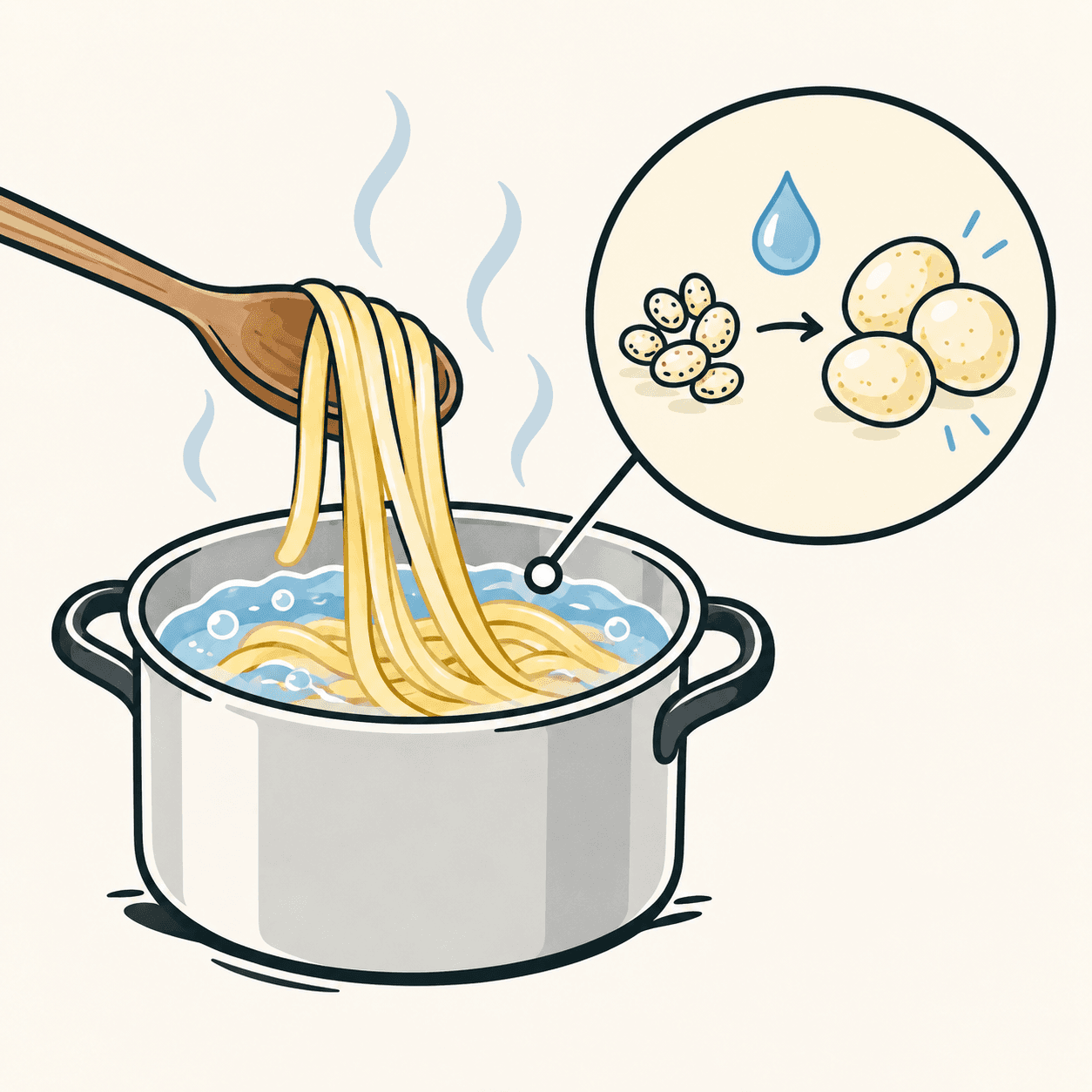
A dry spaghetti strand and a cooked one may start with the same ingredients yet resist bending very differently. Part of the explanation is starch gelatinization. Columbus State Community College’s teaching manual introduces this as the swelling of starch granules when they receive water and heat. In pasta, that absorption accompanies the change towards a softer texture. The transformation happens within the material, rather than simply affecting its outer surface. [1]
To make the process observable, a University of Illinois team studied spaghetti during cooking. In the text deposited on arXiv in 2022, it describes softening that starts outside and moves inward as water enters. A cross-section can therefore have an already softened outer region and a stiffer centre. The entire spaghetti strand does not immediately reach the same condition as soon as it meets the hot water around it. [2]
Starch does not act alone, however. Resmini and Pagani’s 1983 review describes a protein network surrounding gelatinized starch in cooked durum-wheat spaghetti. A continuous protein structure can hold granules as they swell and contribute to the texture. In the abstract we consulted, the authors describe a physical competition between the network’s formation and the starch’s swelling: discussing water alone would leave out part of what happens within the pasta. [3]
An example imagined by our editors: draw two circles representing a cross-section of the same spaghetti strand at different moments. Colour an outer ring in the first; in the second, extend that ring closer to the centre. The colour represents advancing hydration, rather than an ingredient that is actually blue. This illustrative model helps distinguish water temperature from the progress of change within the pasta; it does not replace measuring a sample. [2]
A second editorial example compares pasta with a sauce thickened using starch. For both, the manual connects water, heating and swelling, but we should not expect the same visible result. In the sauce we mainly observe a change in the liquid; with spaghetti, we also care about how the piece’s structure stays organized. Imagining a sauce simply hardened into the shape of spaghetti would therefore be an unhelpful shortcut to understanding it. [1][3]
There are clear limits. The Illinois study uses spaghetti two millimetres in diameter and defined experimental conditions: it does not provide a universal duration for every shape, recipe or preference. The review also distinguishes different structures in the products studied. This article explains a mechanism without prescribing the perfect cooking minute or making nutritional promises. Its useful discovery is a relationship between water, starch and structure, rather than a single switch turning on or off. [2][3]
Take this with youCooked pasta is a changing material: water enters, starch swells and the surrounding structure helps determine its texture.
One idea, in simple words
Pasta contains starch, a substance found in many plant foods. Starch is organized into tiny granules. When those granules receive water and heat, they swell: this transformation is called gelatinization. In pasta, it accompanies the softening we notice after cooking. The name does not mean adding gelatin to the pot: we are discussing starch already present in the food. [1]
Water moves from the outside towards the inside, so the centre and edge can change at different times. An example invented by our editors: draw a round spaghetti cross-section and colour the edge first, then an area closer to the centre. The drawing represents a process, rather than a photograph. The time needed is not identical for every kind of pasta: this model does not provide a universal recipe. [2]
A little discovery to keep
What did you discover?
Read the sources (3)
- Gelatinization of Starches — The Bakeshop Columbus State Community College / OER Commons · accessed 3 Oct 2026
- Swelling, Softening and Elastocapillary Adhesion of Cooked Pasta — preprint Jonghyun Hwang et al., University of Illinois / arXiv · accessed 3 Oct 2026
- Ultrastructure Studies of Pasta. A Review. — abstract, 1983 P. Resmini e M. A. Pagani / Food Structure, Utah State University repository · accessed 3 Oct 2026
Original writing and illustration made with AI assistance. Our editorial method
More in Food