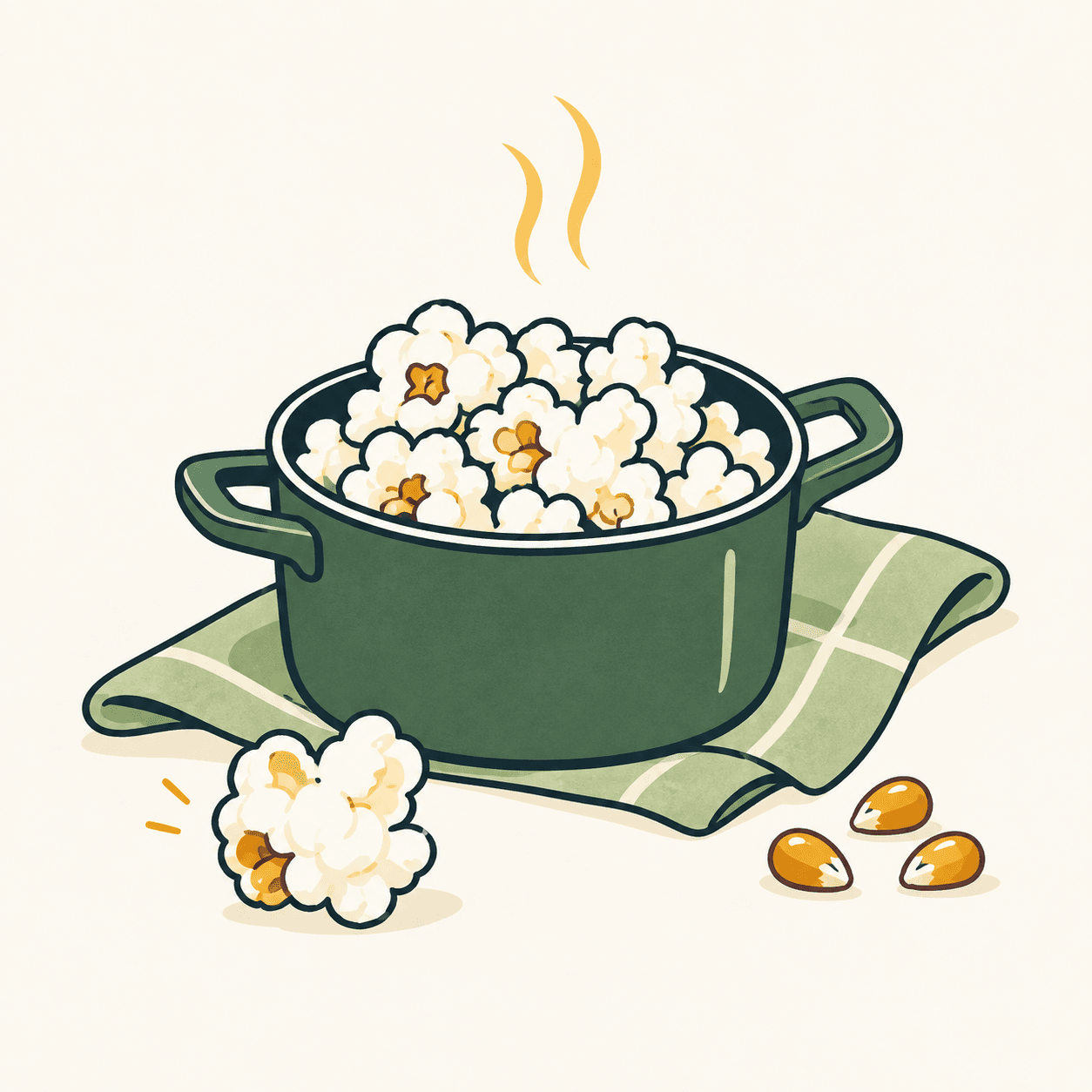
Popcorn does not rise in a pan like a tiny loaf of bread. In Purdue University’s scientific account, each kernel behaves like a miniature pressure vessel: water inside heats up, pressure increases and the outer hull eventually gives way. Starch altered by the heat expands rapidly. The visible surprise therefore depends on what was already enclosed within the kernel. No secret ingredient is required; the structure and moisture must allow the transformation to happen. [1]
The American Chemical Society distinguishes two common shapes of popped corn. The butterfly type has an irregular outline with protruding sections; the mushroom type is rounder. These names describe shapes, not ingredients added to the corn. The distinction invites us to see the result as a structure rather than an undifferentiated white puff. In the association’s explanation, the rounder shape is useful when mixing popcorn with coatings because it withstands that handling better. [2]
Another Purdue account places popcorn among different types of corn and describes breeding work to develop varieties suited to popping. The effect does not automatically belong to every heated corn kernel. Agricultural research and moisture management are as much part of the story as the final action in the kitchen. This is a useful distinction between a familiar food and a uniform material: calling two things corn does not guarantee that they behave in the same way. [3]
Here is an observation suggested by our editorial team, using popcorn that has already been prepared and cooled. Place an unpopped kernel beside a popped piece, without trying to cut or pierce the first. Describe colour, surface and shape, then separate what you can see from the explanation you have just read. You can observe the contrast between a compact hull and an expanded structure; you cannot retrospectively measure the pressure that was inside. If some kernels remain closed, do not infer one universal cause from appearance alone. A general explanation helps us ask questions, but does not replace checking an individual case. For once, a snack can become a scientific model without demanding a lab coat, an improvised experiment or a nutritional theory. Just give it ten seconds before the film begins. It is unlikely to send an invoice for the consultation. [1][2]
Take this with youTry this: describe a transformation in three stages: what is present at the start, which condition changes, and what you observe at the end. With popcorn, the outward spectacle starts with water and structure inside the kernel.
One idea, in simple words
A popcorn kernel contains water and starch. Starch is a substance that makes up much of the kernel. Heat turns the water into vapour, which pushes outwards: this push is called pressure. When the outer shell gives way, the starch expands quickly and the kernel pops. [1]
Not every type of corn becomes popcorn. Popped pieces are not all alike either: some have an uneven shape, while others are rounder. The names butterfly and mushroom describe these shapes, rather than ingredients added to the corn. [2]
Here is an observation from our editorial team: look at a cooled piece of popcorn beside an unopened kernel. Describe their surfaces and shapes. There is no need to heat or cut anything. You can see the result of the change, but looking alone cannot measure the pressure that was inside earlier. [1]
A little discovery to keep
What did you discover?
Read the sources (3)
- What’s under the shell of this popular snack? Purdue University · accessed 19 Sept 2026
- The Secret Science of Popcorn American Chemical Society · accessed 19 Sept 2026
- Kernels of Knowledge: Corn, a family full of variety Purdue University · accessed 19 Sept 2026
Original writing and illustration made with AI assistance. Our editorial method
More in Food