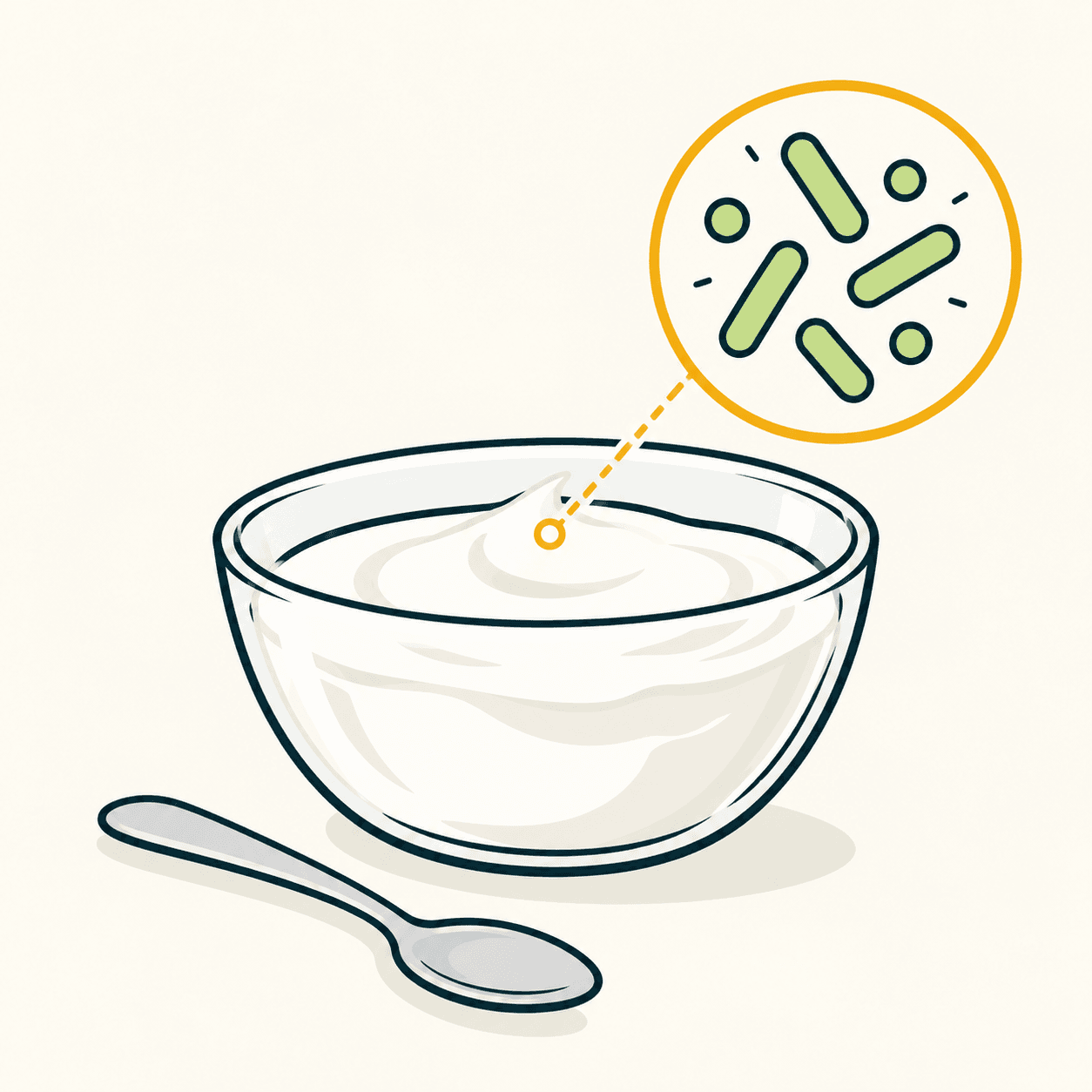
Milk and yogurt can begin with the same ingredient yet have very different textures. The explanation starts with microorganisms, living things too small to see with the naked eye. A University of Illinois guide describes bacteria transforming lactose, a milk sugar, into lactic acid. The acidity encourages proteins to come together and contributes to the thicker structure. This transformation is called fermentation. It is not simply milk becoming cold, even if we meet the finished product in a fridge. [1]
Processing matters too. Utah State University explains that heating, a starter culture and controlled conditions are part of preparation; it also notes that straining yogurt removes some whey and makes it thicker. Two tubs can therefore differ because of how they were made. Thickness alone does not reveal every processing step, nor is it an automatic ranking of quality. It is a characteristic to describe before making a judgement about what it means. [2]
The same university’s general fermentation guide makes a useful qualification: fermented does not mean safe to keep indefinitely at room temperature. Many products still need refrigeration or other treatments. Here we are explaining the process rather than giving a home recipe. Understanding that useful microorganisms can be involved in food does not make it safe to leave milk on a table and accept any change that happens. The conditions of a process matter as well as its name. [3]
Instead, try a paper model invented by our editors. Draw dots to stand for some proteins, then connect groups of dots. This is a very simplified metaphor for a structure forming. The dots neither show the true shape of molecules nor let us see bacteria. Their purpose is to help us follow a chain of events: a sugar changes, acidity increases, and texture changes. A model can be useful without being a literal picture of everything taking place. [1]
Add a second question to our workshop: what can a label tell us? Read the ingredients and descriptions on two unopened packages, without tasting doubtful products or anything forgotten outside the fridge. Record only what is written and separate it from your assumptions. If a label says strained, you have information about processing. If it does not, do not invent a production method from the colour of the tub. This is a reading exercise, not a food-safety test. [2]
Finally, ask a friend to explain the mechanism using three words: bacteria, acidity and proteins. If a connection is missing, return to the relevant passage. This is a teaching suggestion from our editors, meant to support understanding rather than prove health benefits. Food can become a small laboratory of questions without turning into a miraculous promise. The useful curiosity here lies in following what changes and recognising what our example cannot demonstrate by itself. [1][3]
Take this with youTo explain a transformation, describe its stages in order. A different texture is a clue: understanding the mechanism requires a few more questions.
One idea, in simple words
Some bacteria can turn milk into yogurt. Bacteria are tiny living things. They use a milk sugar called lactose and produce lactic acid. The acidity makes proteins, other parts of the milk, come together and changes its texture. This process is called fermentation. Cooling milk on its own does not make yogurt. [1]
Here is an example invented by our editors: draw separate dots, then connect some groups. It is only a model to imagine a structure forming, not a photograph of what happens. Making yogurt requires controlled conditions. Fermented does not mean that food can always stay outside the fridge. Our activity happens on paper: do not leave milk on a table to try to change it into something else. [3]
A little discovery to keep
What did you discover?
Read the sources (3)
- Making Yogurt at Home University of Illinois Extension · accessed 28 Sept 2026
- Homemade Fermented Yogurt Utah State University Extension · accessed 28 Sept 2026
- Fermenting Utah State University Extension · accessed 28 Sept 2026
Original writing and illustration made with AI assistance. Our editorial method
More in Food