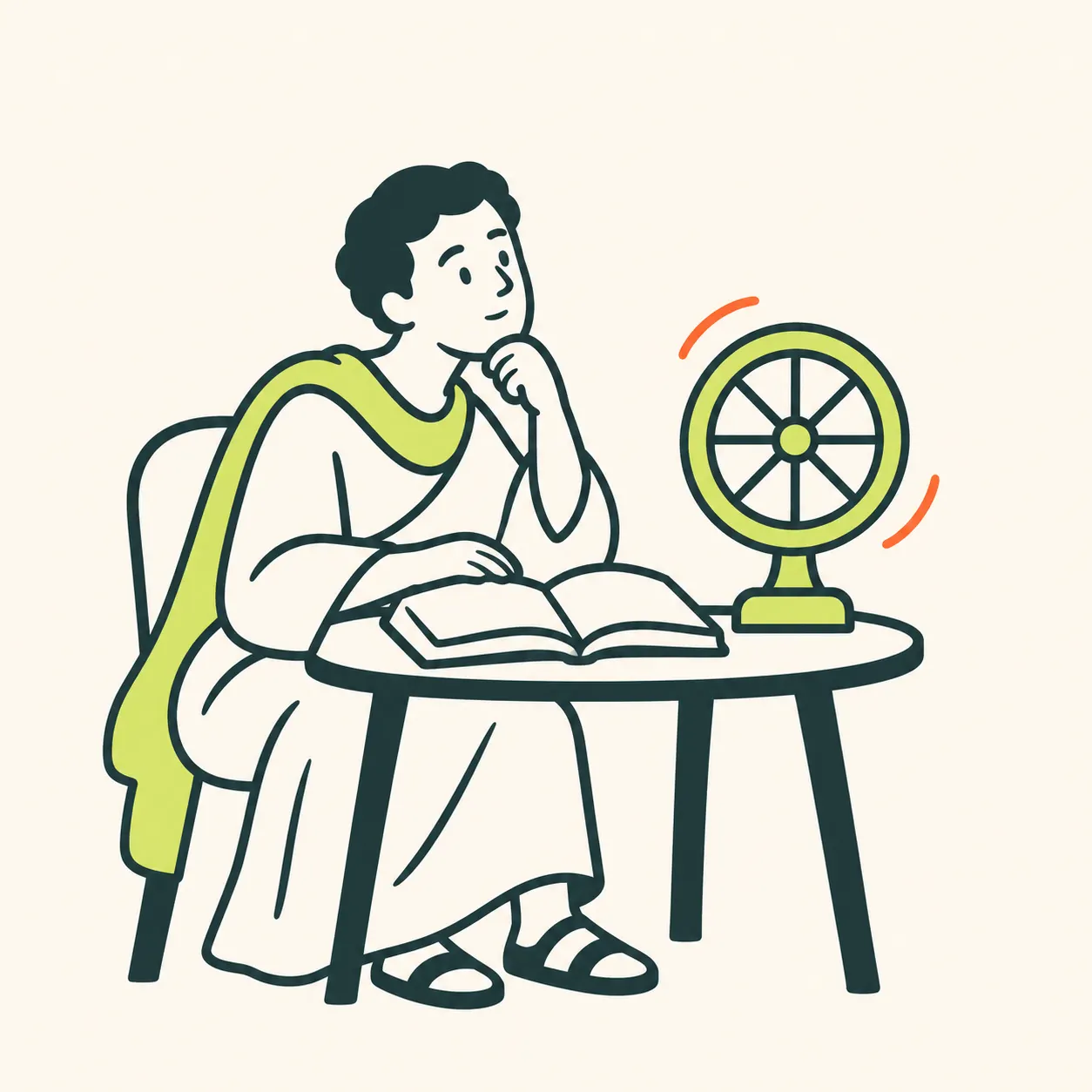
What remains when success stops cooperating? The Consolation of Philosophy places that question inside a dialogue alternating prose and verse. Boethius, a Roman author who lived across the fifth and sixth centuries, wrote the work while imprisoned. Philosophy visits the narrator in the form of a woman. She is a literary personification, rather than a real witness, inviting him to examine his thinking. [3]
In the second book, the discussion distinguishes goods that change with fortune from a good that should not depend entirely upon it. Wealth, position and satisfactions can be lost. The point is not to count them to decide who is entitled to complain. Philosophy seeks a happiness that does not swing with every external change. This is a philosophical argument to examine, not a scientific law. [1]
Today’s phrase comes from the fourth prose section: “Quid igitur, o mortales, extra petitis intra uos positam felicitatem?” Our translation is: “Why then, mortals, do you seek outside yourselves the happiness placed within you?” The Latin is checked against the edition available at Georgetown, with its meaning compared to H. R. James’s English translation. The speaker in the dialogue is Philosophy, not an anonymous oracle. [1][2]
An editorial example can make the question tangible. Imagine carefully preparing a presentation and receiving little applause. We can distinguish at least two judgments: how much of the audience we persuaded, and how seriously we worked. They are not identical. This example does not establish that approval is useless. It asks us to notice which part of our standard we have handed over entirely to other people’s reactions. [1]
The book should not, however, become advice to ignore pain, poverty or injustice. Its very setting involves a grave loss of freedom. In the reading offered here, questioning the value of a possession does not mean denying that material circumstances matter. We can argue with an ancient author and preserve his question without accepting every conclusion within his wider understanding of the world. [2]
As our own exercise, try writing two short lists: what we hope to receive, and how we would like to act. Where do they overlap, and where do they diverge? This is neither a happiness test nor a competition in self-sufficiency. It is a way to slow down judgment. Boethius’s question remains interesting when it opens a conversation, less so when it becomes a slogan silencing somebody who suffers. [1]
Take this with youChoose a success you want and ask which standard depends on the outcome and which on your conduct. Keep that distinction open.
One idea, in simple words
Boethius wrote The Consolation of Philosophy while in prison. In the book, he talks with Philosophy, represented as a woman. She is a literary character. Philosophy asks whether happiness can depend only on changing things, such as wealth and success. In the second book, she invites him to look within himself too. Imagine working carefully on a drawing and receiving few compliments. The compliments and the care you took are two different things. This example is ours. It does not mean that pain or material difficulties do not matter. Boethius’s question is an idea to discuss, not scientific proof or a promise that changing your thoughts alone will make everything better. [1][2][3]
A little discovery to keep
What did you discover?
Read the sources (3)
- Consolatio Philosophiae, II, prosa 4 Georgetown University, edizione di James J. O’Donnell · accessed 10 Nov 2026
- The Consolation of Philosophy, traduzione H. R. James (1897) Project Gutenberg · accessed 10 Nov 2026
- The Consolation of Philosophy, latino e traduzione I. T. (1609), rivista da H. F. Stewart (1918) Project Gutenberg · accessed 10 Nov 2026
Original writing and illustration made with AI assistance. Our editorial method
More in Philosophy