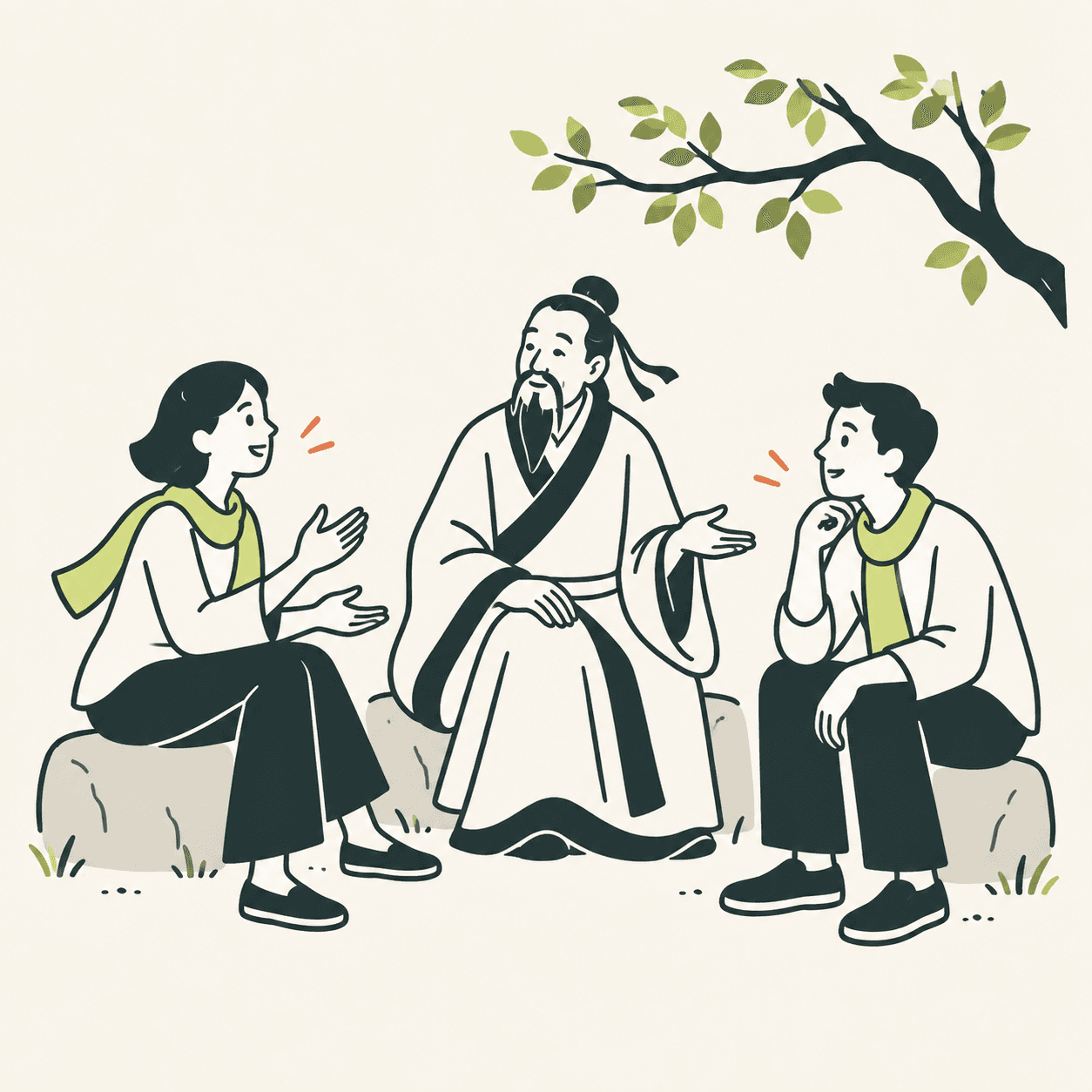
What distinguishes someone who knows many things from someone willing to learn? This question offers a way into Confucius, traditionally dated to 551–479 BCE. The Analects collect conversations and sayings handed down through the tradition. The Stanford Encyclopedia of Philosophy reminds us that the text has a complex history: it should not be treated as a direct transcript of a single voice. [1]
In passage 2.15 the master pairs learning with reflection: repeating acquired knowledge without examining it is insufficient, but thinking without learning does not offer a dependable path either. This is a paraphrase of the passage, not a newly invented saying attributed to the philosopher. [2]
Passage 2.17 adds a criterion: acknowledge what you know and what you do not know. In our reading, this means distinguishing information, reasoning and open questions, without hiding a gap behind a confident answer. [2]
Other people can also provide opportunities to learn. In passage 7.22 the master considers his travelling companions: their good qualities can provide an example, while their bad ones offer a reason to correct himself. Observation therefore does not end with ranking the people encountered. It returns to the observer and his own behaviour. This movement back towards personal conduct makes the short episode more demanding than a simple invitation to look around. [3]
Imagine an example devised by our editorial team: two colleagues must decide how to organise a meeting. One remembers every rule but ignores participants’ needs; the other proposes solutions without reading the available information. They can pause, check what they know and identify what is missing. This is our example, not an ancient episode: it tests the relationship between learning and thinking without attributing a contemporary business method to Confucius. In this exercise, they could finally check whether their proposal addresses the needs collected, and change their minds upon discovering information they overlooked. [2]
Historical distance matters: in the Analects, developing character also concerns ritual, family and political responsibilities. An everyday example cannot replace that context. [1]
Take this with youAt your next discussion, write down one verified fact, one interpretation of your own and one open question. Use them to continue the conversation without turning uncertainty into a contest.
Read the sources (3)
- Confucius Stanford Encyclopedia of Philosophy · accessed 17 Sept 2026
- The Analects, section 1 Internet Classics Archive · MIT · accessed 17 Sept 2026
- The Analects, section 2 Internet Classics Archive · MIT · accessed 17 Sept 2026
Original writing and illustration made with AI assistance. Our editorial method
More in Philosophy