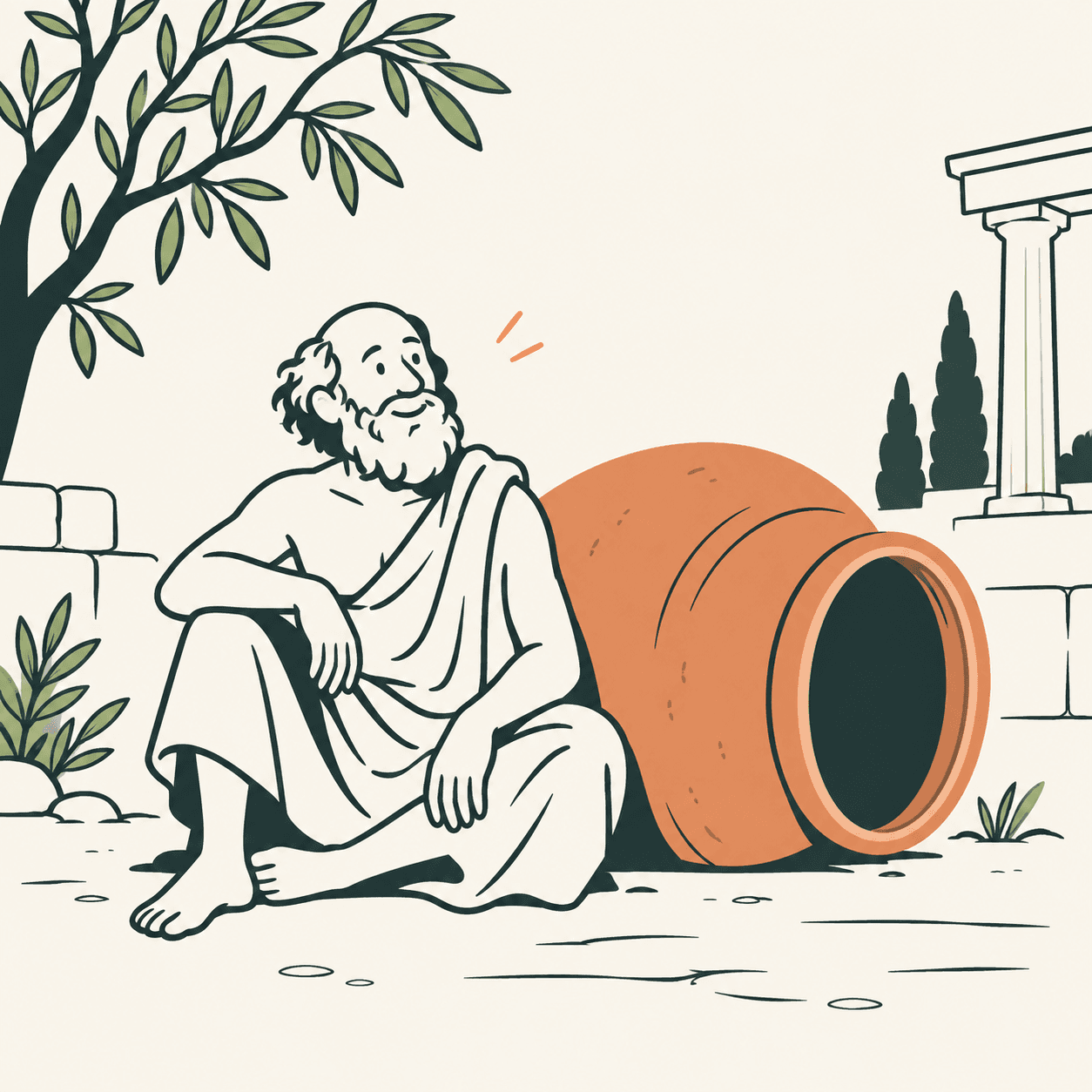
Diogenes of Sinope, who lived in the fourth century BCE, is a central figure in Cynic philosophy. We know him through ancient stories that are often difficult to separate from legend. The scholarly Internet Encyclopedia of Philosophy warns about this uncertainty. His famous large earthenware dwelling should therefore be described as a biographical tradition, rather than a scene recorded by an eyewitness carrying a camera. [1]
A central Cynic question concerns our needs: how much of life depends on conventions and the desire for status? A convention means a shared custom, rather than a law of nature. The Cynics sought freedom through self-sufficiency and daily practice. In the encyclopedia’s interpretation, questioning a custom served an ethical purpose: finding better reasons for living, rather than simply disagreeing with everyone else. [2]
This approach has connections with Antisthenes, who belonged to the Socratic tradition. The scholarly account also discusses uncertainty about the succession of teachers and pupils. Shared themes remain visible: the importance of actions, training one’s character and distance from luxury. We can study these connections without turning a disputed philosophical family tree into a perfectly completed school register. The history of ideas also contains unanswered questions. [3]
Here is an example invented by our editors. Two friends are choosing a school bag. One says their old bag carries books perfectly well, but worries about looking unfashionable because it is not new. The problem no longer concerns only the container; it concerns other people’s opinions. Inspired by this reading, we can ask whether we are choosing something helpful or paying to feel accepted. The question does not automatically decide which bag to buy. [2]
We can discuss that example without mocking anyone for wanting a beautiful object. An activity from our editors: write two different reasons for wanting the new bag, then ask someone you trust to help you distinguish them. Perhaps the old bag is uncomfortable; perhaps you simply fancy a different colour; perhaps both reasons matter. Understanding motives is a more useful exercise than declaring ourselves superior to people who make another choice. [3]
Our interpretation also sets a clear limit: questioning unnecessary possessions does not make a safe home, care or assistance unnecessary. We do not recommend copying the deprivation and provocations in ancient stories. At school, we can question a custom while respecting people and the rules that protect everyone. Before rebelling against something, try explaining your reason and listening to an objection. That too is practice, rather than a competition to deliver the cleverest remark. [1]
Take this with youA question to keep: does this choice answer my needs, care for someone else, or simply protect me from worrying about their opinion?
One idea, in simple words
Diogenes was a philosopher in ancient Greece. A philosopher asks questions about living and understanding the world. Many stories about Diogenes mix facts and legends: we do not know whether every event really happened. He is remembered among the Cynics, thinkers who questioned customs. [1]
Their question was: do we really need what everyone seems to want? Here is an example invented by our editors. Your school bag works, but you want a new one only because classmates have it. You can ask which need you are trying to meet. Perhaps you have other reasons too: discussing them helps. This does not mean giving up necessary things or judging other people. We can question, listen and choose carefully without copying unusual behaviour attributed to an ancient philosopher. [2]
A little discovery to keep
What did you discover?
Read the sources (3)
- Diogenes of Sinope Internet Encyclopedia of Philosophy · Julie Piering · accessed 25 Sept 2026
- Cynics Internet Encyclopedia of Philosophy · Julie Piering · accessed 25 Sept 2026
- Antisthenes Internet Encyclopedia of Philosophy · Julie Piering · accessed 25 Sept 2026
Original writing and illustration made with AI assistance. Our editorial method
More in Philosophy