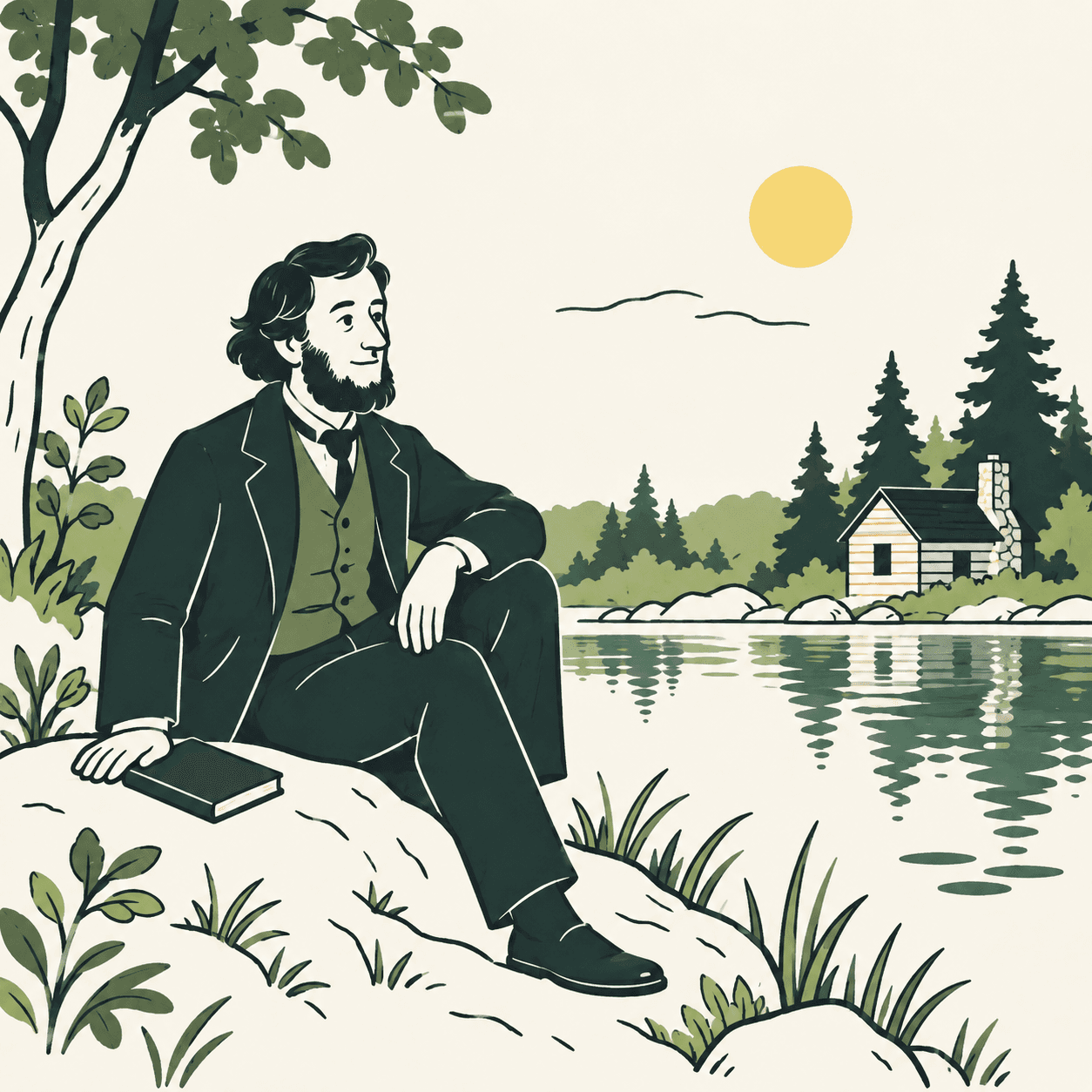
Our life is frittered away by detail: Henry David Thoreau writes this sentence in Walden, in the chapter Where I Lived, and What I Lived For. It is the English original of today’s phrase; the Italian and French versions are editorial translations. In this passage, simplifying concerns how we spend a life. It is not a scientific measurement of attention, but a philosophical provocation that deserves discussion. [1]
Born in Concord, Massachusetts, in 1817, Thoreau was a writer, naturalist and thinker involved in social criticism. The Walden Woods Project recalls his opposition to slavery and his concern with a society transformed by industrialisation. Seen in this context, the woods do not erase the shared world: they offer a position from which to examine it. Reducing this moral investigation to a taste for rustic living would miss its reach. [2]
We should also correct a biographical shortcut: at Walden he did not live as a hermit without contact. He went into town, saw family and friends, and received visitors. The centre preserving his legacy documents this distinction between withdrawal and absolute isolation. Reading the experience as a limited experiment lets us question our own habits without assuming that relationships with other people are obstacles that need to be removed. [3]
The book itself is also a constructed work, rather than an automatic transcript from a cabin. Digital Thoreau allows readers to compare seven manuscript versions of Walden. This information invites a useful pause: a page that feels immediate may result from repeated reconsideration. We distinguish the documented fact, the existence of those versions, from our own reflection: simplicity of expression should not be mistaken for an absence of sustained work. [4]
Consider an example explicitly invented by our editors. Someone wants to read a page, but first decides to organise every folder on their computer. Eventually the folders are immaculate and the book remains closed. Asking which activity served the purpose does not mean despising order: it means noticing a displacement. This is our contemporary application, rather than a scene Thoreau described or an opinion he expressed about digital devices. [1]
The question has a limit: we cannot freely choose every commitment. Caring for someone, earning a living or meeting a deadline does not become unnecessary simply because it takes time. This is our editorial caution about using the phrase today. Try identifying one small habit that can change, rather than judging someone else’s entire life. A philosophical question becomes more useful when it opens an examination instead of closing it with a universal recipe. [1]
Take this with youBefore removing something from your day, ask what you want to make possible. Simplicity can begin with a tiny choice, without becoming a model imposed on somebody else.
One idea, in simple words
Henry David Thoreau wrote Walden, a book inviting readers to think about how they live. In one chapter he says our lives can be scattered among details. He wants us to ask which activities receive our time. He is not describing a scientific experiment. This is a philosophical question: a question about the meaning and reasons behind our choices. [1]
Here is an example invented by our editors. You want to read a page, but spend all your time arranging your desk. Tidying can be useful; this time, however, it has replaced what you wanted to do. You can pause and choose where to begin again. This does not mean cancelling important duties or commitments to other people. It means examining a small habit you really can change, without expecting everyone to live alike. [1]
A little discovery to keep
What did you discover?
Read the sources (4)
- Walden · Where I Lived, and What I Lived For Henry David Thoreau · Project Gutenberg · accessed 9 Oct 2026
- Henry David Thoreau (1817–1862) The Walden Woods Project · accessed 9 Oct 2026
- Myths and Misconceptions The Walden Woods Project · accessed 9 Oct 2026
- Thoreau’s Writings · the digital collection The Walden Woods Project · accessed 9 Oct 2026
Original writing and illustration made with AI assistance. Our editorial method
More in Philosophy