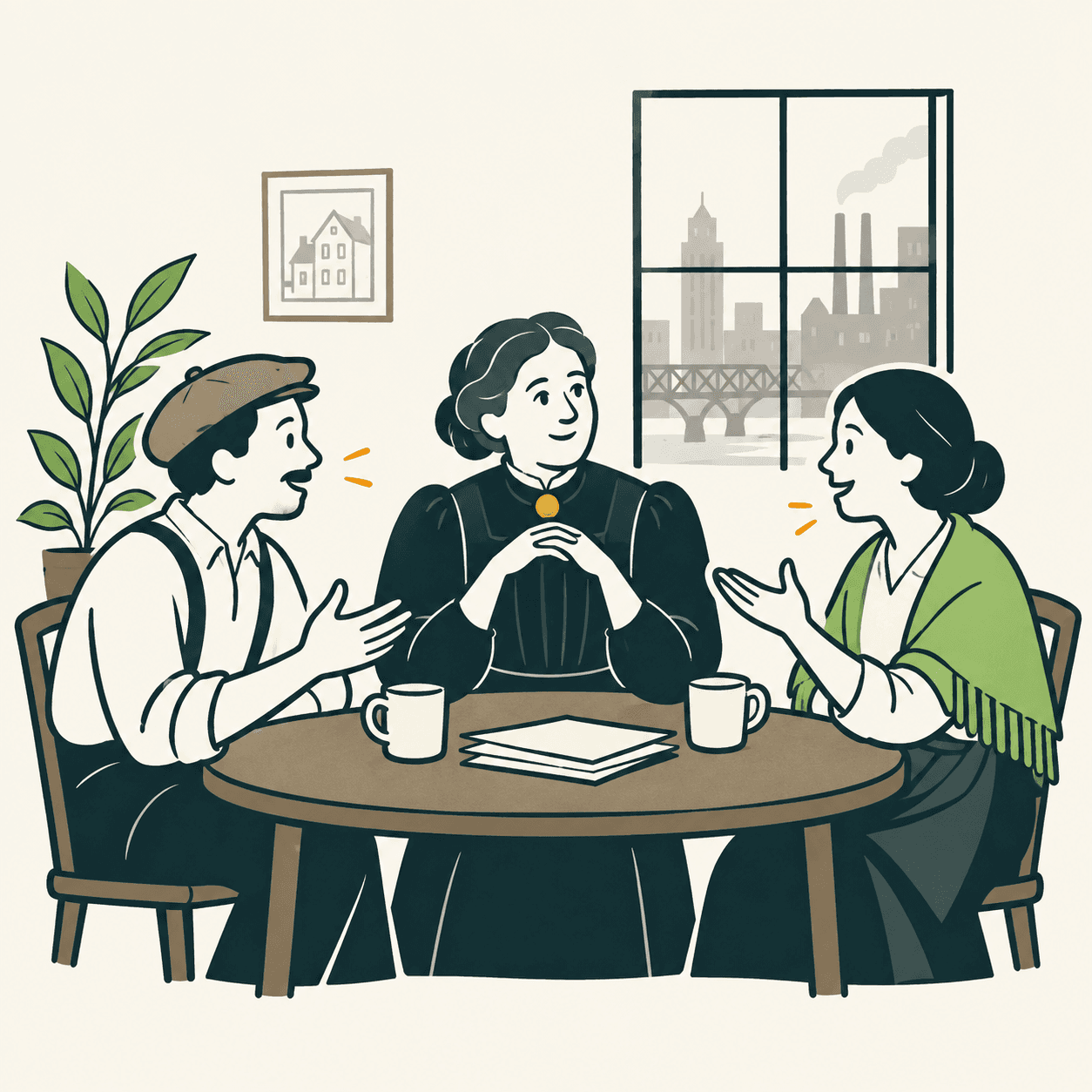
Can we decide what somebody needs without listening to them? American philosopher Jane Addams placed the relationship between knowledge and shared life at the centre of her work. The Stanford Encyclopedia of Philosophy describes a thinker who connected reflection with social action. Her idea of sympathetic knowledge encourages us to understand other people’s experiences instead of treating them as problems to fix from outside. That is the question we bring to this reading. [1]
In 1889, Addams and Ellen Gates Starr started Hull-House in Chicago. The University of Illinois museum also remembers Mary Keyser, an important link with the neighbourhood. The project grew to include libraries, arts activities, classes and childcare. Nearby residents were more than recipients of help: their needs and hopes helped shape the experiment. The story therefore involves more people than the one whose name appears in our title, and their contributions deserve attention too. [2]
The National Park Service documents work extending beyond that house: Addams supported better working conditions, women’s rights and peace initiatives. In 1931, she shared the Nobel Peace Prize with Nicholas Murray Butler. Her opposition to war also attracted hostility. Remembering that prevents an overly comfortable biography: being recognised later does not mean finding everyone in agreement while doing the work. Recognition and disagreement can both belong to the history of the same person. [3]
Now imagine a situation invented by our editors. A class wants to make its school library more welcoming. One group suggests colourful cushions; another wants more comics; a classmate explains that she can never arrive during opening hours. None of these voices describes the whole problem. Before spending their small budget, the pupils also ask children who rarely visit the library what keeps them away. They leave room for an answer nobody had predicted. [2]
In our example, listening does not mean promising everything. Space, time and money are limited. But the group can make those limits visible and explain its choices: test a different opening time, check whether it helps, and adjust it. This is our teaching example, not an incident from Hull-House. It distinguishes a good intention from a decision made together, in which people receiving a proposal can also say that it is not the right one for them. [1]
The exercise does not erase disagreement. Someone might still prefer another solution or find it difficult to speak in front of the others. We therefore add an anonymous suggestion sheet and another chance to discuss the decision. That is a choice in our workshop, not a formula attributed to Addams. The final question remains open: whose experiences have we not heard? A community imagined only by whoever speaks first can exclude the very people it meant to involve. [1]
Take this with youBefore proposing an improvement, ask the people who will use it what they find difficult. Listen to an answer that challenges your first idea, too.
One idea, in simple words
Jane Addams was a philosopher: she thought about how people can live together. She worked at Hull-House, a centre in Chicago with classes, activities and neighbourhood services. She wanted to do more than bring ready-made answers. Learning about other people’s experiences was an important part of her thinking. [1][2]
Here is an invented example. Your class wants to improve the library. You suggest new cushions, but a classmate says he cannot visit during opening hours. Listening reveals a problem different from your own. You can compare ideas and try a solution together. Listening does not mean being able to please everybody. It means making room for the people involved and explaining your choices. Sometimes a thoughtful question helps more than a quick answer. [1]
A little discovery to keep
What did you discover?
Read the sources (3)
- Jane Addams Stanford Encyclopedia of Philosophy · accessed 28 Sept 2026
- Our History Jane Addams Hull-House Museum, University of Illinois Chicago · accessed 28 Sept 2026
- Jane Addams U.S. National Park Service · accessed 28 Sept 2026
Original writing and illustration made with AI assistance. Our editorial method
More in Philosophy