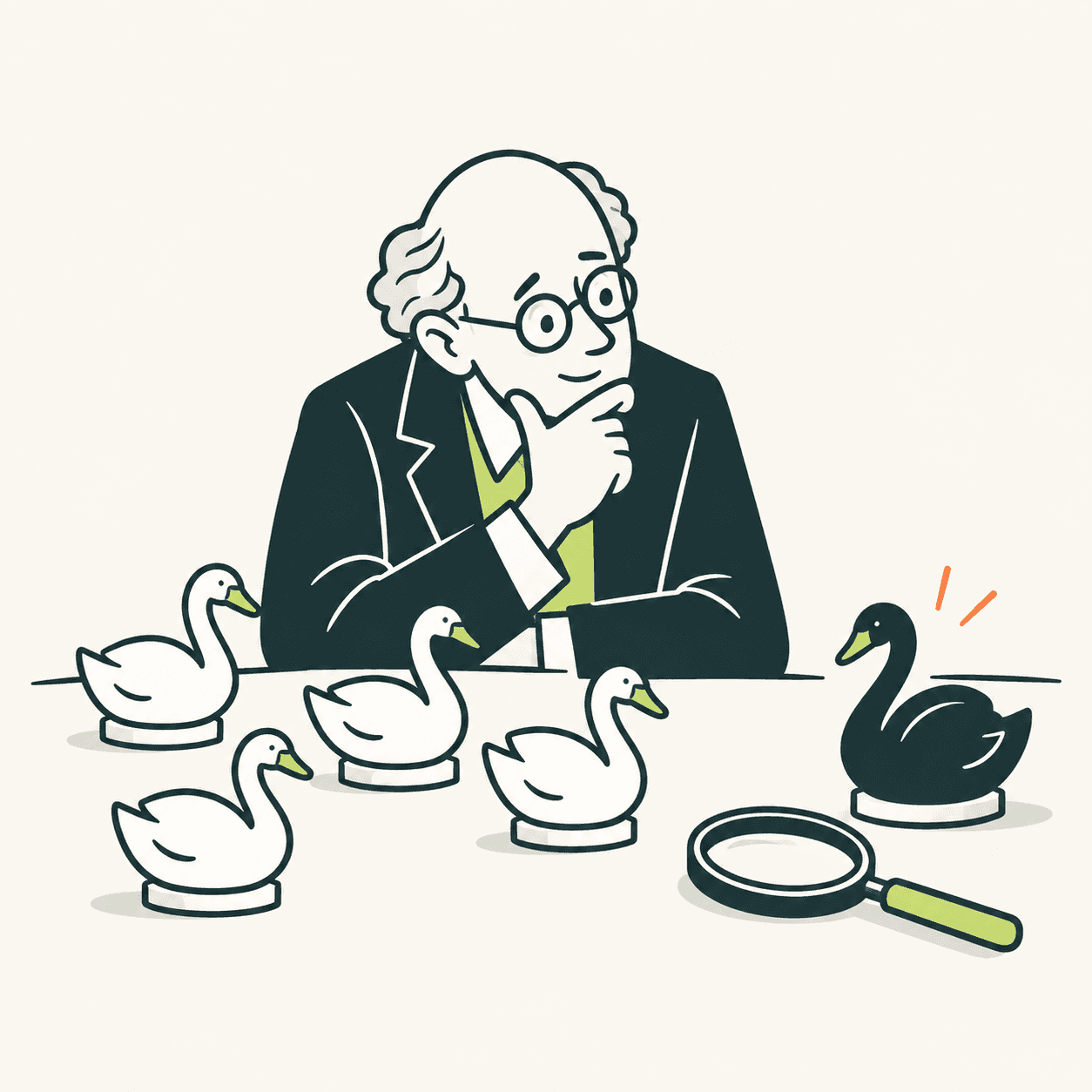
Karl Popper explored a difficult question: what distinguishes a scientific theory from other explanations? His most famous proposal is falsifiability. The word does not mean fabricating results or telling lies. It means that a theory must expose its predictions to tests capable, at least in principle, of revealing a mistake. An explanation that can accommodate every possible outcome does not take that risk, however reassuring it may sound to its supporters. [1]
An example invented by our editors makes the difference easier to see. Suppose we say that every pencil in a box is blue. Finding a blue pencil fits the claim; finding another blue one does not rule out a red pencil underneath. But if we really find a red pencil in that same box, the statement containing “every” cannot stand. The test concerns the precise statement, rather than how much we like the person who made it. [2]
In Science as Falsification, Popper emphasises tests that seriously challenge a theory instead of simply collecting favourable examples. The aim is not to wish every idea would fail. It is to give an idea a real opportunity to be corrected. A theory that survives demanding tests may be kept provisionally: surviving a test is not the same as receiving a permanent guarantee of truth that no future discovery could affect. [2]
Actual research, however, is more complicated than our pencil box. The Stanford Encyclopedia of Philosophy distinguishes the logical argument from scientists' practical work: an instrument may be faulty, a measurement inaccurate, or an observation misinterpreted. A surprising result needs checking. Merely announcing “I found an exception” does not cancel an entire field of knowledge. We must establish what was measured and whether the test was relevant to the claim being examined. [3]
Try a second editorial scenario. Two friends discuss whether a ball always reaches the same point on a cardboard track. First they agree how to release it and how to mark its arrival. Then they record the attempt that looks different from the others too. They can ask whether the track moved, or whether their statement was too strong. This small game does not represent all of science: it practises making conditions, results and possible errors visible. [3]
Popper supplies no universal password for sorting every discussion into true and false. His proposal has been debated and criticised, and it does not reduce the value of poems or moral questions to an experiment. One useful question remains for our reading: what observation would persuade me to revise this explanation? If the answer keeps changing to protect the idea, perhaps we are defending a conclusion rather than putting it to a meaningful test. [3]
Take this with youBefore looking for supporting evidence, write down what could contradict your idea. Revising an explanation after a careful test can be progress, rather than defeat.
One idea, in simple words
Karl Popper studied how to test scientific ideas. One important word in his work is falsifiability. It means being able to imagine a test that could reveal a mistake in an idea. It does not mean inventing false results. [1]
Here is our editorial example: you say every pencil in a box is blue. You find five blue ones. There could still be a red pencil at the bottom. If you find it, you must change the sentence containing “every”. Real scientific tests are harder: instruments can make mistakes too. A strange result therefore needs careful checking. Popper helps us ask what would make us change our minds. We do not have to win every argument. Correcting an explanation can help us learn. [2][3]
A little discovery to keep
What did you discover?
Read the sources (3)
- Karl Popper London School of Economics · accessed 27 Sept 2026
- Science as Falsification (1963) Karl Popper · testo ospitato da Bowdoin College · accessed 27 Sept 2026
- Karl Popper Stanford Encyclopedia of Philosophy · accessed 27 Sept 2026
Original writing and illustration made with AI assistance. Our editorial method
More in Philosophy