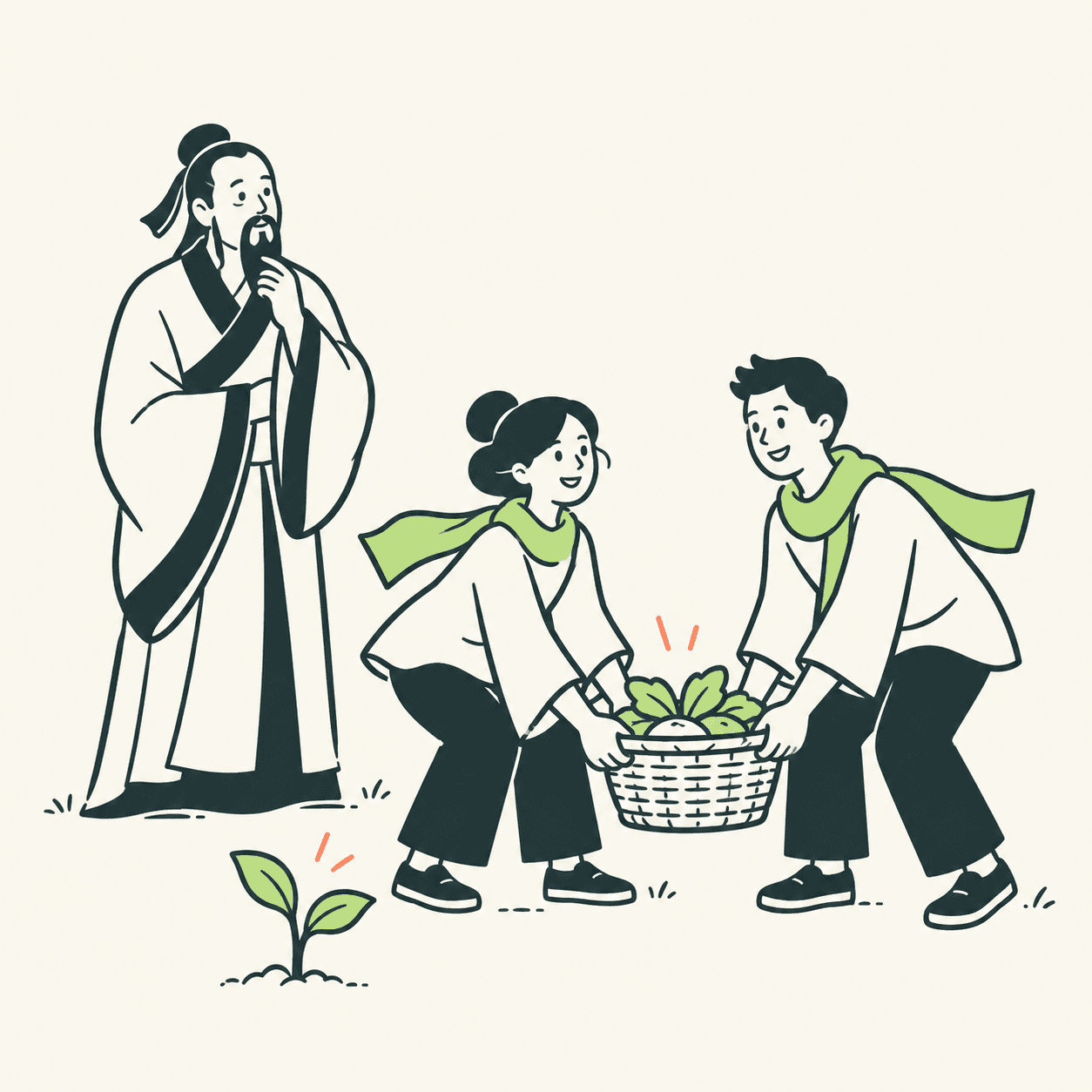
Noticing someone in difficulty and wanting to help: for Mencius, that small beginning matters. The Chinese thinker, active in the fourth century BCE, belongs to the Confucian tradition. His name is also written Mengzi, meaning Master Meng. Our question is not whether we can already call ourselves perfect. It is how we might turn a capacity for care into something we actually do. [1]
Mencius uses a famous imaginary situation: encountering a child about to fall into a well. The immediate feeling of alarm and compassion would not depend on wanting a reward. The Internet Encyclopedia of Philosophy highlights an important distinction: this example is about an initial feeling. It does not demonstrate that everyone will then take the right action. Noticing trouble and doing something helpful are not quite the same thing. [2]
To explain moral development, Mencius uses the image of sprouts. Early tendencies need nurturing, just as a plant needs suitable conditions to grow. Stanford’s discussion of emotions in Chinese philosophy draws attention to this agricultural metaphor. It is not botanical evidence about goodness. It is a philosophical way of thinking about potential, care and surroundings. A starting point does not already contain every successful result. [3]
Now imagine a scene invented by our editors, not a story attributed to Mencius. A new classmate sits alone during a group activity. We notice and feel concerned. We could leave it at that thought, or ask whether they would like to join our table. Perhaps they prefer another group: listening to that answer matters too. Our example separates three stages: noticing, asking, and agreeing together on what to do. [2]
Next, change the setting of the scene. The group is noisy, time is short and we worry that someone might laugh at us. Write down the obstacle that makes helping harder and one small change that could help: taking turns to speak, offering a quiet invitation, or sharing a task. This editorial exercise asks us to notice the conditions surrounding a choice. It is not a way to sort classmates into good and bad people, or claim to know what they are thinking. [3]
Mencius’s account of human nature belongs to a philosophical debate, rather than being an experimental verdict covering every situation. The Stanford Encyclopedia notes that moral growth requires work. We suggest a cautious reading: an initial reaction can become an opportunity, but it does not replace attention to what happens next. We can discuss that idea and look for its limits without turning it into an automatic compliment to ourselves or a reason to stop learning. [1]
Take this with youThink of a time when you wanted to help someone. What practical step could turn that intention into an action that respects their answer?
One idea, in simple words
Mencius was a Chinese philosopher: someone who thought carefully about big questions. One question was how we learn to act well. He compared our early capacity to care with sprouts, which are tiny growing plants. In his view, a good possibility needs care and practice. Having it does not mean we will always make a good choice. [3]
Here is an example from our editors. A new classmate is alone and you feel concerned. You could ask them to join your group, then listen to their answer. Compassion means noticing their difficulty and caring about it. Helping also needs a practical choice. Mencius’s example separates the first feeling from the next action. This is an idea to discuss, not proof that everyone will act alike. [2]
A little discovery to keep
What did you discover?
Read the sources (3)
- Mencius Stanford Encyclopedia of Philosophy · accessed 29 Sept 2026
- Mencius Internet Encyclopedia of Philosophy · accessed 29 Sept 2026
- Emotions in Chinese Philosophy Stanford Encyclopedia of Philosophy · accessed 29 Sept 2026
Original writing and illustration made with AI assistance. Our editorial method
More in Philosophy