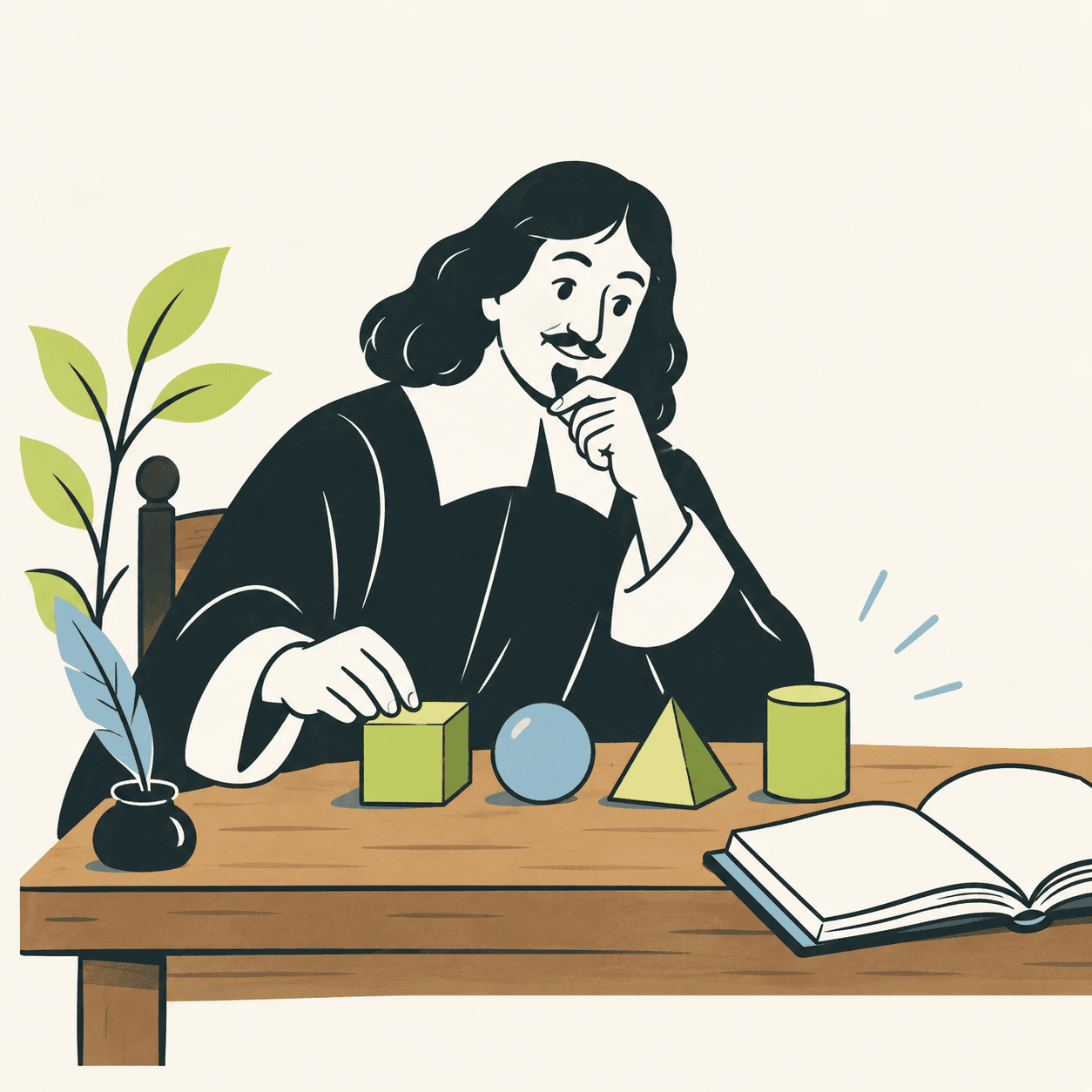
“Le bon sens est la chose du monde la mieux partagée.” This opens René Descartes' Discourse on the Method, published in 1637. We translate it as: “Good sense is the most evenly shared thing in the world.” This is an editorial translation from the French, checked against John Veitch's English version. We have ended the excerpt with a full stop; the original continues after a semicolon. [1][2]
Read alone, the sentence might sound like a compliment to everybody. Descartes goes on to observe that people generally think they already have enough good sense. He then sharpens the question: by good sense he means the capacity to judge and distinguish truth from falsehood; opinions differ partly because we direct our thoughts along different paths. He is not certifying that every opinion we encounter is true. [1][2]
The central distinction is between possessing a capacity and using it well. In the first part, Descartes argues that a strong mind is not enough if it is poorly directed. In the second, he proposes four guidelines: avoid hasty acceptance, divide difficulties, move in order from simple matters to complex ones, and review the whole to avoid omissions. These are not four ready-made answers, but a way to organise the search for an answer. [1]
Take an example invented by the editors. A class wants to understand why two young plants grow differently. Immediately calling one lazy does not solve the problem. Instead, pupils can divide the question: how much light does each receive, what water has each had, and which conditions really are the same? This is neither an experiment by Descartes nor proof of a cause. It illustrates a move from quick certainty towards questions that can be checked. [1]
The Stanford Encyclopedia of Philosophy's scholarly account also emphasises application: understanding the rules means seeing them at work in problems, rather than merely reciting them. This marks a useful limit to our summary. Cartesian philosophy involves much wider questions, and his method is not simply a modern checklist for checking news. We are reading a specific passage here, without turning it into a universal recipe for every situation. [3]
For the editors, the everyday invitation is to distinguish confidence from reasons. We may feel convinced while still needing to check a detail, hear an objection or recognise missing information. That is our reflection, not another quotation attributed to the philosopher. Returning to the context changes the quotation's value: good sense becomes less a badge to display than an ability that deserves care through the way we use it. [1]
Take this with youChoose a conclusion you reached today. Write down the observation supporting it and the new information that could change your mind: the purpose is understanding, rather than winning.
One idea, in simple words
René Descartes wrote Discourse on the Method in 1637. Its opening says that good sense is the most evenly shared thing in the world. By good sense he means the ability to judge: trying to tell truth from falsehood. This does not mean every opinion we hold is right. How we use our thinking matters too. [1][2]
Descartes suggests dividing difficulties into parts and checking our reasoning. Imagine this editorial example: two young plants grow differently. Before deciding why, you could ask how much light and water each receives. You have separated one large question into smaller questions. You have not found the answer yet, but you know better what to observe. Feeling certain and having good reasons are not the same thing. [1]
A little discovery to keep
What did you discover?
Read the sources (3)
- Discours de la méthode · parties I et II, texte français, édition Victor Cousin Project Gutenberg · accessed 6 Oct 2026
- Discourse on the Method · parts I and II, translated by John Veitch Project Gutenberg · accessed 6 Oct 2026
- Descartes’ Method Stanford Encyclopedia of Philosophy · accessed 6 Oct 2026
Original writing and illustration made with AI assistance. Our editorial method
More in Philosophy