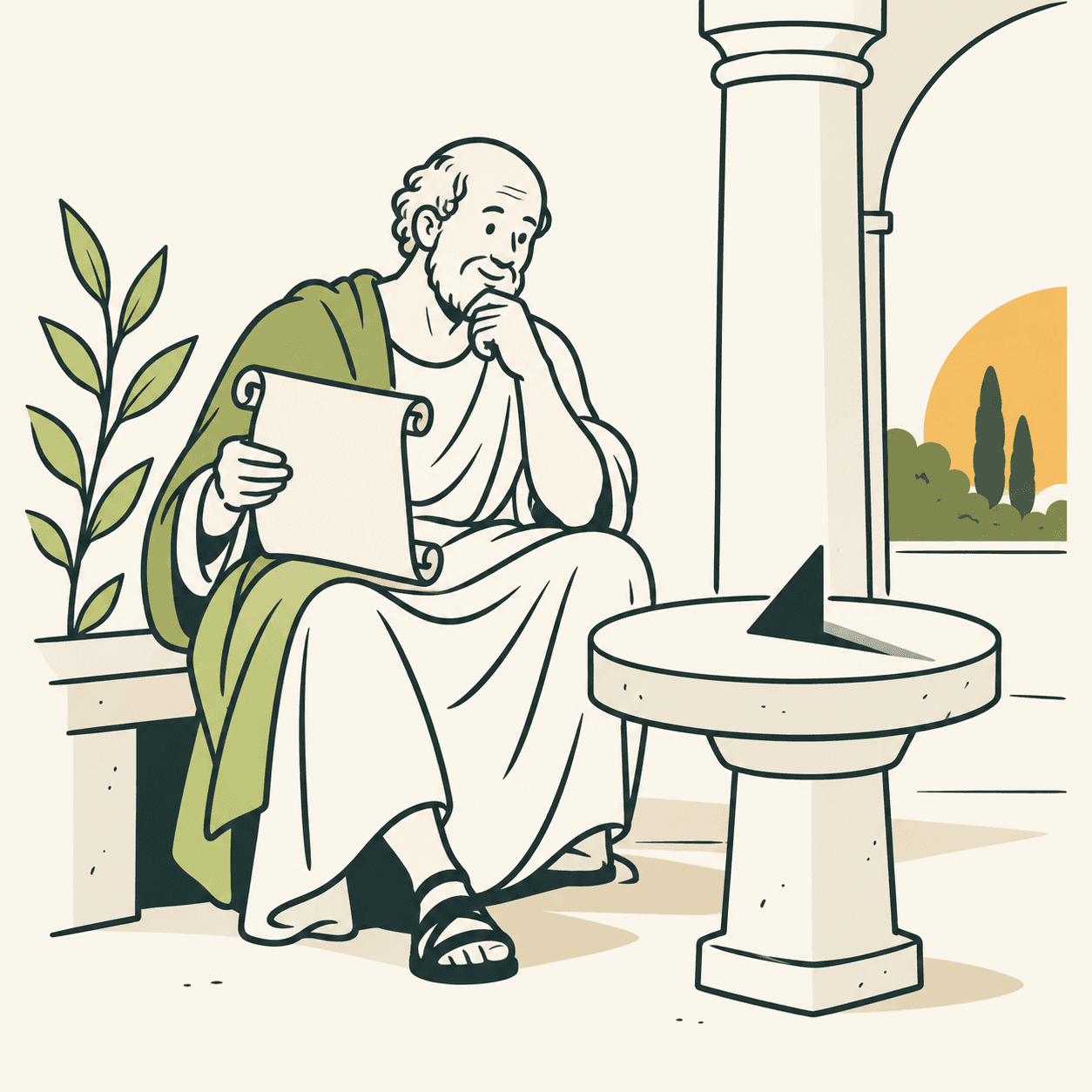
Seneca opens his first letter to Lucilius with a request: take possession of your time again. He distinguishes what is taken from us from what we allow to slip away through inattention. He offers neither a perfect timetable nor a race to do things faster. The text questions the value of our days and the ease with which we postpone precisely what we say matters to us. [1]
The most human passage comes when he imagines his correspondent objecting: how do you behave, when you give this advice? Seneca does not reply by declaring himself faultless. He admits to losing time, but says he can identify what he loses, why and how. That distinction matters: becoming aware of a habit does not mean having overcome it already. It provides somewhere to begin examining yourself. [2]
An editorial example: imagine wanting to build a small kite, but spending the afternoon constantly switching designs. That evening, write three lines: what you intended to do, what you actually did, and when you changed direction. This exercise is not meant to condemn every break. It helps distinguish a choice from an automatic movement. It is not an episode from Seneca’s life, but an invented situation in which to try his question. [1]
The Internet Encyclopedia of Philosophy places this invitation within the moral purpose of the letters. The problem is not simply producing more: Seneca wants philosophical reflection to shape how someone lives. The same source explains that the letters vary in form and subject. Reducing all his philosophy to advice about organising a day would therefore be inadequate. We are reading a particular passage, rather than summarising an entire philosophical school. [3]
A limit to our application deserves to be clear: people do not all have the same control over their hours. In this editorial exercise, a medical appointment, an unexpected event or someone needing help does not automatically count as wasted time. We suggest looking only at a moment when a choice was actually possible. Then ask whether that choice served what mattered to you, without turning the notebook into a report card. [1]
Our final editorial suggestion is to choose one small activity you would like to give attention to tomorrow, leaving room for rest as well. At the end of the day, compare the intention with what happened and note just one reason for any difference. Return to Seneca’s admission: recognising a loss is different from boasting that you never lose anything. The sundial in our illustration is an editorial metaphor, not a record of a scene from his life. [2]
Take this with youBefore filling the next hour, try asking what you really want to give it to, and why.
One idea, in simple words
Seneca was a Roman philosopher, someone who asked questions about how to live. In his first letter to Lucilius, he asks his reader to notice how time passes. He also admits something important: he wastes time himself. He says he can recognise what he loses and why. Noticing a habit is a beginning, not proof that the habit has already changed. [1][2]
Imagine, in our editorial example, wanting to draw a kite but repeatedly changing your idea. Afterwards, write what you wanted to do and what actually happened. This is not a test with a mark. A break or time spent helping someone is not automatically wasted. The exercise asks you to notice a choice. Seneca’s letter is a philosophical invitation, not a scientific rule for planning every minute. [3][1]
A little discovery to keep
What did you discover?
Read the sources (3)
- Moral letters to Lucilius, Letter 1: On Saving Time Seneca · traduzione Richard M. Gummere / Wikisource · accessed 2 Oct 2026
- Epistulae morales ad Lucilium, libro I, lettera I Seneca / The Latin Library · accessed 2 Oct 2026
- Lucius Annaeus Seneca Internet Encyclopedia of Philosophy · accessed 2 Oct 2026
Original writing and illustration made with AI assistance. Our editorial method
More in Philosophy