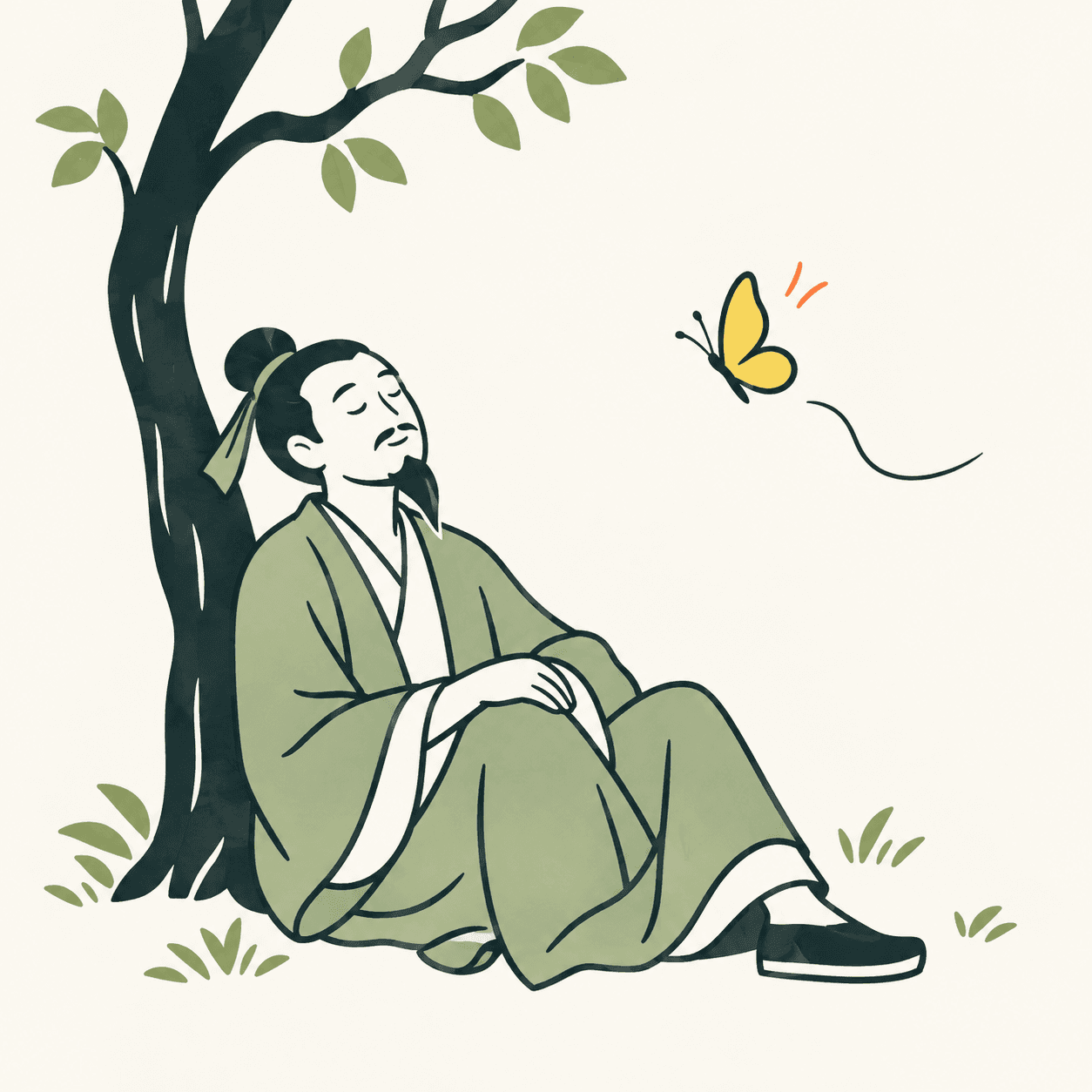
In the best-known story from the Zhuangzi, a man dreams that he is a butterfly, then wakes and wonders which experience contains the other. The Stanford Encyclopedia of Philosophy reads it within a form of mild scepticism: recognising a change in perspective does not guarantee that we have reached the final possible perspective. The butterfly is not scientific evidence about dreaming. It is a character through which a philosophical text makes certainty less comfortable. [1]
We should also distinguish the author from the book. The Internet Encyclopedia of Philosophy describes the surviving text as a collection of thirty-three chapters arranged by Guo Xiang centuries after the period traditionally associated with the master. The first seven are known as the Inner Chapters, but the attribution of individual passages remains debated. Discussing the philosophy of the Zhuangzi therefore does not mean that we possess one person’s private diary. Narrative form, multiple voices and editorial history belong to the question. [2]
The same encyclopedia stresses the difficulty of interpreting the second chapter: its language, judgments and contradictions resist a simple slogan. Reading it through different perspectives is influential, but does not settle every debate. Our proposed reading is therefore limited: use the story to question how we move between convictions. Do not conclude that all claims are equivalent, or that checking facts is pointless. Those would be conclusions supplied by us, rather than the inevitable meaning of the tale. [2]
Consider an example devised by our editorial team. A very short reply in a chat seems irritated. Later, we discover that its writer was boarding a train and simply wanted to confirm an appointment. We have not proved that short replies can never be irritated: we have corrected this interpretation using a particular piece of information. But pause before promoting the new explanation to a universal truth. What do we know now? What are we still imagining? What could we ask directly? This everyday exercise is not equivalent to the ancient parable, nor is it a therapeutic technique. It is our way of distinguishing subjective confidence, new information and willingness to revise a judgment. In the reading we suggest, the butterfly does not erase the world. It merely stops our first impression appointing itself chief executive of reality. [1]
Take this with youTry this: recall an opinion you revised. Write down the information that changed your mind and one question that remains open. Revising a judgment can make it more accurate without turning it into a final verdict.
One idea, in simple words
In an ancient Chinese book, the Zhuangzi, a man dreams that he is a butterfly. When he wakes, he wonders: was he a man dreaming of a butterfly, or the other way round? The story explores a point of view: how we look at something and understand it. [1]
Scholars still discuss what these stories mean. The reading offered here invites us to check our first ideas. It does not mean that every answer is equally right, or that finding information is pointless. [2]
Here is an example invented by our editorial team. A friend answers with just a nod. You think they are angry, but later learn that their mouth was full. New information changes your explanation. You can ask, listen and correct yourself. You have not learned that nobody ever gets angry: you understand that particular moment better. [1]
A little discovery to keep
What did you discover?
Read the sources (2)
Original writing and illustration made with AI assistance. Our editorial method
More in Philosophy