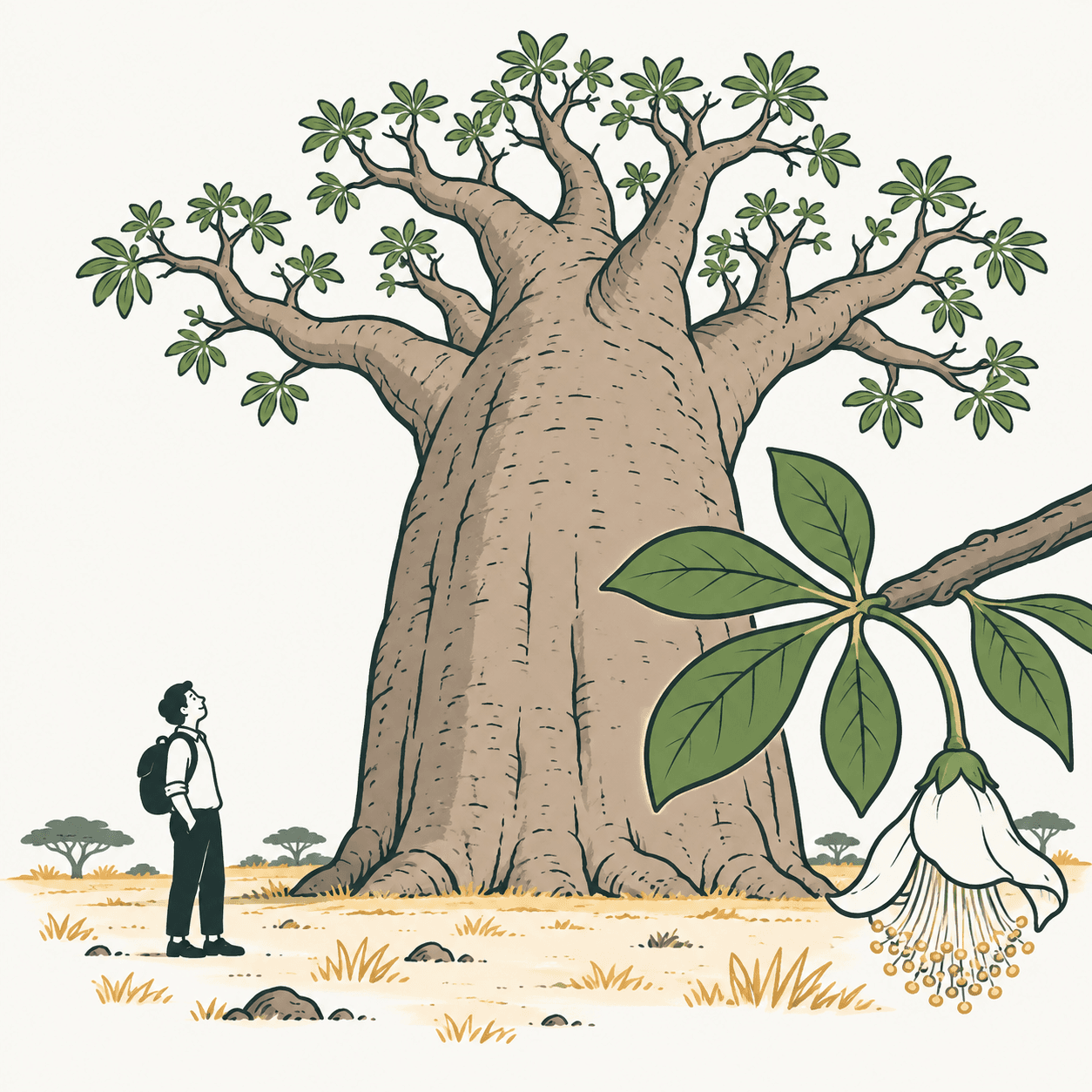
When we picture a baobab, its enormous trunk takes up almost the whole scene. The African species Adansonia digitata, accepted in Kew’s classification, grows mainly in seasonally dry tropical environments. Its native range includes tropical and southern Africa and the southern Arabian Peninsula: a distribution, rather than one single landscape. [1]
Up close, the most revealing detail may be a leaf. The South African botanical portal SANBI describes the adult leaf as normally divided into five to seven finger-like leaflets. Digitata also refers to this resemblance to a hand. These are not seven independent leaves accidentally gathered together: they form one compound leaf. [2]
The baobab sheds its leaves seasonally. SANBI also describes large, hanging white flowers opening in late afternoon and visited at night by fruit bats. The apparently motionless tree therefore participates in relationships that a daytime photograph of its trunk can leave entirely outside the frame: not everything important occupies the centre. [2]
Kew distinguishes leaves, flowers and fruits: flowers have five separate petals and numerous stamens; the fruit contains mealy pulp and seeds. This description helps us read a botanical illustration: a flower should not be drawn as a fruit, and a palmate leaf is more than a decorative green outline. [1]
We should also remember that baobab does not identify a single species. In Kew’s account of its collections, the specimen in the Princess of Wales Conservatory is Adansonia za, native to Madagascar. It is not Adansonia digitata. Even when a common name feels familiar, checking the scientific name prevents automatically transferring characteristics and locations. [3]
The same article compares those baobabs to giant succulents because of the water held in their trunk tissues. That is a useful image, provided it does not become a cartoon water tank. Our editorial reading is cautious: a metaphor introduces a question, but does not replace anatomy or establish one number for every tree. [3]
An editorial exercise: cover the trunk in the illustration for a moment and try recognising the plant by its leaf and flower. Then reopen the botanical entry and compare the details. The giant remains impressive, but stops doing all the work: the leaflets deserve an appearance without needing to hire a public relations team. [2]
This reading concerns observation, rather than home cultivation or food and medicinal uses. The illustration is a declared interpretation to compare with botanical documentation, not a diagnostic plate. The discovery that interests us is a habit of looking: moving beyond quick recognition to asking how the different parts are organised. [1]
Take this with youChoose a familiar plant and examine one detail you usually overlook. Before naming it, describe precisely what you can actually see.
Read the sources (3)
- Adansonia digitata L. — General information Royal Botanic Gardens, Kew · accessed 16 Sept 2026
- Adansonia digitata SANBI · PlantZAfrica · accessed 16 Sept 2026
- 3 trees you need to know about Royal Botanic Gardens, Kew · accessed 16 Sept 2026
Original writing and illustration made with AI assistance. Our editorial method
More in Plants