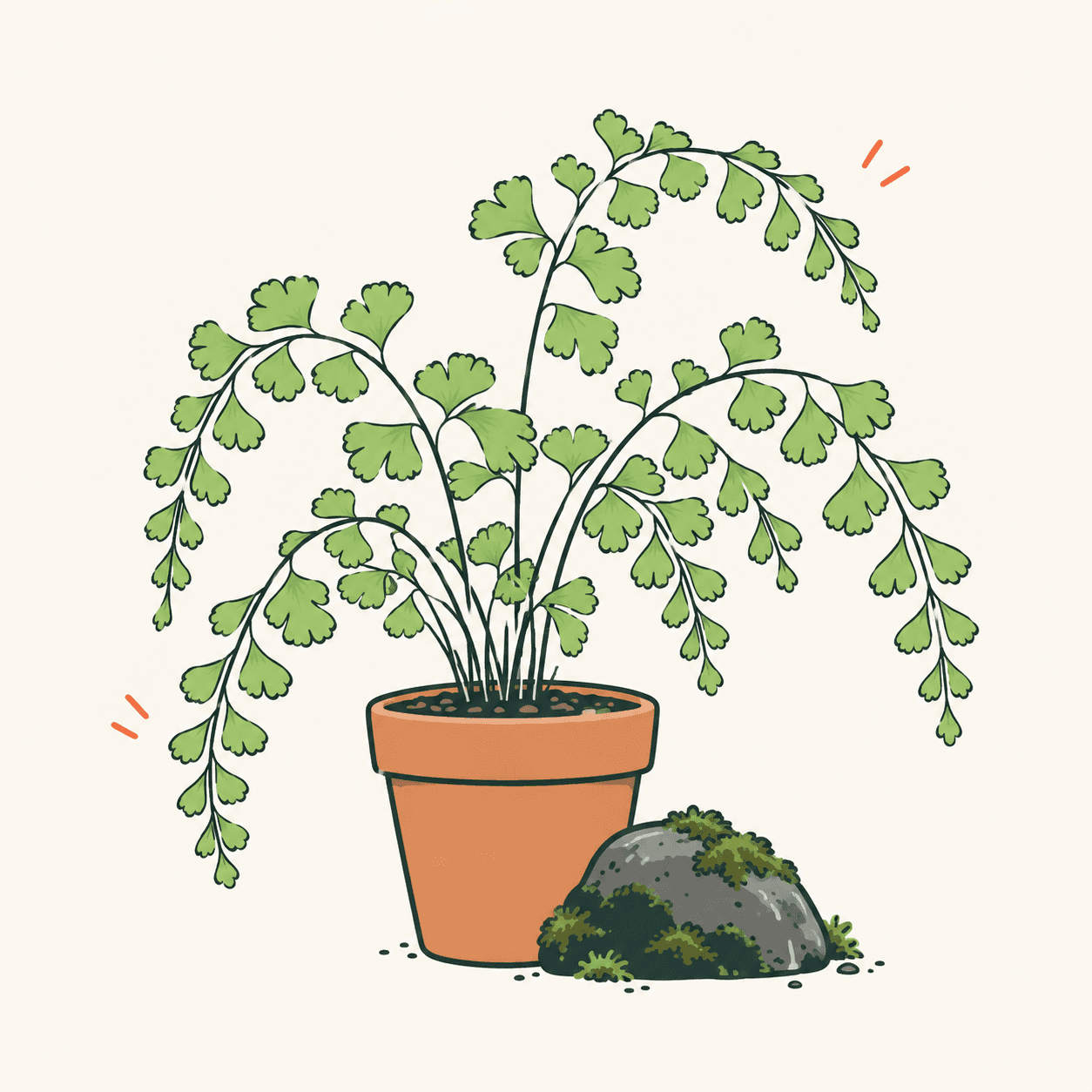
Not every plant builds its story around a flower. Southern maidenhair fern, Adiantum capillus-veneris, is an accepted fern species in Kew’s botanical database and occurs in Italy too. It belongs to the Pteridaceae family. The scientific name helps distinguish this species from other plants called maidenhair ferns. Noticing an attractive shape is a beginning; identifying exactly what we are looking at is a different step. [1]
The Royal Horticultural Society describes arching fronds and slender black supports. A frond is a fern’s leaf; in this species it divides into smaller, fan-like parts. Notice the contrast between green surfaces and dark lines: it is a useful starting point for observation. Colour alone, however, is not enough to identify every specimen, especially when we are looking at a simplified illustration rather than the actual plant. [2]
North Carolina State University’s plant guide explains the central point: this fern produces neither flowers nor fruit. It reproduces through spores. Underneath its small leaf divisions, near their folded edges, are sori: clusters of structures that produce spores. We should not automatically interpret those areas as something that has damaged the leaf. Before judging an unfamiliar detail, it helps to find out what that detail belongs to. [3]
Here is an editorial exercise using a clearly identified botanical photograph. First draw only the dark lines, then add the little green fans. In a second drawing, mark where the source shows the reproductive structures. Add three headings: observed, explained and still uncertain. This notebook is not a competition to find the best artist. It helps us separate what we can see from what we have learned by reading. [3]
Add another question to the notebook: what would we look for if we were used to identifying every plant by its petals? In our example, we could wait for a sign that this fern will never provide. We can change our approach, looking at the fronds, their supports and their undersides instead. With a living plant, observe without tearing off the parts you want to understand. A good photograph can also supply the detail needed for this first exploration. [2]
Kew records a very wide geographical range for this species. That does not mean it grows everywhere or that all ferns are alike. This discovery introduces a few features of one species, not a complete identification key for unknown plants. Our drawing also fails to show the scale of the spores or every stage of reproduction. It is most useful when it opens further questions, rather than pretending to be a complete explanation of the plant. [1]
Take this with youNext time you look at a fern, describe it without searching for petals. Which detail helps you ask a more precise question?
One idea, in simple words
Southern maidenhair is a fern. Its leaves are called fronds and divide into many smaller parts. Some look like little green fans held on thin, dark supports. We do not have to wait for petals to appear before we can learn about this plant. [2]
This fern makes neither flowers nor fruit. It reproduces through spores, tiny units involved in producing new ferns. Underneath the fronds are groups of spore-producing structures called sori. Here is an example from our editors: use a botanical photograph to draw the top and underside of a frond. Where should we look for a flower? Nowhere. Our drawing reminds us to look for other clues. It does not show every stage in the fern’s reproduction. [3]
A little discovery to keep
What did you discover?
Read the sources (3)
- Adiantum capillus-veneris L. Royal Botanic Gardens, Kew · Plants of the World Online · accessed 29 Sept 2026
- Adiantum capillus-veneris Royal Horticultural Society · accessed 29 Sept 2026
- Adiantum capillus-veneris North Carolina State University Extension · accessed 29 Sept 2026
Original writing and illustration made with AI assistance. Our editorial method
More in Plants