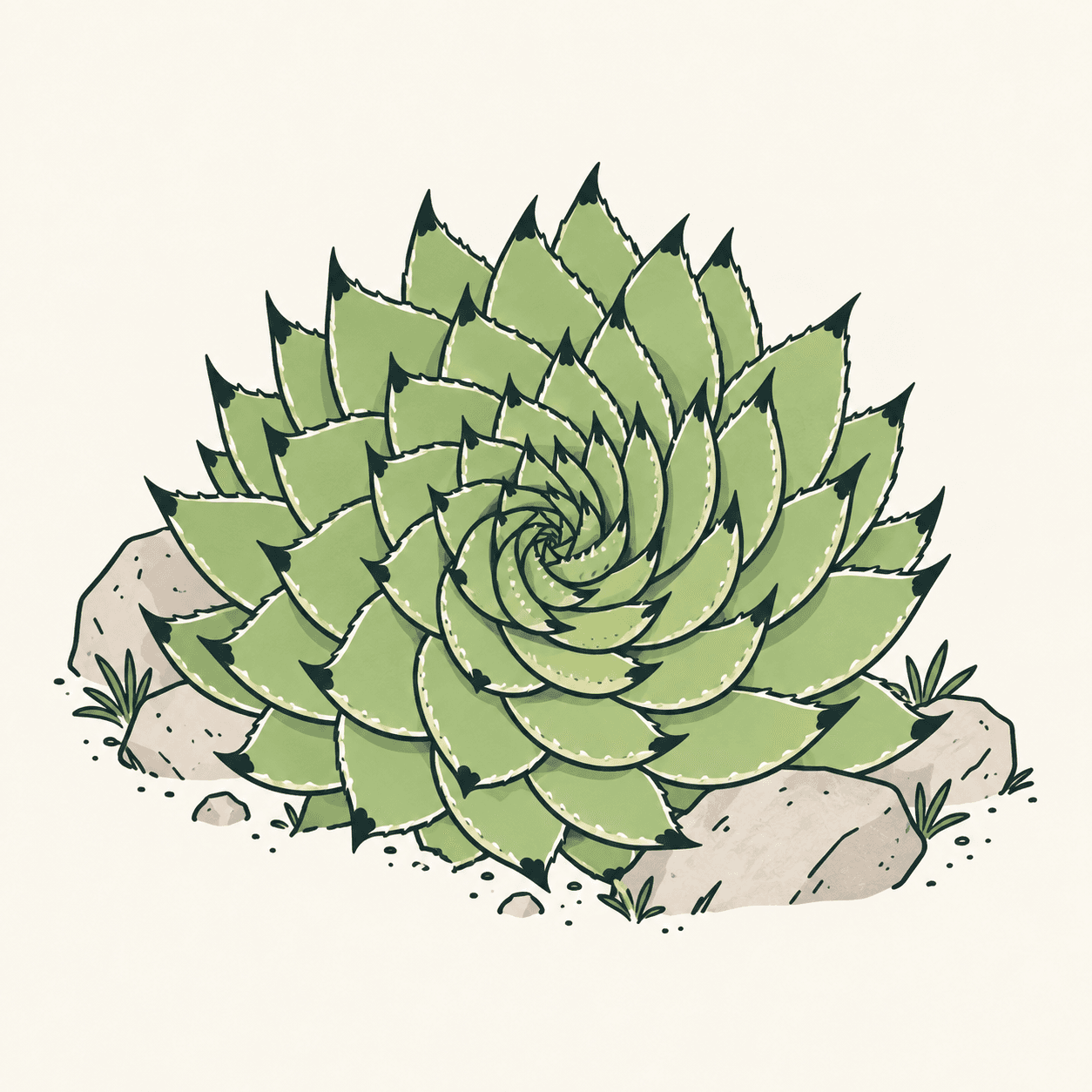
A plant can resemble a geometric drawing and still have a very particular geography. Aloe polyphylla is an accepted species in Plants of the World Online at the Royal Botanic Gardens, Kew. The database places its native range in Lesotho’s Maluti Mountains and classifies it as a succulent perennial in the Asphodelaceae family. Its scientific name lets us follow the same species across sources, without confusing it with any aloe arranged in a rosette. [1]
The Royal Horticultural Society describes a compact evergreen plant whose fleshy leaves form a pronounced spiral. Pale spines line their margins, while each tip ends in a brown spine. Tubular flowers appear on a branching flower spike. These details help us read the structure: the decorative effect is not a flat surface, but an arrangement of separate leaves that overlap and end in points. [2]
SANBI’s botanical account explains that the spiral can turn clockwise or anticlockwise. It also describes a setting unlike the desert we may imagine for many succulents: steep mountain slopes, crevices among basalt rocks, cool summers and mist. Summer water and good drainage coexist. Looking only at symmetry would therefore leave out an essential part of the plant’s natural history. [3]
A garden photograph also tells a different story from a wild population. In his 2015 account for Denver Botanic Gardens, curator Panayoti Kelaidis observed the contrast between rarity in the wild and growing availability in cultivation. This is a dated observation, not a 2026 census. It nevertheless helps us frame the right question: seeing many specimens for sale does not, by itself, tell us how the species is doing in its habitat. [4]
Here is an exercise devised by our editorial team. Take a botanical photograph from above and, without immediately looking for a formula, follow five successive leaves with your eyes. Then compare it with a side view: which overlaps become visible? Which tips were hidden? Draw two small diagrams, leaving gaps wherever you cannot see clearly. This method does not demonstrate a particular mathematical law: it separates observation from details supplied by your imagination. The illustration on this page is also an editorial interpretation, not a scientific measurement of the rosette. [2][3]
Take this with youWhen a plant catches your eye because of its shape, add its name and place of origin to your description. Then choose one detail to examine more closely: recognising a spiral is only the beginning.
Read the sources (4)
- Aloe polyphylla Schönland ex Pillans Royal Botanic Gardens, Kew · Plants of the World Online · accessed 17 Sept 2026
- Aloe polyphylla: many-leaved aloe Royal Horticultural Society · accessed 17 Sept 2026
- Aloe polyphylla South African National Biodiversity Institute · PlantZAfrica · accessed 17 Sept 2026
- The Spiral Aloe perplex Denver Botanic Gardens · accessed 17 Sept 2026
Original writing and illustration made with AI assistance. Our editorial method
More in Plants