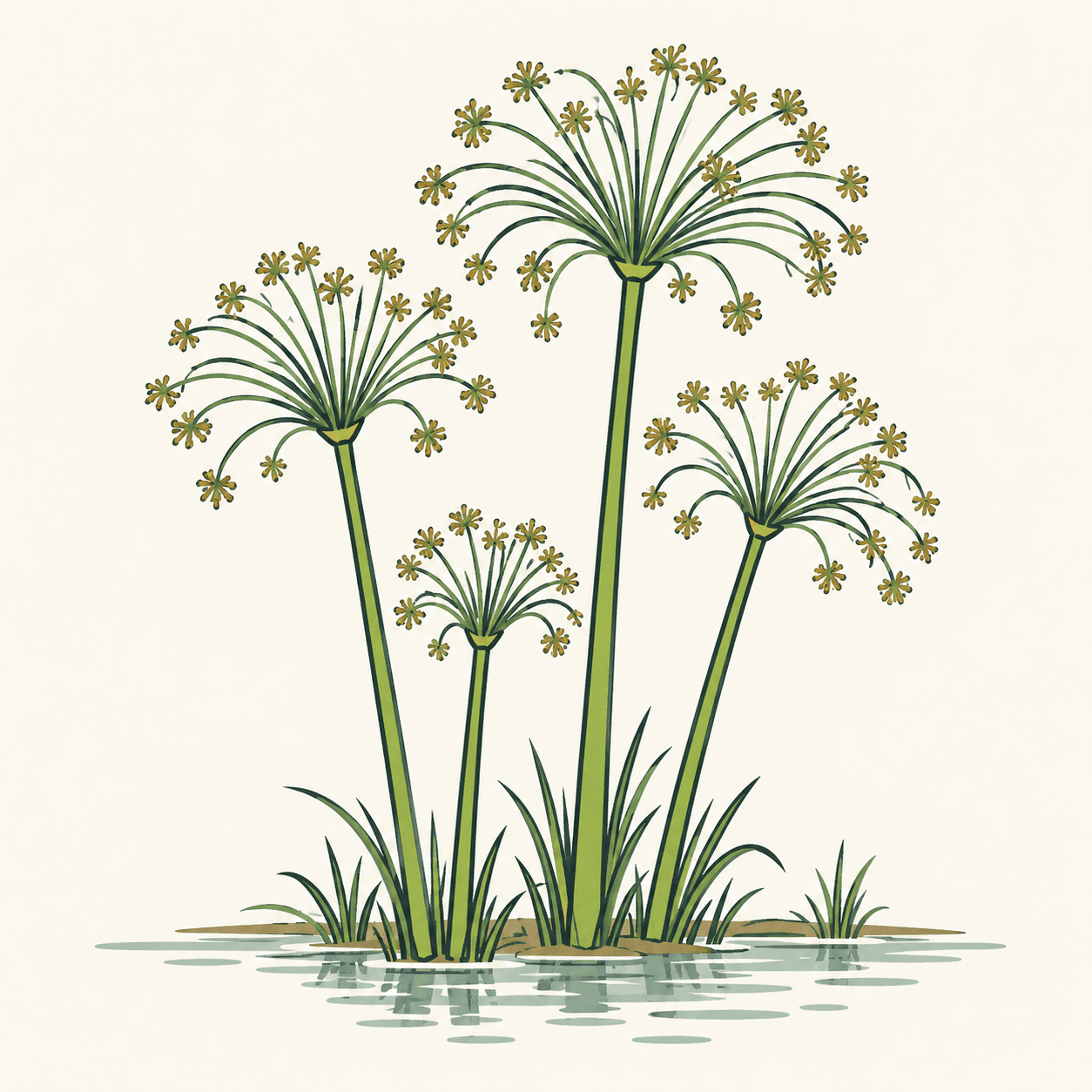
Say papyrus and an ancient document may immediately come to mind. Before the document, however, there is Cyperus papyrus: a plant in the Cyperaceae family, recognised as an accepted species by Kew's Plants of the World Online. Its habitats include swamps and the edges of fresh water. Starting with the living plant lets us follow the material without imagining that ready-made sheets grow at the tops of its stems. [1]
Its most recognisable feature is the large inflorescence at the end of the stem: an airy structure with many slender rays. The stems can have a triangular cross-section and do not carry a sequence of large leaves along their entire length. Kew's botanical descriptions distinguish stems, sheaths, rays and small spikelets. The tuft that seems like a single object from a distance therefore contains different parts, with different names and roles. [1]
To reach the writing material, we need to look mainly inside the stem. The Metropolitan Museum of Art describes pale, spongy pith from which strips were cut. Arranged in layers and dried under pressure, these formed a writing surface. The fine rays at the top did not directly become the sheet: the useful material came from a different part of the plant. [2]
The University of Michigan Library explains a detail that can also be sought in photographs of surviving objects: the two layers were laid crossways. Fibres therefore run in one direction on one side and in the other direction on the reverse. A document preserves a trace of the work needed to prepare it, alongside the words somebody wrote. This is our suggested way of looking, based on the description of the technique. [3]
Here is an editorial exercise that needs no collecting or cutting of plants. Draw three boxes on a sheet: the whole plant, a section of stem and a small fragment of the finished material. Beside them, write what you observe directly and what you have learnt from sources. A photograph of the whole plant, for example, does not reveal its internal organisation by itself. Keeping two columns helps avoid confusing a mental reconstruction with a detail that is actually visible. [1][3]
The name requires care too. The living papyrus, the prepared material and the written document represent three connected but distinct stages. The Met's examples include letters and administrative records: the material supported different uses. Our final question is practical: when admiring an ancient text, can we also see the plant transformation and human work that gave it a surface? [2]
Take this with youLook at a photograph of an ancient papyrus and seek the direction of its fibres. Return to the plant image: which part connects the two objects?
One idea, in simple words
Papyrus is not only an ancient document. It is also a plant, called Cyperus papyrus, that grows in wet places. It has long stems and large tufts with many thin rays. The botanical name helps us know exactly which plant we mean, even when we are only looking at a photograph. [1]
People made the writing material from the pith, the inside of the stem. They divided it into strips, arranged them in two crossing layers and pressed them. The tufts at the top did not directly become sheets. Imagine an editorial example: lay paper strips in one direction and others across them. This model helps you picture the crossing layers, but does not reproduce the whole ancient papyrus-making process. [2][3]
A little discovery to keep
What did you discover?
Read the sources (3)
- Cyperus papyrus L. · General information Royal Botanic Gardens, Kew · Plants of the World Online · accessed 5 Oct 2026
- Papyrus in Ancient Egypt The Metropolitan Museum of Art · accessed 5 Oct 2026
- Papyrus: the Paper of the Ancient World University of Michigan Library · accessed 5 Oct 2026
Original writing and illustration made with AI assistance. Our editorial method
More in Plants