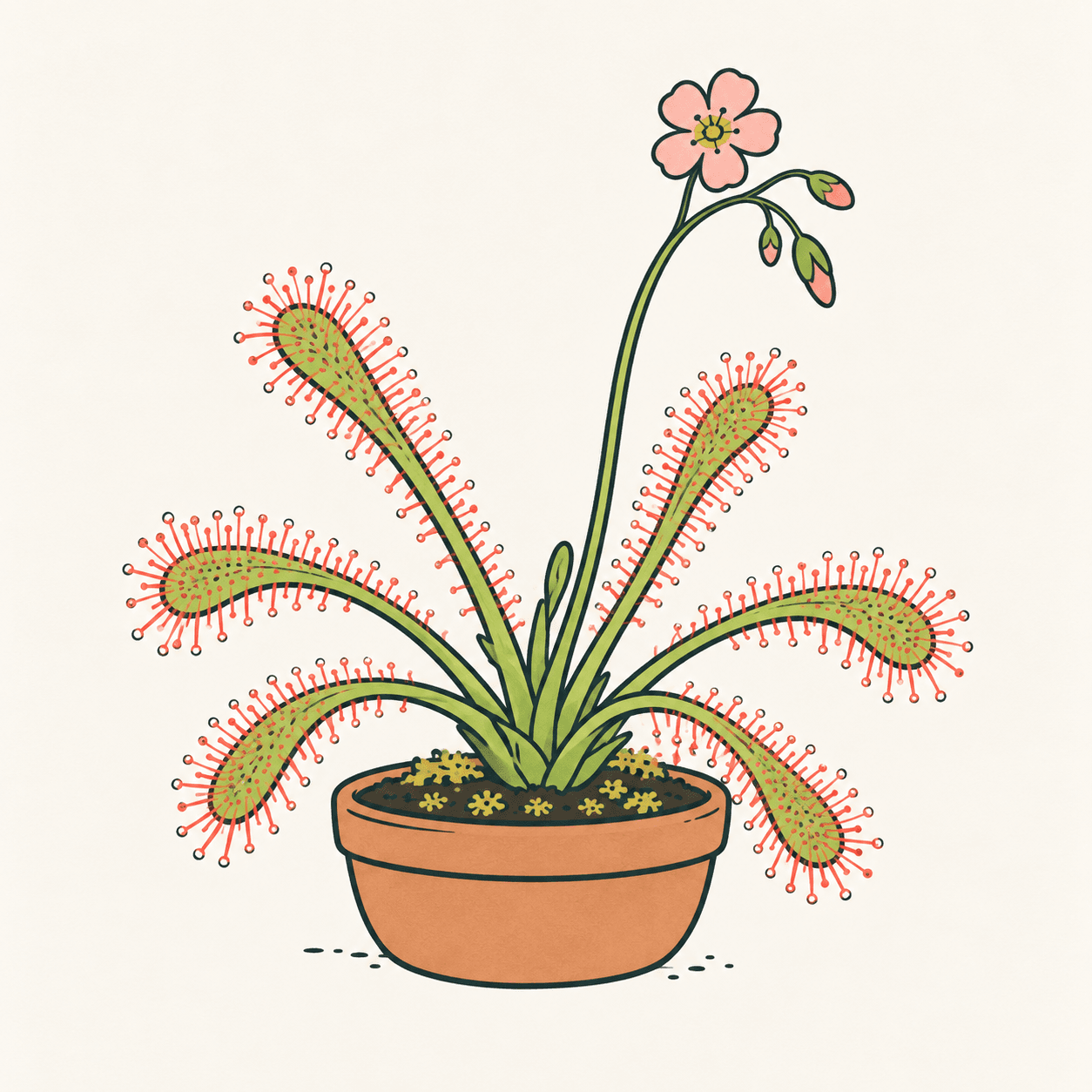
Drosera capensis appears to wear tiny pearls. These are not raindrops that happened to settle there: they are secretions made by glands on the leaves. The Royal Horticultural Society describes long, narrow, spoon-shaped leaves arranged in rosettes and covered in red or pink glandular hairs. These structures help capture and digest insects. Their bright appearance belongs to a working part of the plant, rather than a decoration. [1]
The scientific name identifies a particular species accepted by Kew’s Plants of the World Online catalogue. Its native range lies in South Africa’s Cape region. This detail helps distinguish Drosera capensis from other sundews. Sharing a botanical genus does not mean plants have identical leaves, distributions or characteristics. In a nature investigation, knowing the plant’s full name can be just as useful as having a clear photograph. [2]
Kew explains the general mechanism of sundews: tiny tentacles carry a sticky substance. An insect caught on them may be enclosed by structures that respond to its movement. Digestive enzymes, substances that break down biological material, then make nutrients available for the plant to absorb. The sequence is capture, digestion and absorption. There is no mouth with teeth, so adding one to a drawing would explain the wrong mechanism. [3]
Here is a comparison invented by our editors. Imagine sticky tape that could not only hold a tiny crumb but also recover some substances from it. The comparison explains adhesion and recovery only. A living leaf has glands and carries out chemical processes that tape cannot perform. Analogies are most useful when we explain where they stop working, instead of turning a helpful comparison into a literal account of nature. [3]
The RHS description also includes pink flowers. The specialised leaf, rather than the flower, is the part that catches prey. When observing a specimen or botanical image, we can therefore look for three separate features: the rosette, droplets on the hairs, and flowers. Carnivorous plants do not all use the same device. Identifying the actual structure prevents us from confusing every species with the famous snapping trap of the Venus flytrap. [1][3]
An activity from our editors: draw two boxes, one for what you can see and one for what you know from sources. Narrow leaves and shiny dots belong in the first box. The fact that glands produce an adhesive substance belongs in the second. A photograph alone does not demonstrate every stage of digestion. Separating observation from explanation is useful even when a plant seems to belong in a fantasy story. [1][3]
Take this with youNext time a plant surprises you, identify the part doing the work: leaf, flower or root. An accurate detail teaches more than an imaginary monster.
One idea, in simple words
Drosera capensis is a plant with long, narrow leaves. Tiny hairs on the leaves have glands: parts that produce a substance. Here that substance is sticky and forms shiny droplets. When an insect lands on a leaf, it can become stuck. The leaf acts as a trap. It is not a mouth with teeth. [1][3]
In sundews, substances called enzymes help break down the prey after it is caught. The plant can then absorb nutrients, materials useful for living. Imagine sticky tape that could also recover something from whatever it held. That is an example from our editors, not a full description: tape is not alive. The pink flowers of Drosera capensis have a different role from the leaves that catch insects. [1][3]
A little discovery to keep
What did you discover?
Read the sources (3)
- Drosera capensis — Cape sundew Royal Horticultural Society · accessed 23 Sept 2026
- Drosera capensis L. Royal Botanic Gardens, Kew · Plants of the World Online · accessed 23 Sept 2026
- Carnivorous plants explained: Venus flytraps, pitcher plants & more Royal Botanic Gardens, Kew · accessed 23 Sept 2026
Original writing and illustration made with AI assistance. Our editorial method
More in Plants