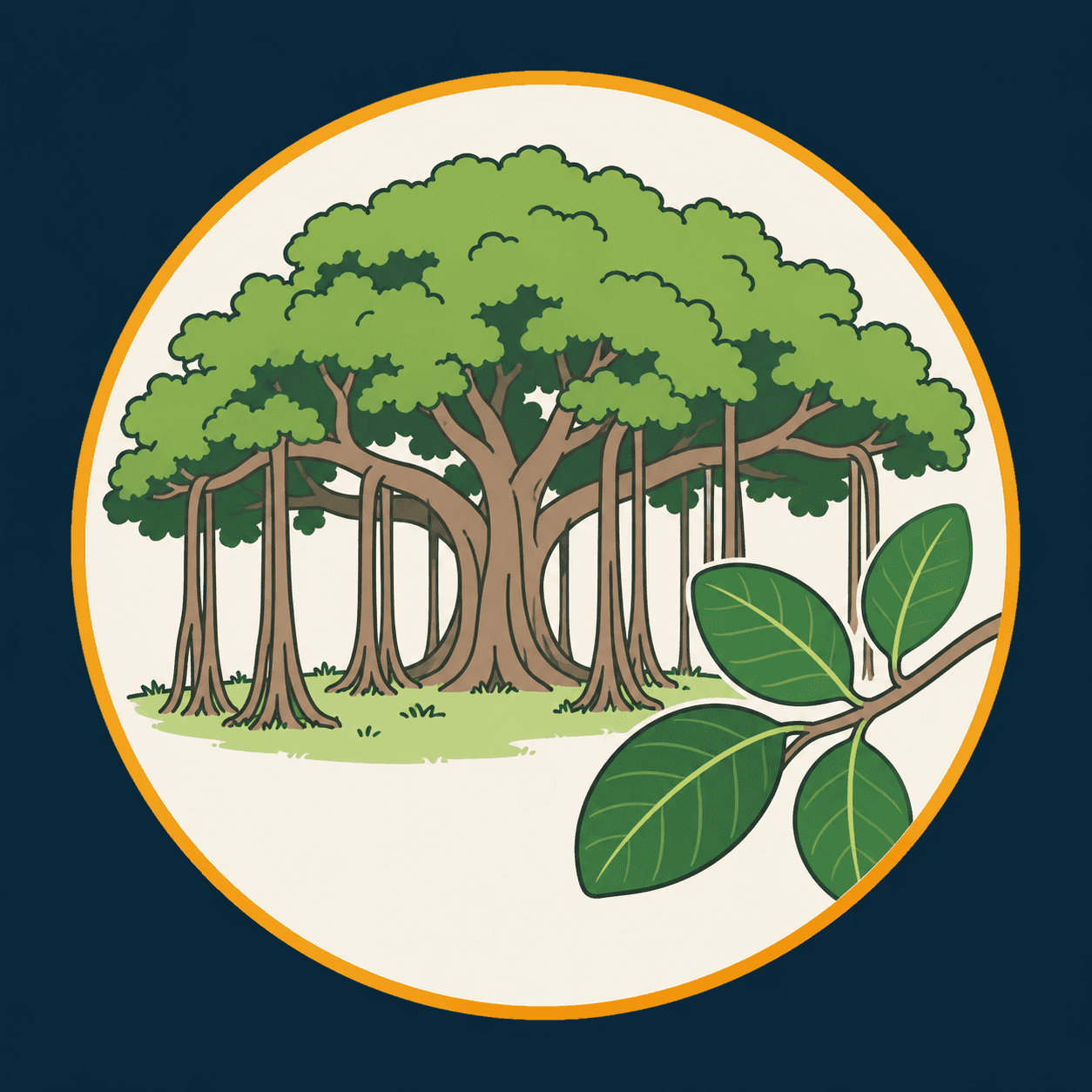
From a distance, a large banyan can suggest several trees standing close together. Follow the connections overhead and the scene changes: some of those columns belong to the same structure. Ficus benghalensis produces aerial roots that hang from branches and become woody when they reach the ground. NParks describes this transition. The interesting question is how a tree can create new supports some distance from its original trunk. [1]
The scientific name helps identify our subject precisely. Plants of the World Online, the Royal Botanic Gardens, Kew database, accepts Ficus benghalensis as a species in the Moraceae family and places its native range in the Indian subcontinent. Its record separately lists places where it has been introduced. Finding a specimen in another country therefore does not mean that you have discovered its place of origin. [2]
HortFlora, published by Royal Botanic Gardens Victoria, describes a broad canopy supported by a system of trunk-like aerial roots. It also notes the oval or elliptical leaves. When observing the tree, connect its overall form with individual details: follow a root towards a branch, then look for a leaf. Comparing the supports to columns makes them easier to picture, but remains our metaphor: the tree grows rather than assembling parts designed by an architect. [3]
Here is an editorial example using a drawing, without interfering with a plant. Draw a broad canopy, a central trunk and two sideways branches. From one branch, draw a line down to the ground; from the other, stop halfway. Make the first line thicker. Now show someone the drawing and ask them to follow the connections before counting trees. The model distinguishes a root still hanging in the air from a support that has reached the ground. It neither describes growth times nor measures the strength of the structure. [1][3]
There is also a less obvious beginning. The University of Florida describes seeds carried by animals into the crowns of other trees. They can germinate there, initially growing on a host and sending roots downwards. Their growth may eventually envelop and kill the host tree. This makes the banyan a strangling fig. The reassuring image of a green roof does not tell the whole story of the plant’s relationships with its surroundings. [4]
A documented example, separate from our drawing, is the Ficus benghalensis listed by NParks as a Heritage Tree in Tiong Bahru Park, Singapore. A record about one individual specimen connects the species with a specific place. Our illustration instead simplifies the connections to explain the phenomenon: it is not a measured record of that tree. Even when a shape seems familiar, it is useful to ask what we are observing and what we are only imagining. [5]
Take this with youFollow one connection at a time when looking at a complex structure: apparently separate parts may belong to the same tree.
One idea, in simple words
Ficus benghalensis is the scientific name of the Indian banyan. This tree comes from the Indian subcontinent. Its aerial roots begin above the ground and descend from branches. When they reach the soil, they can become woody. A root that looks like another trunk can therefore belong to the same tree. [2][1]
These supports hold up a very broad canopy. The leaves are oval or elliptical, meaning like a stretched oval. Here is our editorial example: draw a branch and a root going down to the ground. Follow the line to see the connection. This is a simple model, not a measurement of growth. The banyan can also begin growing on a host tree and wrap its roots around it. [3][4]
A little discovery to keep
What did you discover?
Read the sources (5)
- Ficus benghalensis L. National Parks Board, Singapore · accessed 3 Oct 2026
- Ficus benghalensis L. Royal Botanic Gardens, Kew · Plants of the World Online · accessed 3 Oct 2026
- Ficus L. — Horticultural Flora of South-eastern Australia Royal Botanic Gardens Victoria · accessed 3 Oct 2026
- Ficus benghalensis — Banyan tree University of Florida, IFAS · accessed 3 Oct 2026
- Indian Banyan (HT 2013-204) National Parks Board, Singapore · accessed 3 Oct 2026
Original writing and illustration made with AI assistance. Our editorial method
More in Plants