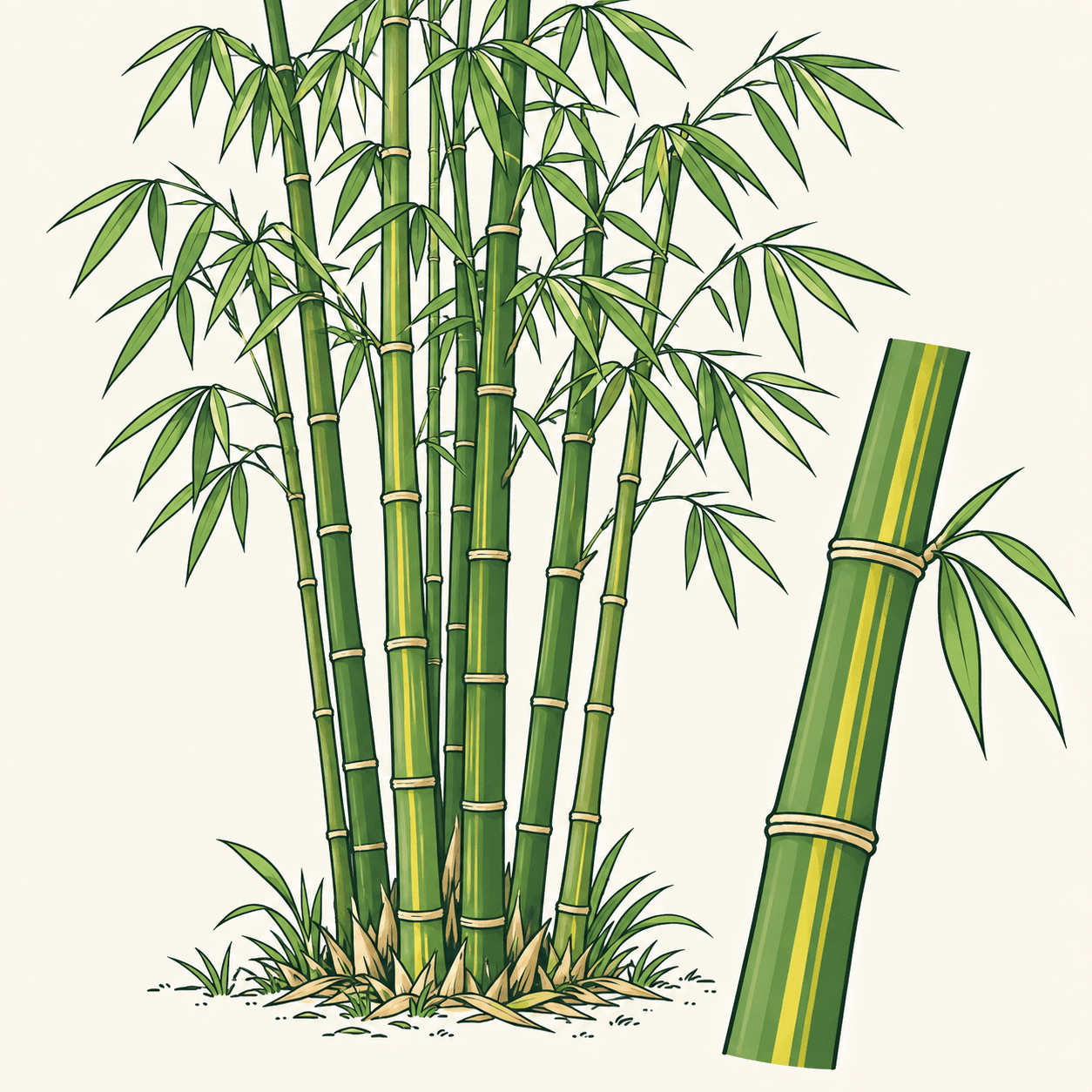
Gigantochloa verticillata is a tropical bamboo that Kew places in Poaceae, the grass family. It forms clumps of woody stems, called culms, with recognisable nodes and narrow, pointed leaves. Its impressive shape may suggest a tree, but its classification describes a different botanical relationship. Height alone is not enough to establish that relationship or identify the plant. [1]
Kew’s bamboo garden includes species with different appearances, including different leaf shapes and sizes. We are therefore not describing one identical bamboo that fits every photograph. Here is an editorial example: put two drawings beside each other, one with narrow leaves and another with broad leaves. Before assigning names, leave an empty space for the things you do not yet know. [2]
Our suggested observation exercise starts with the illustration: follow a single stem with your finger from its base upwards. Mark where you see a node and where a leaf begins. Compare the drawing with a photograph carrying a reliable botanical name. If a detail differs, do not change the photograph to make it match the illustration. Note the difference and look for a more useful description. [1]
A 2018 account by the manager of Kew’s arboretum describes a collection developed through introductions and garden observations. It explains that different bamboos need different conditions, including light. This sets an important limit to our reading: recognising a family does not automatically provide growing instructions for every species, climate or balcony. We are learning to observe, rather than prescribing a plant to buy. [3]
A second editorial example: imagine a catalogue organised only by height. Every tall plant would go into one drawer and every small plant into another. Write a different question on each drawer: how are the leaves arranged? What name appears on the label? Which details are missing? Our imaginary catalogue shows one choice of organisation. It does not replace botanical work or identify a plant collected outdoors. [2][1]
For a notebook page, we suggest three boxes: “I can see”, “I read in the source” and “I need to check”. Draw an outline in the first, record only the species name and family in the second, and write a question in the third. Our editors invented this activity to separate impressions from information. No leaves need picking or stems cutting: photographs and reference pages let us leave the plant and its surroundings undisturbed. [1][3]
Take this with youThe surprise is not just its size: a tree-like appearance does not remove this bamboo from the grass family.
One idea, in simple words
Gigantochloa verticillata is a large bamboo in the grass family. Its woody stems are called culms. Being tall does not automatically make it a tree. Its name helps us find the right plant description. [1]
Bamboos have different appearances and leaves. That means saying “it is big” is not enough to recognise a species. Try this activity invented by our editors: look at a picture and draw just the outline of the stem and leaves. Then compare it with a botanical reference, which describes the plant. Use two colours for what you observed and what you read. Leave a question mark beside any missing detail. Looking carefully includes knowing when we do not yet have an answer. [2]
A little discovery to keep
What did you discover?
Read the sources (3)
- Gigantochloa verticillata (Willd.) Munro Royal Botanic Gardens, Kew — Plants of the World Online · accessed 1 Oct 2026
- Bamboo Garden and Minka House Royal Botanic Gardens, Kew · accessed 1 Oct 2026
- Bamboos – from Victorian curiosity to elephant food Royal Botanic Gardens, Kew · accessed 1 Oct 2026
Original writing and illustration made with AI assistance. Our editorial method
More in Plants