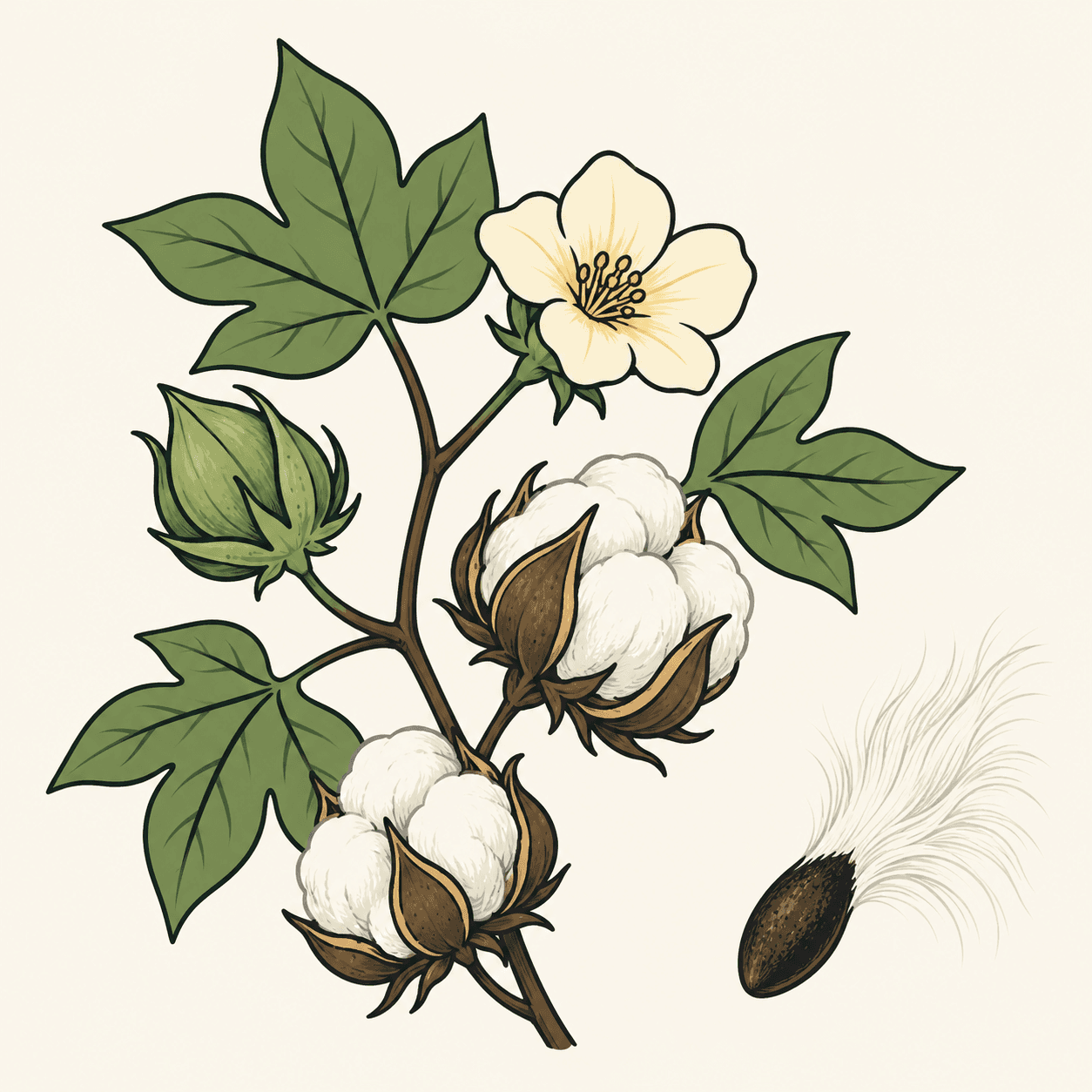
A cotton branch with its pale tufts looks as though it carries soft flowers. Yet the part we are interested in is not a ring of petals. In the botanical descriptions of Gossypium hirsutum gathered by Kew, cotton consists of hairs attached to seeds. Those seeds sit inside capsules, fruits divided into several compartments. The fluffy tuft we see therefore belongs to the seed’s story, rather than the petals’ story. [1]
The flower exists, and it is different. The University of Texas botanical account describes five pale petals that may become pinkish, together with leaves divided into lobes. It also describes the ripe capsule: as it opens, its hard sections allow the tufts to project outwards. Our illustration places a flower, a closed fruit and an open fruit together to clarify the difference. It does not claim that every branch always carries all these stages simultaneously. [2]
North Carolina State University describes this species as variable in its growth, and commonly cultivated as an annual. In its account, the fruit changes from green to brown and contains seeds with both long and short fibres. These observations help us read an image: a green ball, an open flower and a white tuft are not three colours of the same part. They indicate different structures or different stages. [3]
An editorial example: draw three separate panels. Put a flower in the first, a closed capsule in the second, and an open capsule with a seed and its hairs in the third. Connect the panels with arrows and write down what you observed in the sources. To show where the hairs attach, enlarge the seed and label the enlargement. Do not draw a tuft growing straight out of a petal: that would change the explanation. [2][3]
Details require care too. Kew brings together accounts from different floras, whose descriptions of size and appearance may vary; the Texas source describes plants in its own region. We should not extract a universal measurement from our drawing. Instead, choose features consistent across the sources: lobed leaves, flowers distinct from capsules, and hairy seeds. An educational illustration helps reveal relationships, but does not replace a botanical identification key. [1][2]
A second editorial exercise: look at a T-shirt and ask which plant part might have supplied its fibre, without guessing from colour alone. Read the label to find the declared material, then return to the drawing of the seed. This is an invitation to connect an everyday object with a plant origin. It is not a test of the fabric’s composition, the farm it came from, or its environmental impact. [3]
Take this with youWhen you look at cotton on a branch, find the open fruit: the white fluff tells the story of seed hairs, not a flower.
One idea, in simple words
The white fluff on a cotton plant is not made of petals. In Gossypium hirsutum, it consists of hairs growing on seeds. The seeds sit inside a capsule, a fruit with compartments. As the ripe capsule opens, the fluffy parts become visible. The plant also has real flowers. These have pale petals and look different from an open cotton fruit. [1][2]
Here is our editorial example: draw a flower, a closed green capsule and an open brown capsule in three boxes. Put a seed with hairs inside the last one. This helps show which part carries the cotton. Leaves have several lobes, like broad points joined together. Plants can vary, so a drawing cannot give every exact size. Our enlarged seed is an illustration to explain the connection. [3][1]
A little discovery to keep
What did you discover?
Read the sources (3)
- Gossypium hirsutum L. — General information Royal Botanic Gardens, Kew · Plants of the World Online · accessed 2 Oct 2026
- Vascular Plants of Williamson County: Gossypium hirsutum University of Texas at Austin · A. C. Gibson · accessed 2 Oct 2026
- Upland Cotton — Gossypium hirsutum North Carolina State University · Extension Gardener Plant Toolbox · accessed 2 Oct 2026
Original writing and illustration made with AI assistance. Our editorial method
More in Plants