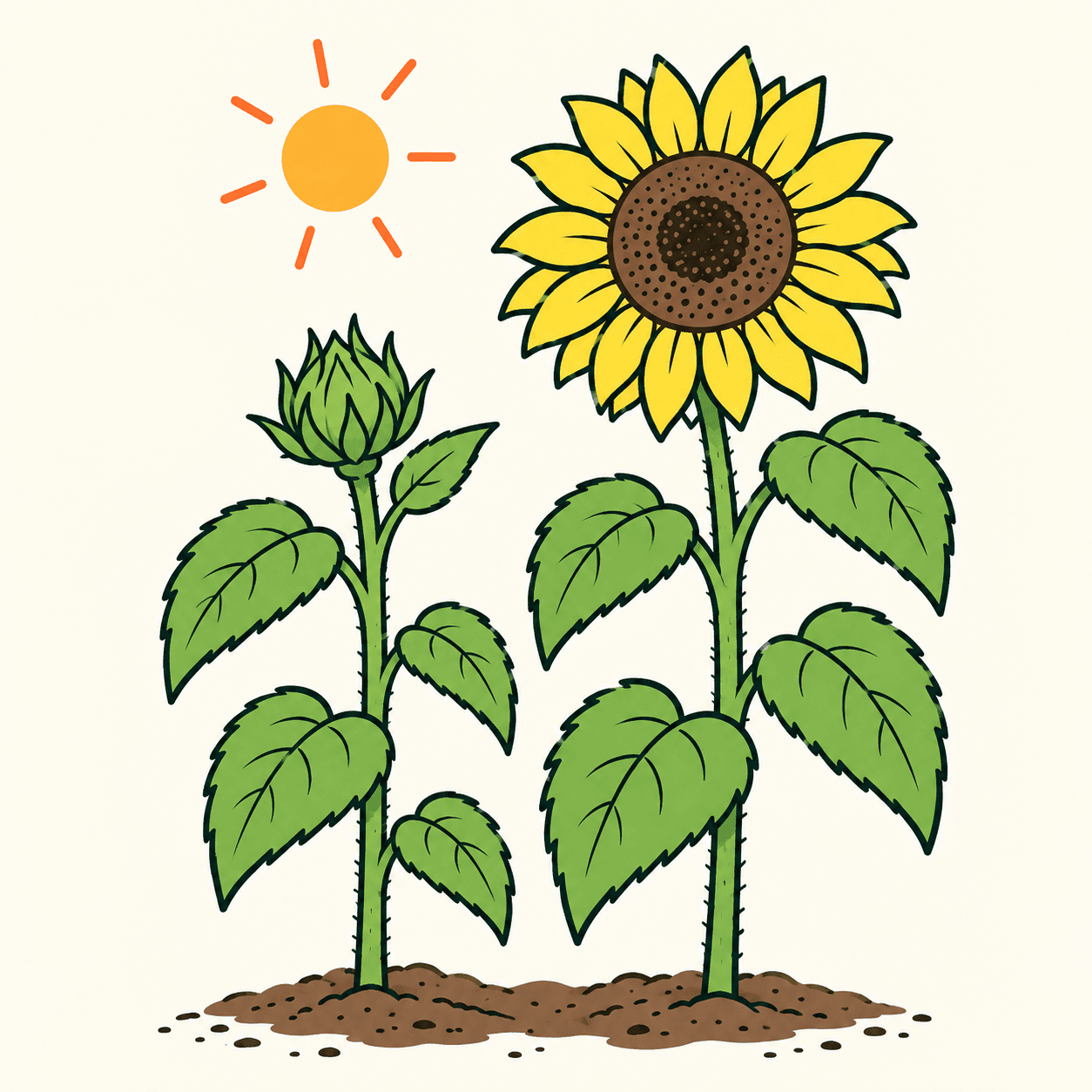
In young sunflowers studied at UC Davis, the stem grows differently on its two sides: the head tracks the sun during the day and returns east at night. An internal rhythm of roughly twenty-four hours, called a circadian rhythm, contributes to the movement. It is growth, not a plant making a decision. [1]
Make a prediction in this editorial exercise. Draw three boxes on paper: one for morning, one for afternoon and one for the following day. Put an arrow in each before reading the explanation. Then use another colour for corrections. The difference between the colours preserves an interesting question: did we think the plant had to wait for sunlight before preparing for morning? [1]
As the head matures, this movement decreases and its orientation settles towards the east. In experiments described in 2021, east-facing heads warmed earlier in the morning and attracted more bees. Researchers compared pots facing different directions: orientation was a variable to test, not merely a pleasing photograph. [2][1]
We suggest an observation diary, if you can watch sunflowers without touching them or entering somebody else’s field. Choose a place you can return to and note the time, clouds, and whether you see buds or open heads. If you cannot return, simply write “observation missing”. Do not fill the box with the result you expected. That is our workshop’s choice: distinguish what was seen from the picture we imagined. [2]
A 2023 study compared plants grown indoors and outside. It found different gene activity and left the identification of genes responsible for sun tracking unresolved. A gene is a stretch of biological instructions. Knowing that a behaviour exists therefore does not mean every step has been explained. [3]
Our diary can have two further columns: “I observed” and “I want to understand”. In the first, write the direction you actually checked. In the second, ask why one plant differs from its neighbour. A single visit is not enough to turn that difference into a general rule. This editorial suggestion is meant to slow a hasty conclusion: a careful drawing, a time and a question can be an excellent beginning without a complete answer. [3]
Take this with youBefore saying “sunflowers do this”, check the plant’s stage and separate what you observed from what you expected.
One idea, in simple words
A young sunflower can follow the sun during the day. As it matures, its head stops turning and settles towards the east, where the sun rises. In experiments, that position helped heads warm early and attract bees. [2]
Our editors suggest making a diary. Draw a bud and an already open head in two different boxes. They are not the same plant stage. Leave space below each for the direction you observed and the time. If you can watch plants from a public path without touching them, fill the boxes with what you see. Leave missing information blank. Your diary does not need to prove you were right at all costs. It should help you ask better questions. [2]
A little discovery to keep
What did you discover?
Read the sources (3)
- Sunflowers Move by the Clock University of California, Davis · accessed 22 Sept 2026
- Why Sunflowers Face East University of California, Davis · accessed 22 Sept 2026
- How Sunflowers See the Sun University of California, Davis · accessed 22 Sept 2026
Original writing and illustration made with AI assistance. Our editorial method
More in Plants