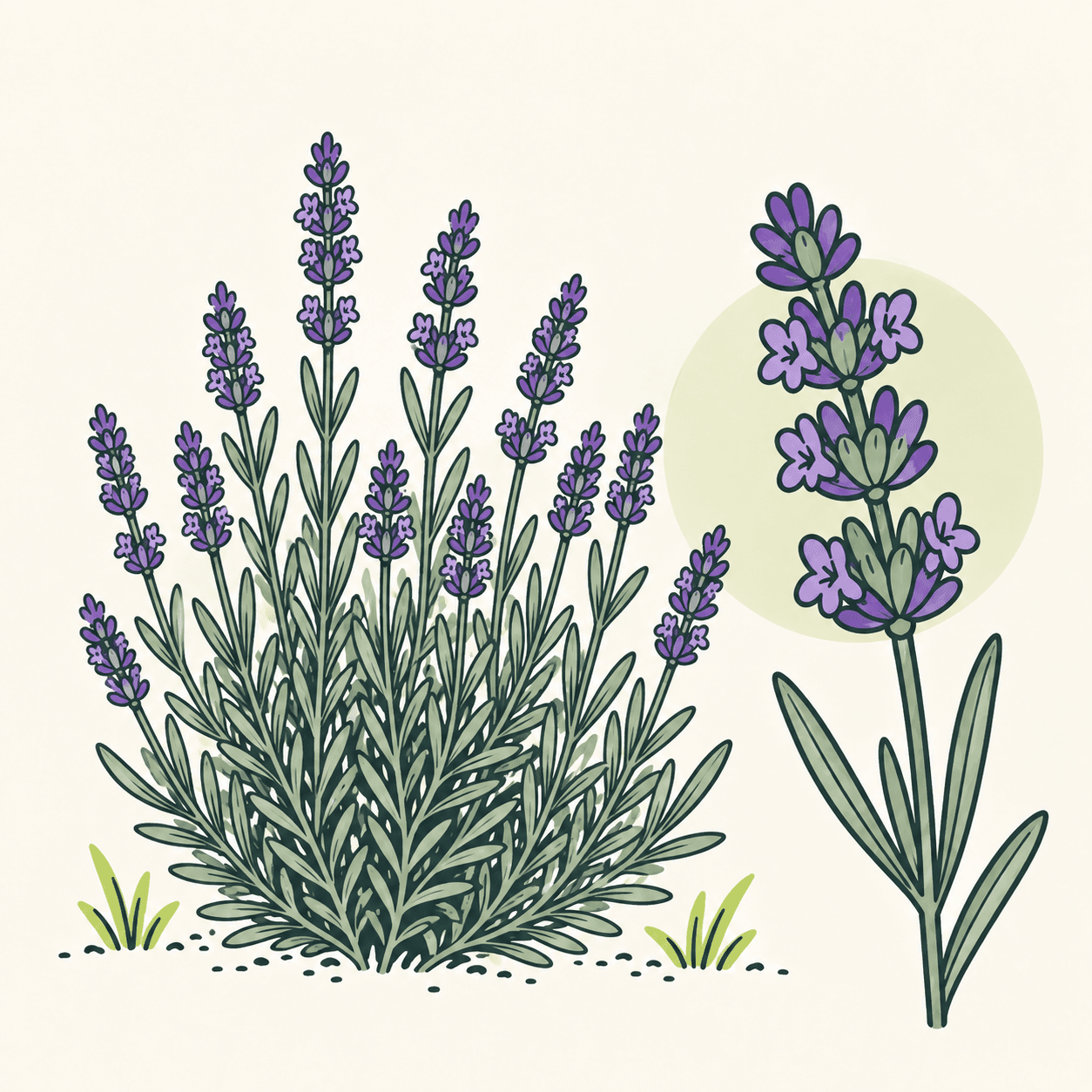
At first glance, it looks like a purple paintbrush. Look more closely and lavender’s flowering head reveals many tiny flowers grouped along a stem. The Royal Horticultural Society describes Lavandula angustifolia as having narrow grey-green leaves and short, dense flower spikes on long, unbranched stalks. Here is our discovery: a patch of colour seen from a distance can be a collection of different parts, which we can observe one at a time. [1]
The scientific name helps identify which lavender we mean. Kew’s Plants of the World Online accepts Lavandula angustifolia as a species and gives its native range as north-eastern Spain to Italy. It belongs to the Lamiaceae family and is a small shrub. It is also called English lavender, but a common name is not a certificate of origin: a plant’s geography needs checking rather than guessing from a familiar label. [2]
The RHS guide to English lavenders notes that cultivated varieties may carry pink or white flowers as well as purple ones. It also describes their appeal to bees and butterflies. For our portrait, we choose purple flowers without turning that choice into the only possible appearance. An illustration can highlight characteristics, while the actual plant may display variations that the drawing does not show. A useful picture is still a selective representation. [3]
Here is a notebook exercise invented by our editors. First draw only the outline of a shrub you can observe in a garden, without picking any part of it. In a second box, draw one stem; in a third, enlarge what you can distinguish in the flower spike. If a detail is too small, write that you cannot see it. An empty space may be more accurate than a petal invented to finish a picture that looks incomplete. [1]
Then add two columns: what you observe and what you need to check. The colour visible today belongs in the first; the species name, without a reliable label, belongs in the second. This distinction is the point of our exercise. A familiar smell does not settle every question, and our drawing must not become a confident identification of an unknown plant. We are practising attention, rather than gathering ingredients to taste or offering instructions for using them. [2]
Finally, observe the same plant on another occasion and compare your drawings. Have you changed your distance? Does the light make the grey in the leaves easier to see? Are there parts you previously overlooked? These are questions from our editors, not results decided in advance. There is no need to fill every page with difficult terms. Choose one detail, describe it carefully, and say what remains uncertain. Even a small shrub can teach us to ask better questions. [3]
Take this with youWhen looking at a plant, separate what you can see from what you think you know. One carefully observed detail is worth more than a hurried name.
One idea, in simple words
The lavender called Lavandula angustifolia has narrow grey-green leaves. What looks like one purple flower from far away is a spike: a group of tiny flowers. The stems holding these spikes rise above the leaves. Not every variety has the same colour. Some have pink or white flowers instead. [1][3]
Try this activity from our editors. Look at lavender in a garden without picking its leaves or flowers. First draw the whole shrub, then one stem and finally a flower spike. If something is too small to see, leave it for another check. You do not have to invent the detail. Careful observation includes noticing what you still do not know. The drawing is for learning, not for deciding whether a plant is safe to eat. [1]
A little discovery to keep
What did you discover?
Read the sources (3)
- Lavandula angustifolia Royal Horticultural Society · accessed 28 Sept 2026
- Lavandula angustifolia Mill. Royal Botanic Gardens, Kew — Plants of the World Online · accessed 28 Sept 2026
- English lavender Royal Horticultural Society · accessed 28 Sept 2026
Original writing and illustration made with AI assistance. Our editorial method
More in Plants