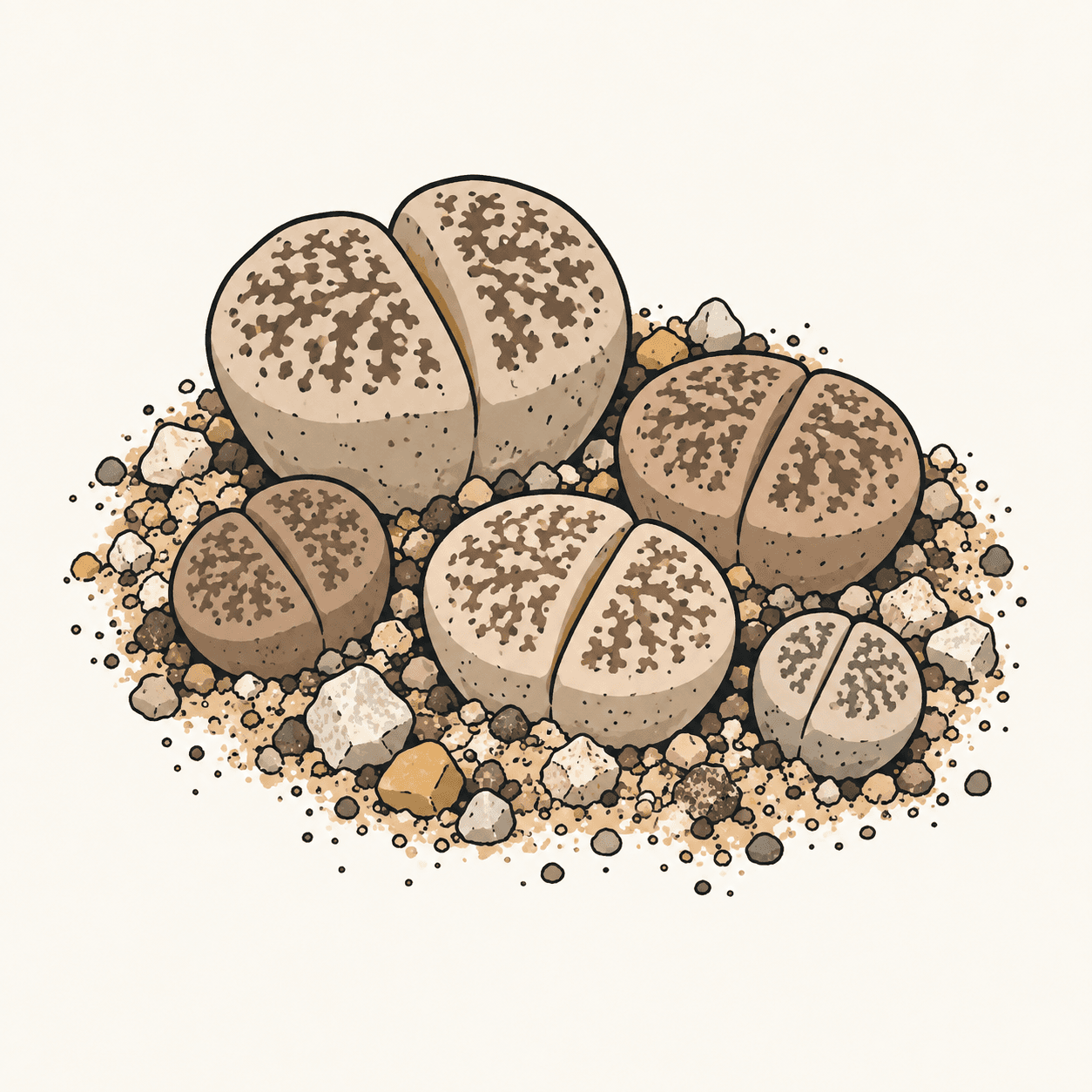
Lithops are small southern African succulents known as living stones. The University of Wisconsin describes two fleshy leaves joined at the base and separated at the top by a fissure; much of the body remains below ground in their habitat. Their shapes and colours can blend with the stony landscape. We are not looking at a pebble with a plant emerging from it: that compact pair is already the leafy part of the plant. [1]
Here is the central discovery: the leaves have translucent areas through which light can enter. The Science & Plants for Schools resource describes them as windows towards chloroplasts deeper inside. Reduced surface area and tissues storing water form part of their adaptation to dry habitats. A window is not an open hole: it is plant tissue through which light can pass. Looking like a stone therefore does not prevent the leaf from doing its work. [2]
Lithops do not all have the same pattern. For a specific example, NParks describes Lithops schwantesii subsp. gebseri as having pale pink to purplish-brown upper surfaces with a brown network. The same entry describes yellow flowers and capsules that open when wet. These are details of that taxon, not a universal identity card for the genus. Keeping the group distinct from the example avoids identifying a plant simply because it has the expected colour. [3]
Here is an exercise devised by our editorial team, using botanical photographs without touching or cutting the leaves. Draw two adjoining shapes, then mark the fissure and the areas that look different. Compare your drawing with an identified photograph: which observations match, and which were only impressions? Now imagine a room mostly below ground with a skylight. This is our analogy for visualising the position of the light, not a complete model of how the plant works: a pane of glass and a leaf are not equivalent. The distinction helps us use an image without treating it as an explanation of every process. The illustration accompanies this reading, but cannot identify a species or determine its cultivation needs. The little plant-stone has windows; we can resist giving it an imaginary floor plan as well. [2]
Take this with youTry this: when looking at an unfamiliar plant, start with its structure rather than its nickname. Look for leaves, apparent openings and surfaces, then check a botanical source to test what you recognised.
Read the sources (3)
- Living Stones: Lithops University of Wisconsin–Madison · Division of Extension · accessed 18 Sept 2026
- Using Living Stones (Lithops) in the Lab Science & Plants for Schools · accessed 18 Sept 2026
- Lithops schwantesii subsp. gebseri National Parks Board Singapore · accessed 18 Sept 2026
Original writing and illustration made with AI assistance. Our editorial method
More in Plants