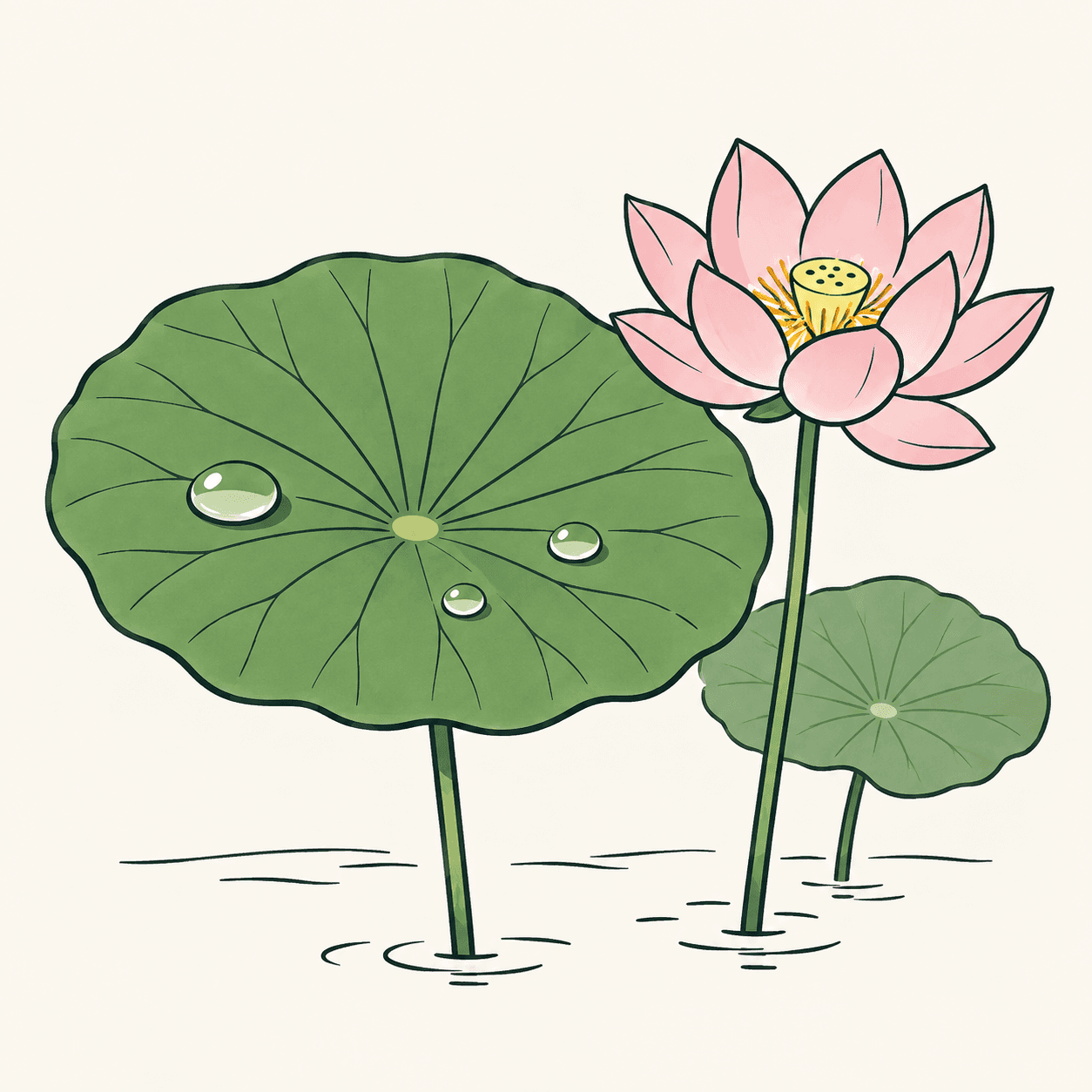
Sacred lotus, Nelumbo nucifera, is a perennial aquatic plant: its rhizomes grow in mud and its leaves can rise above the water. They are peltate: the stalk joins the blade towards its centre rather than its edge. Watching a droplet up there can bring a marble to mind. [1]
The upper surface, apparently so even to the naked eye, looks remarkably elaborate under a microscope. Ensikat and colleagues describe projections called papillae, covered with dense, tiny wax tubules. This structure at two different scales greatly reduces the area where water touches the leaf. A droplet does not spread as it would on an easily wetted surface. [2]
To picture the principle, consider an editorial analogy: a ball supported on several points rather than resting across a whole surface. The comparison does not reproduce the physics of water; it simply helps visualise reduced contact. In lotus, the geometry of the projections and the properties of the wax act together. Merely making a surface rough is not enough. [2]
As a droplet rolls, it can collect particles lying on the leaf and carry them away. This self-cleaning behaviour is the lotus effect, explained by the surface structure and low adhesion. Our editorial reading is that mud and cleanliness can stop looking like a poetic paradox once we learn to observe the material properties involved. [2]
The study’s authors stress that measuring how rounded a droplet appears is not enough to compare surfaces properly. Its adhesion and the angle at which it starts moving also matter. Two leaves may seem equally water-repellent in a photograph yet behave differently when water actually has to leave them. The picture begins the question; it does not supply the whole answer. [2]
The structure also gives the wax some protection: areas between the papillae are less exposed to mechanical contact. That does not make the leaf indestructible. The research records damaged or eroded wax and explains that defects can make water cling more strongly. Describing lotus as a perfect coating under every condition would erase the limitations that help make it interesting. [2]
Kew distinguishes lotus from water lilies, describing the inverted-cone-shaped receptacle at the flower’s centre. Our illustration highlights that feature, emerging leaves and droplets. It is an editorial interpretation; to observe the microscopic surface, look at the images in the research paper. [1][2]
Take this with youWhen you watch a droplet, also ask how it moves. Lotus reminds us that an apparently smooth surface can have a busy microscopic life. No cleaning company required.
Read the sources (2)
- Nelumbo nucifera — descrizione botanica e profilo della specie Royal Botanic Gardens, Kew · Plants of the World Online · accessed 15 Sept 2026
- Superhydrophobicity in perfection: the outstanding properties of the lotus leaf Ensikat et al. · Beilstein Journal of Nanotechnology · accessed 15 Sept 2026
Original writing and illustration made with AI assistance. Our editorial method
More in Plants