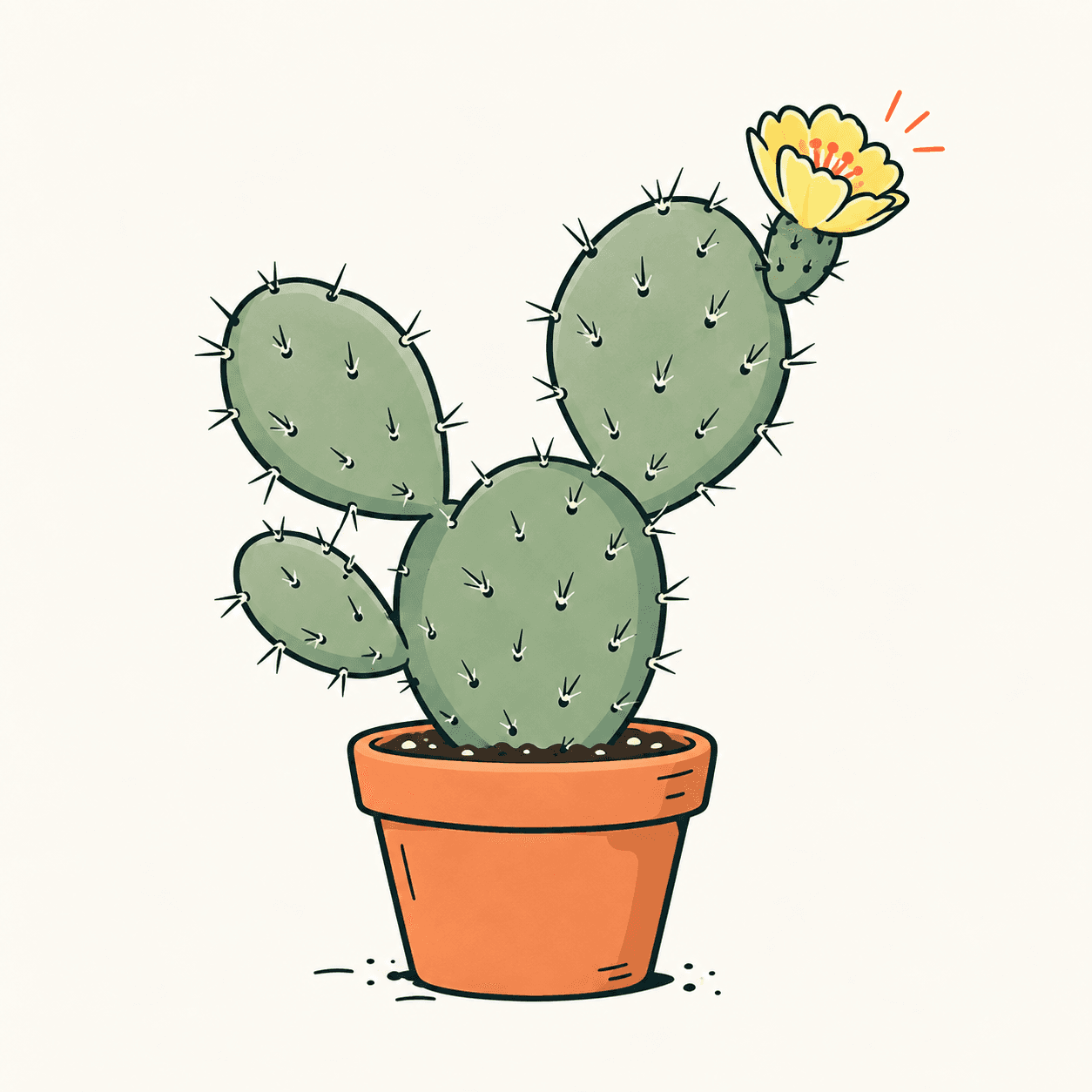
A prickly pear can look as if it were built from large oval leaves stacked on top of each other. But the Royal Horticultural Society describes those grey-green parts as flattened stems. This cactus species is called Opuntia ficus-indica. Here is our central discovery: being flat and green does not automatically make a plant part a leaf. Botany asks us to look at how the plant is organised as well. [1]
In the genus Opuntia, these stem sections are called cladodes, or simply pads. North Carolina State University distinguishes them from the small, inconspicuous leaves, which do not last long. Its account also describes areoles: little points producing spines and tiny hooked bristles called glochids. There is no need to run a finger over the plant to investigate them. A close photograph can reveal details that our hands would do better to leave alone. [2]
The Italian common name, fico d’India, can suggest the wrong geographical journey. The Royal Botanic Gardens, Kew database places this species’ native range in Oaxaca, Mexico, and lists it as introduced in Italy. Origin and the place where we encounter a plant today are different pieces of information. Seeing one in a familiar landscape cannot establish that it originally came from there. We need a source that documents its distribution. [3]
The species description includes yellow or orange bowl-shaped flowers and fruit that may be purple, orange or red. These parts will not necessarily all be present when we look. A plant record helps distinguish what is visible today from the features the species can develop. Our newspaper illustration also simplifies things. It can help us recognise the structure, but it is not enough to identify every cactus we might encounter. [1]
Try an editorial exercise using pictures only. Put a photograph of a pad beside one of a leaf you know. First record shapes and colours without naming the parts. Then consult their botanical records and correct your labels. If your first idea was wrong, keep both versions: they show what changed your hypothesis. You do not need to break off pieces, collect fruit or taste anything to make this discovery. [2]
Finally, draw two boxes in a notebook: one for what you observe and another for what you have checked by reading. The first might say oval surface; the second, flattened stem. Our editors suggest this as a way to make the journey from impression to knowledge visible. It also helps when a common name is misleading. Learning to observe does not mean always guessing correctly. It means noticing which clues are missing and knowing where to look next. [3]
Take this with youWhen a plant part looks like a leaf, treat that as a hypothesis. Check its botanical name before turning a resemblance into certainty.
One idea, in simple words
A prickly pear is a cactus. Its big, flat, green parts are called pads. They look like leaves, but they are pieces of stem: the part of a plant that branches and supports other parts. Shape can fool us. Being flat and green is not enough to make something a leaf. [1]
Small spots on the pads carry spines and tiny bristles. Do not touch them to investigate: they can irritate skin. Instead, try our editors’ idea and look at a photograph. Draw a pad’s outline and compare it with a leaf you know. Then check their names in a botanical record, an expert description of a plant. Changing your mind after reading is not losing. It means you have learned from a new clue. [2]
A little discovery to keep
What did you discover?
Read the sources (3)
- Opuntia ficus-indica Royal Horticultural Society · accessed 30 Sept 2026
- Opuntia North Carolina State University Extension · accessed 30 Sept 2026
- Opuntia ficus-indica (L.) Mill. Royal Botanic Gardens, Kew · Plants of the World Online · accessed 30 Sept 2026
Original writing and illustration made with AI assistance. Our editorial method
More in Plants