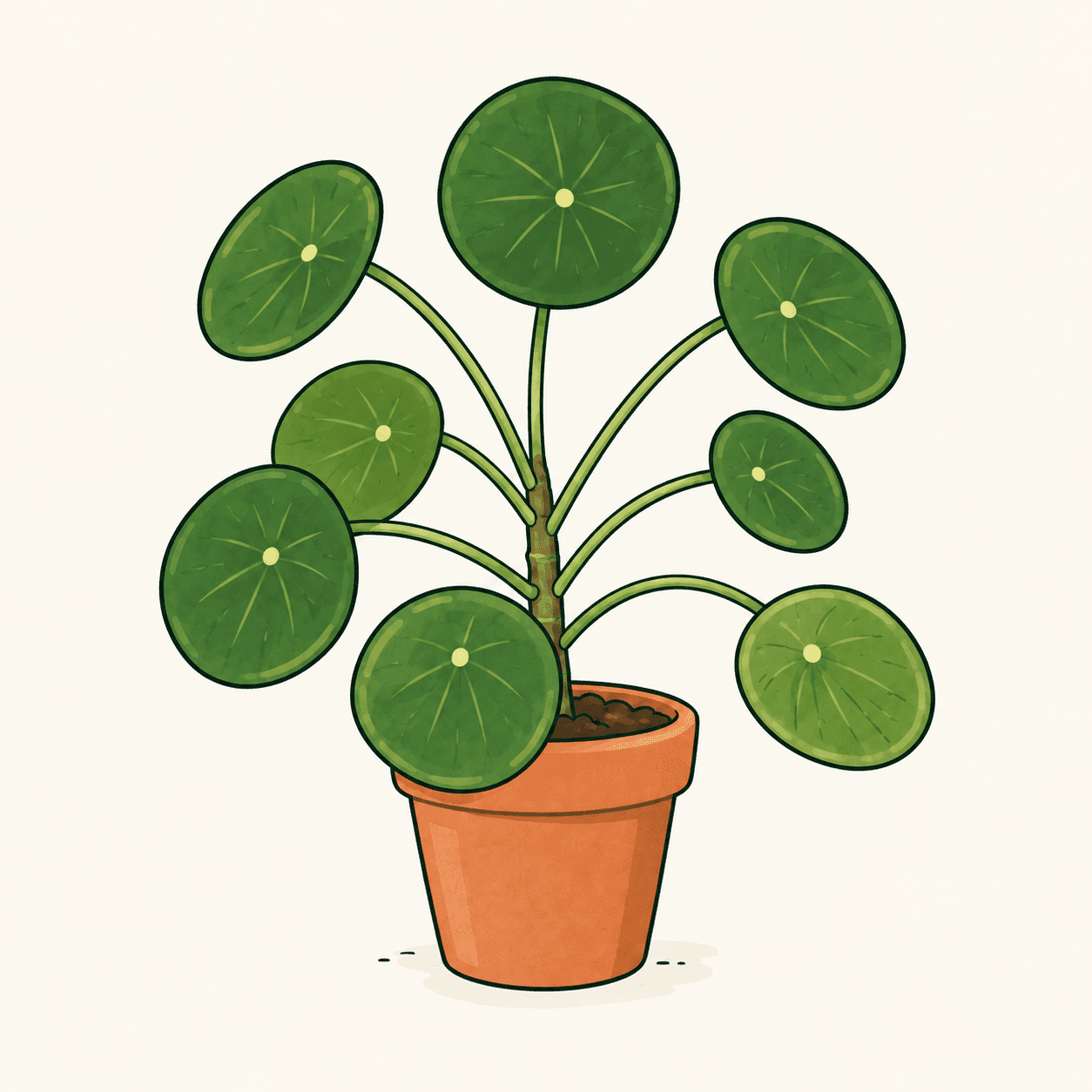
Pilea peperomioides catches the eye with round leaves, but the useful detail is underneath. The stalk, or petiole, joins the blade away from its edge, near the centre: botanists call this arrangement peltate. The term describes more than a circular outline; it identifies the relationship between a leaf’s surface and its support. [1]
The botanical name moves us from a nickname to a particular species. Kew’s Plants of the World Online accepts Pilea peperomioides Diels and places its native distribution in southwestern Sichuan and western Yunnan, China. The name was first published in 1912. It belongs to the Urticaceae family: names communicate classification, rather than decorative resemblance alone. [3]
The Royal Horticultural Society describes an upright evergreen perennial with fleshy leaves on long stalks. It also produces tiny pale-green flowers, sometimes tinged pink. The foliage is conspicuous, but those discs are not the whole plant: it has a life cycle and reproductive structures that are less visually spectacular. [2]
For cultivation, NC State Extension specifies bright indirect light and a well-drained growing medium, warning that excess water can encourage root rot. These are conditions to observe in your own environment, rather than a promise that every pot will respond identically. The “money plant” nickname does not fund its drainage system. [1]
The RHS also lists propagation by division and detaching rosettes in spring. That detail helps us read the new growth beside a main plant. Before attempting any intervention, distinguishing a shoot from a leaf already means asking a more precise botanical question about what is in front of us. [2]
Try this editorial observation without cutting anything. Choose a leaf and follow its stalk to the blade, then compare it with a second leaf on the same plant. Draw just three things: the outline, the attachment point and one vein. Artistic skill is unnecessary: sketching makes you decide what you can actually see. If a detail remains hidden, mark it as uncertain rather than filling it in from habit. [1][2]
A second exercise is to make a small record with two columns: “observed” and “to check”. The first holds a leaf’s position and the attachment you have seen; the second holds a proposed identification or a possible cause of irregular growth. This is an editorial method, not a diagnostic test. Its purpose is to separate clue from conclusion: an appealing photograph can start our curiosity without requiring us to pretend that every answer is already inside the image. [3][1]
Take this with youObserve a leaf without picking it and note a detail you previously missed. To recognise a plant, a precise question is worth more than a convincing nickname.
Read the sources (3)
- Pilea peperomioides NC State Extension Gardener Plant Toolbox · accessed 15 Sept 2026
- Pilea peperomioides Royal Horticultural Society · accessed 15 Sept 2026
- Pilea peperomioides Diels Royal Botanic Gardens, Kew · Plants of the World Online · accessed 15 Sept 2026
Original writing and illustration made with AI assistance. Our editorial method
More in Plants