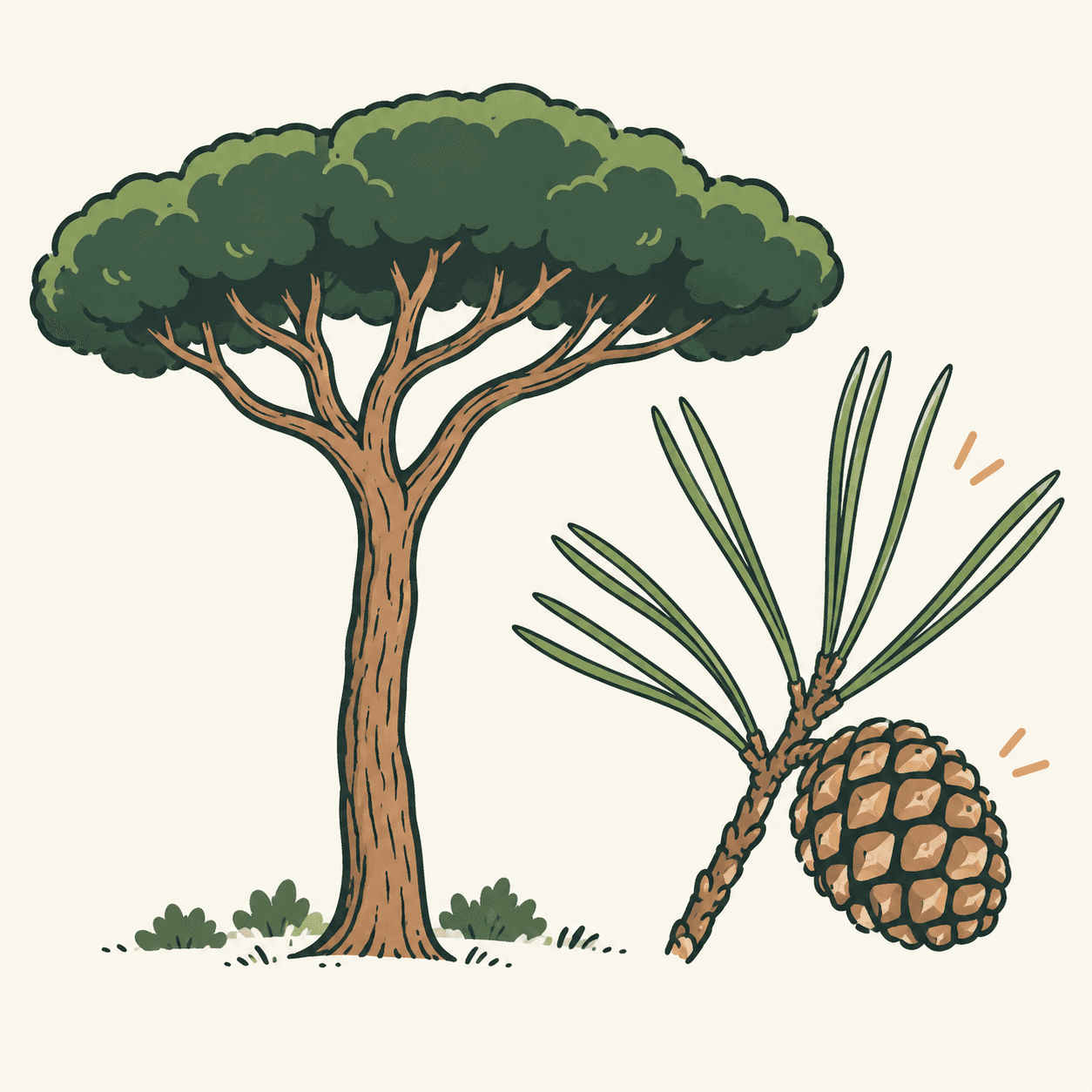
A mature stone pine, Pinus pinea, can develop a broad, umbrella-like crown. Kew also describes a less obvious feature: its needles, the narrow leaves, grow in pairs. The overall outline and small details together help us describe the plant. [1]
The Royal Horticultural Society describes it as an evergreen conifer with stiff green needles and rounded or oval cones. These cones take three years to mature. Their shape belongs to a developing process, rather than an object that never changes. [2]
NC State University’s plant profile notes that a young specimen can look bushier. As it grows, it sheds lower branches and develops its characteristic spreading top. The outline of an adult is therefore not a picture that applies at every age. [3]
Here is an original suggestion from our editors: imagine making a label for a park walk. Your first drawing shows only the tree’s outline; underneath, write observed from a distance. In a second box, leave room for a detail seen close up without removing anything. In the third, note what you could not see. You can use a photograph you have permission to use if there is no tree nearby. The exercise is not about guessing a species: it asks you to explain where each observation comes from. [1]
Continue our invented situation with two labels: one made quickly and another after a second look. The first says only umbrella-shaped tree. The second includes an outline, a drawing of a needle pair and a question about the cone. Which lets a classmate understand your observation better? You do not have to fill every space. In our workshop, an empty box marked not observed is more useful than a detail added simply because it seemed right. You can always return to a question later, with a better view. [2]
Finally, imagine comparing a drawing of a young tree with one of an adult. Before declaring one picture wrong, ask whether they show the same stage of life. This comparison is an activity devised by our editors, not a sufficient method for identifying every pine. Where botanical identification matters, use competent guides. Our everyday aim is smaller: slow down our looking, keep a question and learn to describe a difference without immediately filling it with certainty. The notebook can remain a record of learning rather than a display of perfect answers. [3]
Take this with youAn outline is a useful beginning, not a complete description. Notice details and the plant’s age too; distinguish clearly between what you observed and what you still need to find out.
One idea, in simple words
Stone pine is also called Pinus pinea. When mature, it can have a broad crown like an umbrella. The crown is the part with branches and leaves. Its narrow leaves, called needles, grow in pairs. [3]
Its cones take three years to mature. A young tree can have a different outline from an adult. Here is an activity invented by our editors: divide a page into three spaces. In the first, draw an outline. In the second, draw a detail you can actually see, without picking anything. In the third, write a question. If a detail is hidden, you can leave its box empty. You do not need to guess everything: you are learning to separate observation from imagination. [2][3]
A little discovery to keep
What did you discover?
Read the sources (3)
- Pinus pinea L. — General information Royal Botanic Gardens, Kew · accessed 26 Sept 2026
- Pinus pinea Royal Horticultural Society · accessed 26 Sept 2026
- Pinus pinea — Extension Gardener Plant Toolbox NC State University · accessed 26 Sept 2026
Original writing and illustration made with AI assistance. Our editorial method
More in Plants