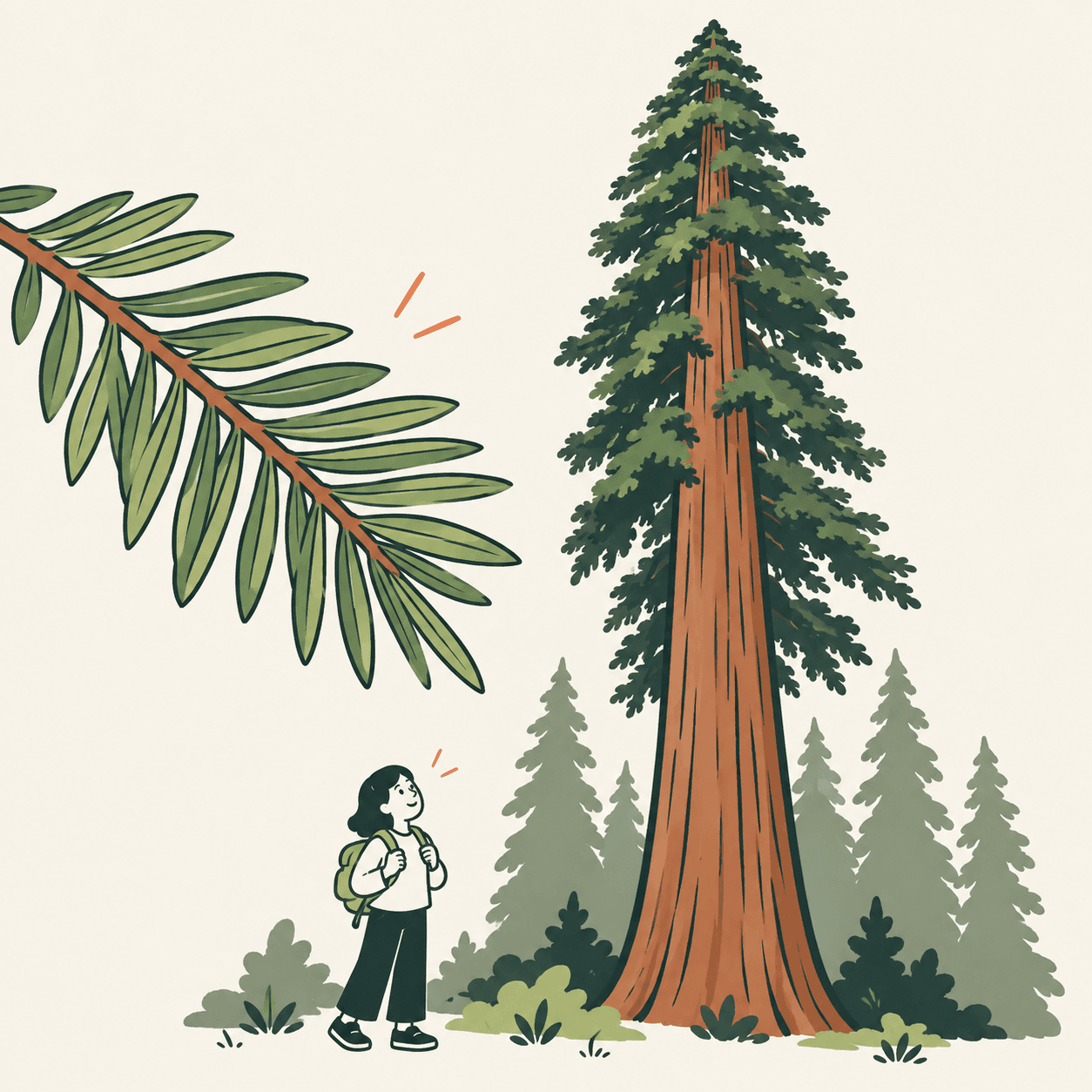
A redwood can make us tip our heads back until its branches disappear from view. Yet not all redwoods belong to the same species. Kew distinguishes Sequoia sempervirens, the coast redwood that reaches the greatest heights, from Sequoiadendron giganteum, the giant sequoia noted for volume. Tall and bulky describe different measurements. Confusing them changes the meaning of a botanical record before we have even started comparing trees. [1]
Plants of the World Online, Kew’s scientific catalogue, places the native range of Sequoia sempervirens between southwestern Oregon and western California. A native range is the area where a species occurs naturally. Finding a specimen in a garden elsewhere does not automatically enlarge that range: someone may have planted it. The origin of a species and the address of one individual tree are different pieces of information. [2]
Fog matters in this landscape. The National Park Service guide explains that it helps coastal forests through dry summers by reducing water loss from leaves. This does not make rainfall or soil irrelevant. The central discovery concerns a relationship: even an enormous tree depends on conditions that we cannot measure simply by looking at the height of its trunk or the size of its crown. [3]
The Forest Service account also describes new shoots emerging from the base, alongside reproduction through seeds. This gives the species another way to continue growing. That account is a review from 1992: here we use its botanical mechanism, rather than presenting its old height records as a current leaderboard. A useful source should be read together with its date and with attention to exactly what it supports. [4]
An example from our editors: imagine two labels for a photograph. The first says only enormous tree. The second identifies the species, location and surroundings. Which helps us ask better questions? Draw a line between the tree and each part of the landscape you would like to investigate: soil, water and other plants. The lines represent questions in our exercise, rather than findings from research that has already been carried out. [2]
A final activity from our editors begins with a tree near home, without removing leaves or bark. Observe it from a permitted path: which parts can you describe confidently, and which remain hidden? Write down one observation and one detail to check in a botanical guide. There is no need to find the world’s tallest tree immediately. Separating observation from assumption can make the tree we pass every day interesting too. [4]
Take this with youA giant does not grow apart from everything else. When you look at a tree, try including its landscape in your question.
One idea, in simple words
The coast redwood is called Sequoia sempervirens. It grows naturally along part of the California and Oregon coast. It is not the same species as the giant sequoia. The first is famous for height; the second for volume, meaning how much space its body takes up. [2][1]
Even a huge tree depends on its surroundings. In coastal forests, fog helps during dry summers by reducing water lost through leaves. The tree can also produce shoots, small stems growing from its base. Here is an exercise from our editors: point to the tree in a photograph, then to the ground and air around it. What would you like to know about each? A photograph shows some things, but cannot explain everything. Understanding a giant also means asking about where it grows. [3][4]
A little discovery to keep
What did you discover?
Read the sources (4)
- 7 reasons to visit our Pinetum Royal Botanic Gardens, Kew · accessed 25 Sept 2026
- Sequoia sempervirens (D.Don) Endl. Kew Science · Plants of the World Online · accessed 25 Sept 2026
- Redwood National and State Parks U.S. National Park Service · accessed 25 Sept 2026
- Sequoia sempervirens, redwood USDA Forest Service · Fire Effects Information System · accessed 25 Sept 2026
Original writing and illustration made with AI assistance. Our editorial method
More in Plants