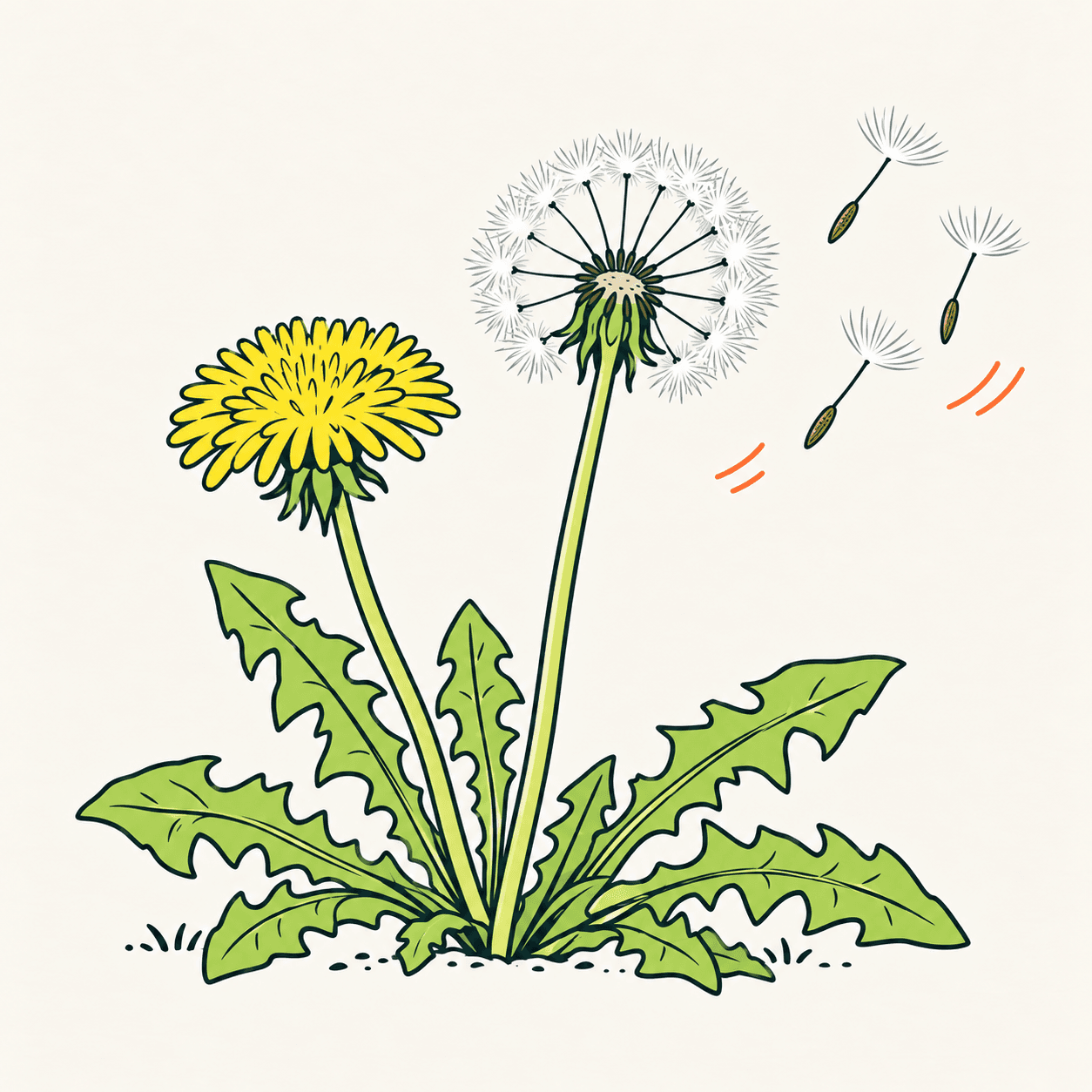
A dandelion changes its appearance dramatically: the yellow flowerhead is followed by the pale seedhead we know as a dandelion clock. A flowerhead contains many small flowers grouped into one structure. Kew's botanical descriptions identify leaves gathered at the base, hollow leafless stalks and numerous small fruits carrying a tuft of hairs. Looking at those parts separately helps us avoid mistaking the entire white sphere for one enormous seed. [1]
The tuft is called a pappus. Beneath it hangs a tiny fruit containing the seed: in everyday language we often call the whole flying unit a “seed”. The University of Edinburgh studies this combination of a light, filamentous upper part and a heavier part suspended below it. It immediately resembles a parachute, but a visual resemblance is not yet a complete explanation of how the structure works as it moves through air. [2]
An ordinary parachute has a large fabric surface; a pappus leaves plenty of empty space. Experiments by the Edinburgh group show that neighbouring filaments interact with airflow and help create a ring of rotating air separated from the structure. At this tiny scale, allowing air between the hairs can help stabilise the system. We do not need to imagine flapping wings or a hidden motor to explain the fruit's remarkable movement. [2]
The distinction between fruit and seed also helps us read a drawing. If we show only a little white cloud without the suspended part, we lose an essential element. If we fill the gaps with a solid sail, we change what makes the structure interesting. Our editorial illustration simplifies details, but the pappus must remain open and connected to its small fruit. An attractive metaphor should not erase the object it is meant to explain. [1][2]
Here is an observation exercise proposed by our editors: look at an enlarged photograph of a dandelion clock and draw two panels. In the first, show the whole sphere; in the second, show one detached unit. Describe in your own words what belongs to the group and what belongs to an individual fruit. Your drawing is not a scientific measurement. It helps you ask a clearer question: are we looking at one object, or many neighbouring objects that appear to be one from a distance? [1]
There is a limit to the name too. The genus Taraxacum includes many species and microspecies: Kew documents a complex classification. Here we discuss the common dandelion, referred to as Taraxacum officinale, without treating a similar-looking leaf as a secure identification. Our central discovery concerns the organisation of the flowerhead and pappus. Observation is enough to appreciate it; collecting the plant or trying dietary and medicinal uses is unnecessary for this exploration. [1]
Take this with youLook at the whole, then at one part. Even the space between a dandelion’s filaments matters: a gap can be an important feature of a structure.
One idea, in simple words
A dandelion has leaves at its base and leafless stalks. What looks like one yellow flower is a group of tiny flowers. Later we see the white dandelion clock. It is not one huge seed: it contains many small fruits, each holding a seed. [1]
Each fruit has a tuft of hairs called a pappus. It resembles a parachute, but lets air pass between its hairs. Researchers found that these gaps matter for flight. Here is a drawing idea: first draw a circle for the entire dandelion clock. Next to it, draw just one tuft with its little fruit hanging underneath. These are two ways of looking at the same plant. The hairs are not flapping wings: they work together with the air. [2]
A little discovery to keep
What did you discover?
Read the sources (2)
- Taraxacum: general information and botanical descriptions Royal Botanic Gardens, Kew · Plants of the World Online · accessed 27 Sept 2026
- Form and function of the dandelion fruit University of Edinburgh · accessed 27 Sept 2026
Original writing and illustration made with AI assistance. Our editorial method
More in Plants