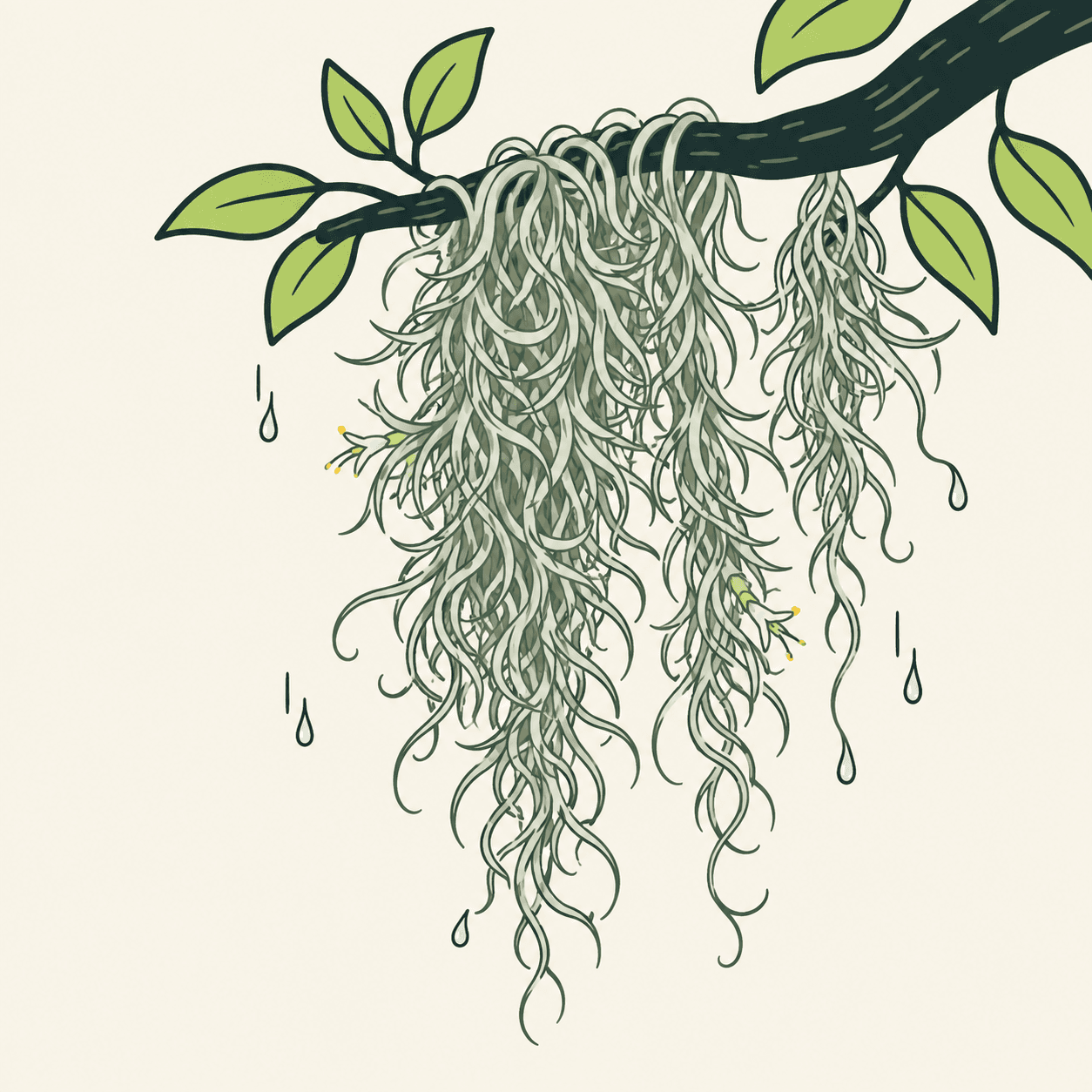
That grey-green beard hanging from branches has a misleading common name: Spanish moss. Tillandsia usneoides is not a moss. It belongs to the Bromeliaceae, the same botanical family as the pineapple. Kew places its native range in tropical and subtropical America. Its common name is therefore a useful reason to ask a question, rather than a reliable scientific identity card that tells us what the plant actually is. [1][2]
It is an epiphyte: a plant growing on another plant for support. This does not make it a parasite, an organism taking resources from its host. The University of Florida explains that these tillandsias obtain water and minerals from their surroundings. A branch provides somewhere to hang; it does not act like a drinking straw inserted into the tree’s sap. Separating support from nourishment is the central discovery. [2]
How can it live without reaching down into soil? Kew describes tiny surface structures called trichomes: specialised scales that absorb water and nutrients. They cover the stems and leaves and contribute to the plant’s silvery appearance. Its leaves are slender, elongated and often curled; when wet, they look greener. Mature plants have no roots. The long hanging tangle is therefore not a waterfall of exposed roots searching for the ground. [1]
Our editors suggest a comparison: imagine a cloth hanging from a washing line. What supports it and how it gets wet are separate questions. The branch, like the line in this example, holds it in place; water arrives from outside. The comparison stops there. A cloth is not alive, has no leaves and does not grow. A useful mental picture explains one relationship without pretending to replace the real plant. [1][2]
Appearances can also mislead us about size. Kew describes how long hanging curtains can consist of shorter, tangled individuals rather than one enormous plant. The species produces small, inconspicuous flowers and can spread through fragments carried elsewhere. Looking closely therefore changes three first impressions: it is not moss, the hanging growth is not roots, and the long beard does not necessarily belong to one individual plant. [1]
Saying it is not parasitic does not mean every accumulation is irrelevant. The University of Florida notes that heavy growth can shade lower leaves and worsen conditions on already weakened trees. Seeing this plant and a sick branch together does not establish what caused what. An activity from our editors: look at a botanical photograph and separate what you can observe from what you are only imagining, without collecting or tasting specimens. [2]
Take this with youThe branch supplies support; the plant’s surface collects water. Sometimes understanding a plant starts with separating two different jobs that first appeared to be one.
One idea, in simple words
Spanish moss has a confusing name. It is not moss: it is a plant with tiny flowers, called Tillandsia usneoides. It hangs from branches. It is an epiphyte, meaning it uses another plant for support. It does not suck the tree’s sap as a parasite would. [2][1]
Its surface has tiny scales called trichomes. They help collect water and useful substances from the surroundings. The small leaves are narrow and often curled. Mature plants have no roots. Here is a comparison from our editors: a cloth hangs on a washing line while rain wets it from outside. Unlike the cloth, the plant is alive and grows. The branch and the water have separate jobs: one provides support, while the other reaches the plant’s surface. [1]
A little discovery to keep
What did you discover?
Read the sources (2)
- Tillandsia usneoides — General information and species profile Royal Botanic Gardens, Kew · accessed 24 Sept 2026
- Spanish Moss, Ball Moss, and Lichens — Harmless Epiphytes University of Florida · IFAS Extension · accessed 24 Sept 2026
Original writing and illustration made with AI assistance. Our editorial method
More in Plants