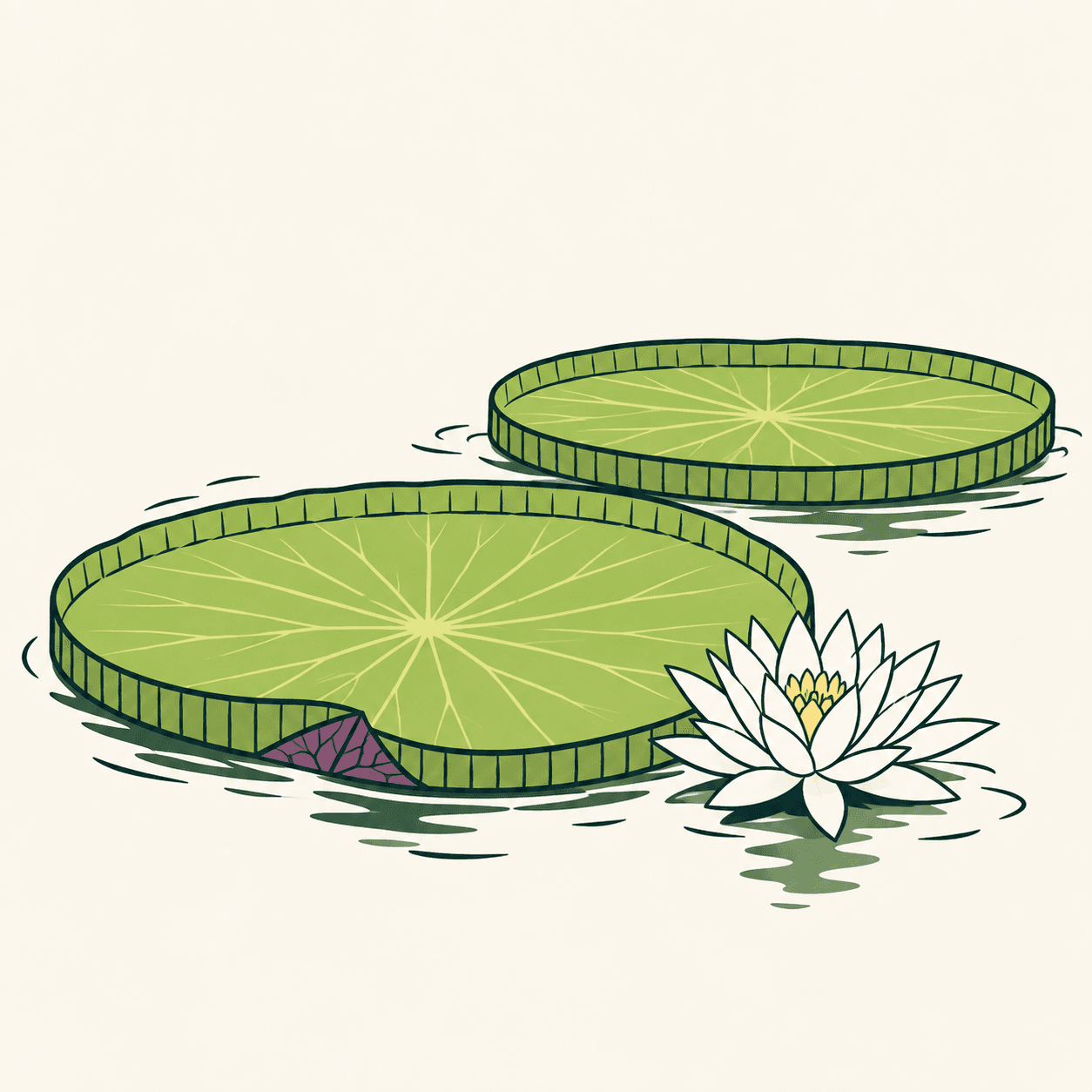
Victoria amazonica is a waterlily from the Amazon basin. Its leaves are large and circular; the updated botanical description gives them a relatively low, almost vertical rim when one is present. A network of veins runs underneath. That lower surface matters: a leaf is more than the green shape we see when we look down at a pond. [1]
A 2022 study of the genus Victoria linked leaf strength to the arrangement of its veins, comparing leaves and mechanical models. Here is the question to remember: where is the material placed? This does not mean that every amazonica specimen has exactly the characteristics measured in the study. [2]
Consider an example from our editors. A sheet of paper stretched between two books bends easily. If we change its shape, we can compare how it behaves without changing the amount of paper. This small model does not reproduce a living plant or prove the study’s findings. It helps us ask a question: does strength depend only on how much material we have, or also on where and how we arrange it? [2]
Size does not tell the whole story of growth. In Kew’s account of cultivation, young plants start from seed and are moved as they develop. Light, warm water and controlled care support their growth. The botanic garden repeats the cultivation each year. This is a particular example of glasshouse management, rather than a universal timetable every waterlily must follow in its natural habitat. [3]
Names need care too. In 2022, researchers at Kew and their Bolivian partners distinguished Victoria boliviana from the other species in the genus. We therefore do not automatically describe Victoria amazonica as the world’s largest waterlily today. An old caption may predate that revision. Checking which species is being discussed is more useful than chasing the most impressive number on the page. [4]
There is also a lesson in observation. Botanical illustrator Lucy Smith compared flowers, buds and other details, contributing to research on the different species. A scientific drawing aims to record differences that can be checked. Our image is an editorial illustration: it accompanies the reading but cannot replace photographs, measurements or specimens. Looking carefully and knowing what we are looking at are two parts of the same task. [5]
Take this with youDraw the top and underside of a leaf seen in a photograph. Record what you can actually see, leaving blank anything you cannot distinguish: that is observation too.
One idea, in simple words
Victoria amazonica is a waterlily from the Amazon River region in South America. Under its round leaves are veins: firmer lines that form a network. [1]
A study of giant waterlilies links this network to the leaf’s strength. [2]
Our editors suggest an example: compare a flat sheet of paper with the same sheet folded. This is only a model, not a real leaf. [2]
In 2022, scientists recognised another species, Victoria boliviana. Giant waterlilies therefore do not all have the same name. Our illustration helps us imagine the topic; it does not measure a plant. You can draw what you see and put a question mark beside anything you cannot make out. You do not have to invent an answer just to fill the space. [4][5]
A little discovery to keep
What did you discover?
Read the sources (5)
- Victoria amazonica: general information and botanical descriptions Royal Botanic Gardens, Kew — Plants of the World Online · accessed 21 Sept 2026
- Unlocking the mechanical secrets of giant Amazonian waterlilies University of Oxford · accessed 21 Sept 2026
- How we grow giant waterlilies at Kew Royal Botanic Gardens, Kew · accessed 21 Sept 2026
- Giant waterlily grown at Kew Gardens named new to science Royal Botanic Gardens, Kew · accessed 21 Sept 2026
- The botanical artist who helped uncover the world’s biggest waterlily Royal Botanic Gardens, Kew · accessed 21 Sept 2026
Original writing and illustration made with AI assistance. Our editorial method
More in Plants