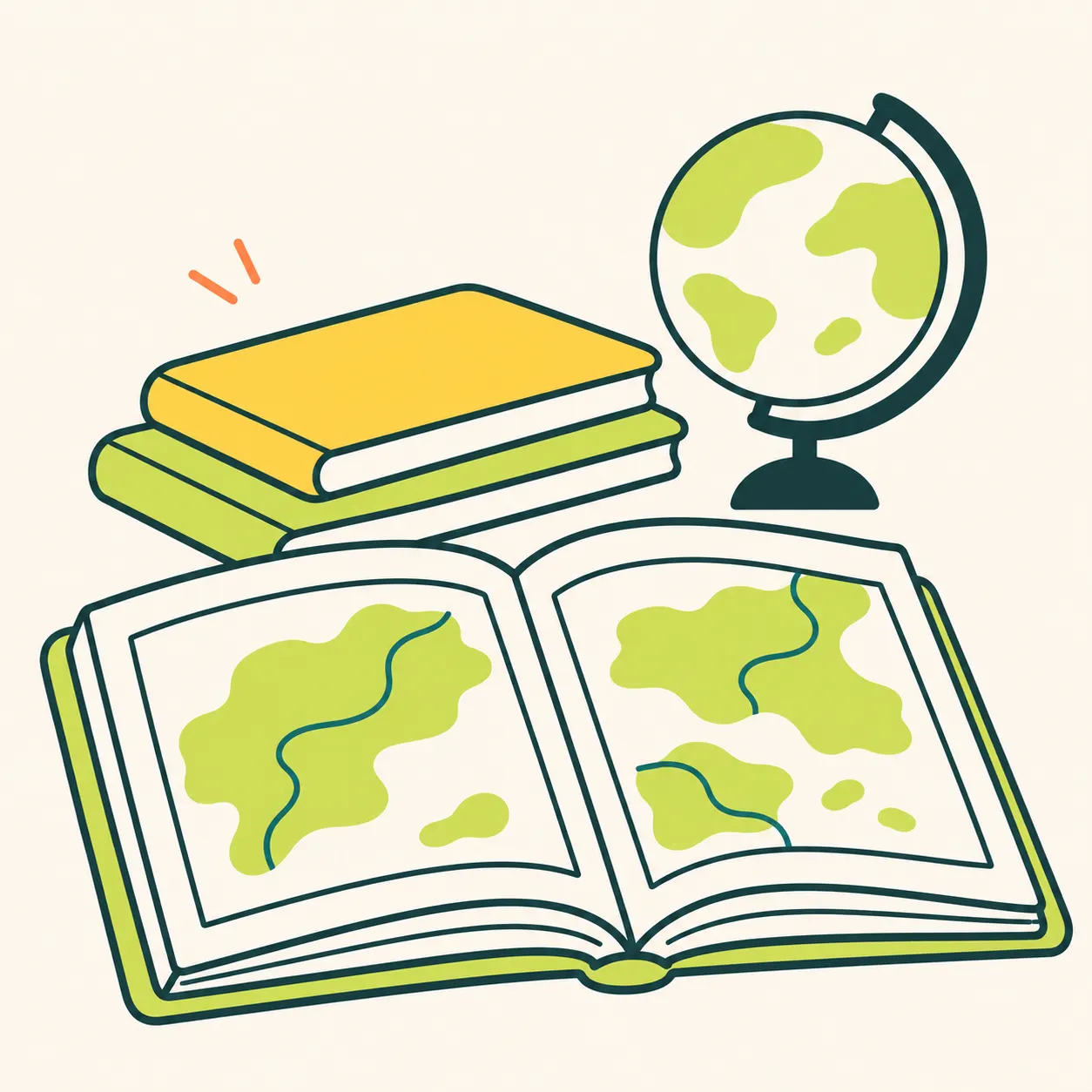
Take an atlas and open it without immediately searching for a city. The word on the cover already tells you something: inside is an organised collection for consultation, not one isolated map. Treccani traces the Italian noun atlante to the title of Gerard Mercator’s geographical collection of 1595. The documented starting point is therefore a particular publishing work whose name came to identify a whole category of books. [1]
We must separate the history of the name from that of the format. Utrecht University Library explains that Abraham Ortelius published the Theatrum Orbis Terrarum in 1570, regarded as the first modern world atlas. Mercator’s cartographic work, issued in parts between 1585 and 1595, was instead the first to receive the name Atlas. Saying the word derives from his title does not mean nobody previously assembled maps into a book. [2]
The 1595 publication was also a family undertaking. Mercator had died in 1594; his son Rumold brought together available materials and maps to publish the work. The full title recorded by Utrecht begins Atlas sive cosmographicae meditationes. There is no need to turn this episode into a legend of solitary genius. The book has a history of preparation, engraving and editorial work. A short word can preserve a much longer chain of activity. [2]
In Italian, the meaning expanded. An atlante can organise geographical maps, but also anatomical, botanical or celestial plates; a linguistic atlas shows how features of language are distributed across space. Not everything containing many pictures is automatically a well-made atlas. The dictionary suggests a systematic collection, and the quality of that organisation still needs examination. This observation about consultation is our interpretation, not a universal rule governing how every page should be designed. [1]
Imagine an example devised by our editors: three pictures of the same region show landforms, rivers and settlements. Looking at them together may encourage comparisons that a single picture makes less immediate. The value lies not simply in the number of pages, but in the questions their arrangement lets us ask. This example does not describe a particular Mercator plate. It helps explain why an ordered collection needs a different name from a single image. [1]
The English and French versions of this reading discuss the same Italian word, without substituting the etymology of an equivalent. And the origin of a name does not guarantee accurate maps: Utrecht even documents a 1606 copy in which a map of Cyprus appears in place of Cuba. The mistake does not erase the cartographers’ work. It reminds us that a book designed to orient us must also be checked. The cover promises a world; the pages demand attention. [1][2]
Take this with youWhen opening an atlas, notice the order of its plates as well. A title can become a common noun; a collection becomes useful through clear comparisons.
One idea, in simple words
The Italian word atlante means an organised collection of maps or plates. Treccani connects its origin to the title of a work by Mercator published in 1595. This does not mean Mercator alone invented collecting maps: Ortelius had published a modern world atlas in 1570, using a different title. After Mercator died, his son Rumold helped publish his father’s work. Today Italian also uses atlante botanico for a collection of botanical plates. Imagine three maps of one area: one shows mountains, another rivers, and another towns. Their order helps us compare them. An atlas can still contain mistakes that need checking, however carefully we think its pages have been arranged. [1]
A little discovery to keep
What did you discover?
Read the sources (2)
- Atlante² — significato ed etimologia Treccani, Vocabolario on line · accessed 3 Nov 2026
- The Atlas by Mercator and Hondius Utrecht University Library · Marco van Egmond · accessed 3 Nov 2026
Original writing and illustration made with AI assistance. Our editorial method
More in Words