A pencil in our hand may leave a grey mark, but the Italian name matita leads elsewhere. Treccani traces matita to the older form amatita and the etymology of ematite, hematite. The discovery is not that every modern pencil contains that mineral. It is that a name can keep travelling even when the material associated with an object changes. To follow it, we must keep the dictionary and the pencil case separate. [1]
Ematite comes through Latin from the Greek haimatítēs, related to hâima, blood. The reference belongs to the stone’s name. However, the dictionary also notes that this mineral can appear as shiny black crystals, not only reddish masses. Saying that the name recalls blood therefore does not justify colouring every specimen the same red. A good etymology opens a trail; it does not replace a description of the material itself. [2]
Il Nuovo De Mauro records matita before 1533 and describes the contemporary object with a core of graphite or other colouring substances. That date concerns documentation of the Italian word, not a birth certificate for every pencil. Again, we need to frame the question carefully. Are we asking when a name appears, how an object is made, or when someone first used a similar writing tool? Those questions are not interchangeable. [3]
Our editors suggest a simple comparison. Write two headings: where the name comes from, and what this object is made of. Under the first, put the origin verified in a dictionary; under the second, information about the product in front of you. Do not fill one column by automatically copying the other. The exercise is useful because similarities between words can make us feel we already have a complete answer. [1]
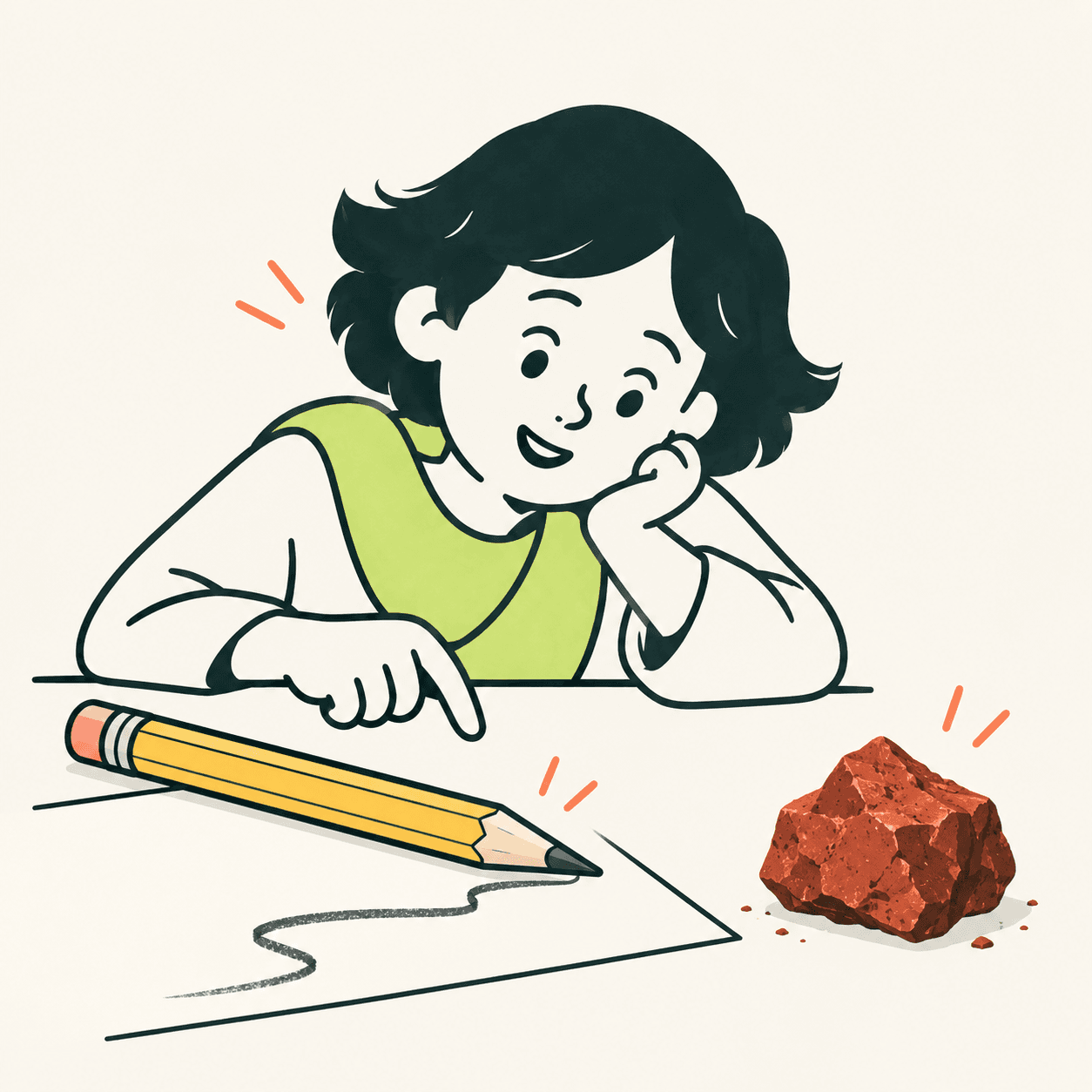
Our illustration places a pencil beside a reddish stone to explain the linguistic connection. It does not show the recipe used to make that pencil, or a documented historical scene. This is an editorial example of reading an image: first describe what it shows, then ask what relationship it means to explain. Placing one object next to another does not automatically make the first an ingredient of the second. [2]
Finally, we can invent a small museum label for our pencil case. One line introduces the object, a second tells the name’s story, and a third identifies the source consulted. If information is missing, leave the question open rather than filling it with a legend. Our editors suggest trying another everyday object too. There is no need to uncover a spectacular story. Learning to distinguish a documented curiosity from a plausible tale is enough. [3]
Take this with youMatita, the Italian word, points to the history of hematite. Etymology explains a name; a modern pencil’s composition requires a different kind of information.
One idea, in simple words
The Italian word matita means pencil. It comes from the older form amatita, linked to ematite, the name of a mineral, a natural material. This does not mean your pencil is made of hematite. Etymology, the study of where words come from, explains an object’s name. It does not always describe the materials inside the object today. [1]
The dictionary describes a modern pencil with a core of graphite or other colouring substances. The core is the part that makes the mark. Try our editors’ game: write two questions on a page. Where does the name come from? What is this object made of? Looking for separate answers helps keep a word’s history distinct from its materials. [3]
A little discovery to keep
What did you discover?
Read the sources (3)
Original writing and illustration made with AI assistance. Our editorial method
More in Words