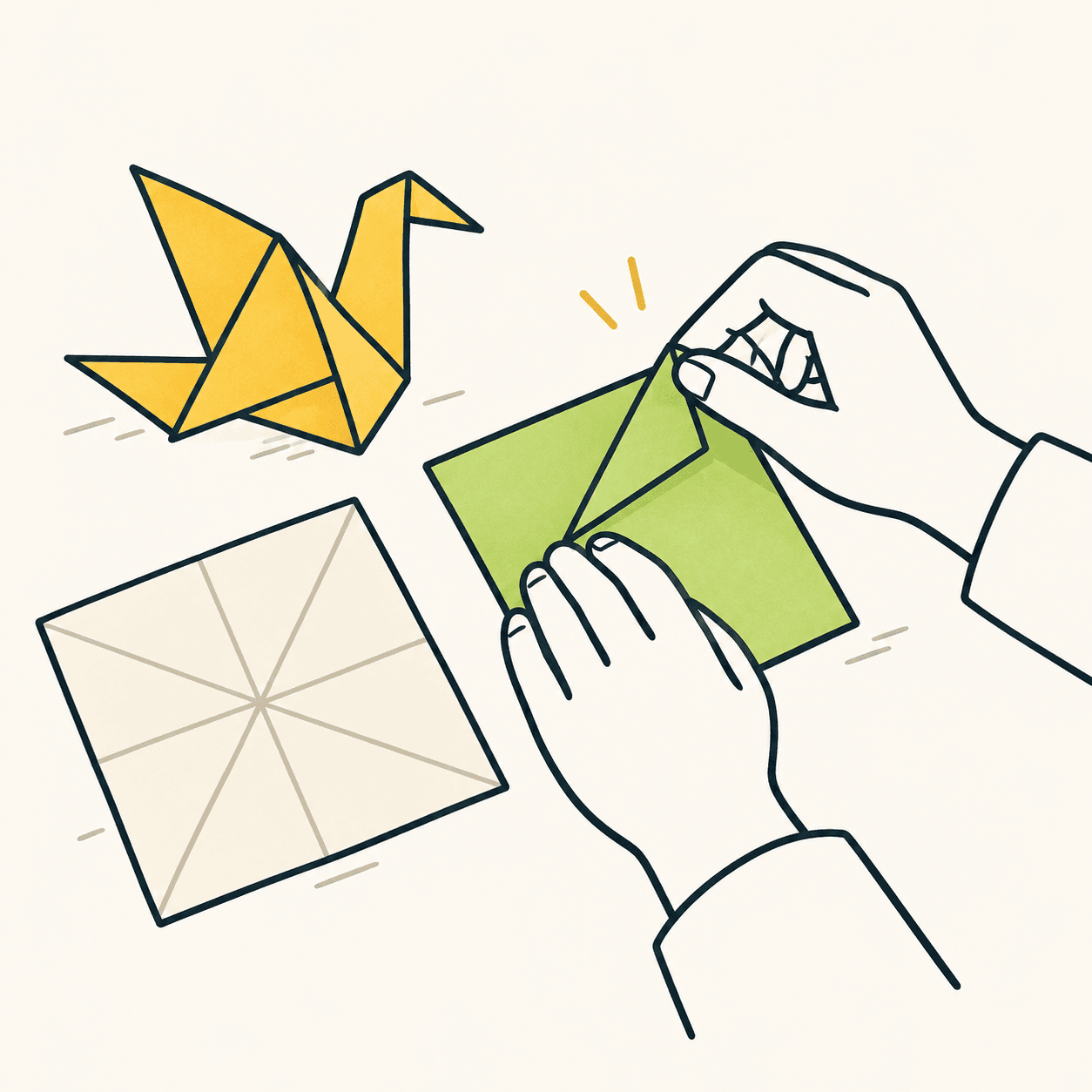
What does the name of a small paper figure tell us? The Italian word origami is borrowed from Japanese. Treccani identifies its two components: ori, associated with a fold or folding, and kami, paper, which appears as gami in the compound. The name therefore brings an action and a material together. This documented origin is enough to begin examining the word without inventing a more picturesque story for it. [1]
Il Nuovo De Mauro records origami as an invariable masculine noun in Italian. The same word means both the art of making figures by folding paper and the resulting object. We can therefore speak of origami as an activity or observe an origami on a table. The distinction does not require two different words: the surrounding sentence helps us understand whether the process or its result is intended. [2]
Try two sentences invented by the editors. “Oggi dedico un'ora all'origami”, meaning that today I am spending an hour on origami, centres the activity. “Ho appoggiato un origami vicino alla finestra”, meaning that I put an origami by the window, suggests a figure. To make the difference clear, mentally replace the word first with a description of doing and then with a description of an object. This is not a Japanese translation exercise: it explores everyday Italian usage. [2]
The definition also requires precision. Treccani describes folding sheets and specifies that scissors or glue are not generally used. That qualification discourages us from turning a lexical explanation into a universal rulebook for every possible practice. A dictionary explains a use of a word. It does not replace a complete history of techniques, schools and the people who work with paper. [1]
Here is a second editorial experiment. Take a sheet and imagine describing a fold to somebody who cannot see your hands. “Bring one corner towards the opposite corner” is more useful than “do this”. Then compare the description with what actually happens. If the shape differs, look for the point where information was missing. The name origami does not contain all these instructions: recognising an etymology begins understanding, but does not supply the skill needed to make every model. [1]
Finally, keep two journeys separate. The Italian word comes from Japanese; this English article explains that same Italian word. We are not assigning a Japanese origin to every English expression for folded paper. Keeping the subject fixed lets us compare languages without accidentally changing the question. A sheet changes shape when folded; an explanation stays precise when we remember what we are explaining. [2]
Take this with youWrite two Italian sentences with origami: one about the activity and one about the finished figure. Underline the surrounding words that signal the difference.
One idea, in simple words
The Italian word origami comes from Japanese. It joins ori, which concerns folding, and kami, meaning paper. In the compound, kami appears as gami. The name brings together what we do and the material we use. Different folds can produce figures without the name having to describe every individual step. [1]
Origami can mean the activity or a finished figure. Here are two editorial examples in Italian: “Mi piace l'origami” can describe enjoying the activity; “Questo origami è sul tavolo” points to an object on the table. The other words in a sentence help explain the meaning. Knowing the name's origin does not automatically teach us every fold. To make a figure, we also need instructions and attention to the paper in front of us. [2]
A little discovery to keep
What did you discover?
Read the sources (2)
- Origami · Vocabolario on line Istituto della Enciclopedia Italiana Treccani · accessed 5 Oct 2026
- Origami · Il Nuovo De Mauro Internazionale · Il Nuovo De Mauro · accessed 5 Oct 2026
Original writing and illustration made with AI assistance. Our editorial method
More in Words