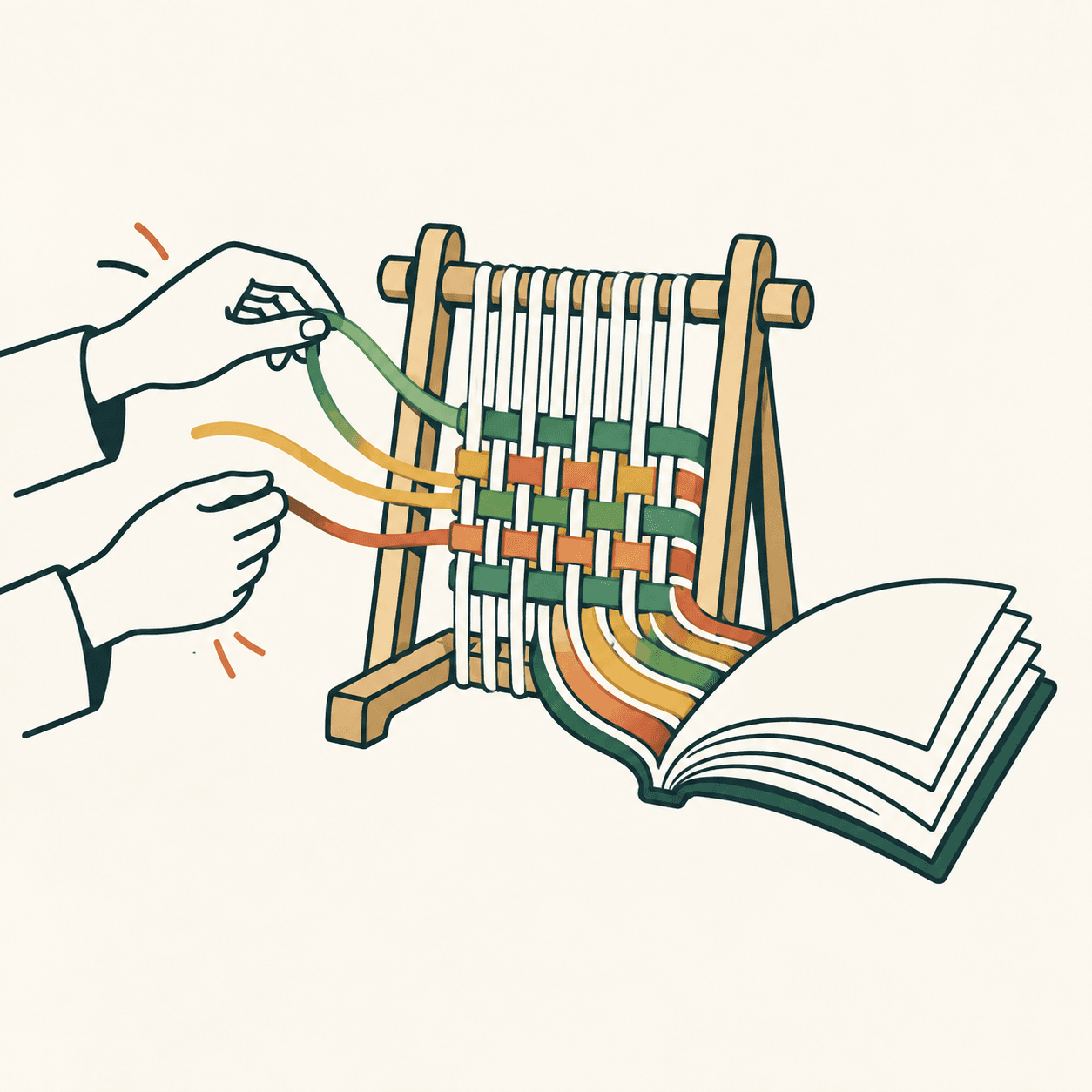
The Italian word testo retains a connection with weaving. Treccani traces it to Latin textum or textus, both linked to the verb texere. There is no need to invent someone who supposedly had the idea while looking at a loom: etymology documents a relationship between words, but does not automatically supply a scene of their birth. [1]
In an Accademia della Crusca language consultation about texture, linguist Miriam Di Carlo follows the same family: texere includes weaving and interlacing and, by extension, writing; she connects the participle textus with Italian testo and French texte. This relationship makes the textile metaphor understandable. Our subject nevertheless remains the origin of the Italian word, rather than an undifferentiated history of every similar-looking word in other languages. [2]
The dictionary uses testo both for the exact words of a written work and, in linguistics, for a meaningful whole that can also be spoken. Writing on paper is therefore not the only possible case. [1]
How can we recognise that unity? In the Enciclopedia dell’Italiano, Angela Ferrari explains coherence through the organisation of meaning: discourse maintains a recognisable focus, refers back to elements already introduced and advances the information. The criterion also depends on audience and context. This does not mean that a grammatically correct sentence is sufficient, or that coherent content is necessarily true. Connections between parts are a separate question from checking the claims they make. [3]
Let us try an example devised by our editorial team. Imagine writing to a friend, in Italian: «Ho portato il libro. Lo lascio sul tavolo dell’ingresso» — you have brought the book and will leave it on the entrance table. The second sentence refers to an object already named and adds a place. Now replace it with «Il tavolo è rettangolare», meaning that the table is rectangular. This sentence is understandable too, but someone waiting for the book lacks a step. This is our own writing exercise, not an example taken from the sources. [3]
Continue the experiment by changing the recipient: imagine someone unfamiliar with the house. You might need to specify which entrance, or agree on another place. Then remove details that do not serve that task. The weaving metaphor becomes a practical editorial question: which connections should be made visible, and which can remain implicit? We have not reconstructed a Latin scene; we have used a verified word relationship to examine a contemporary message. [2]
Take this with youReread a message before sending it: are its pronoun references clear, and does the next piece of information follow? One small explicit connection may save the recipient a question.
Read the sources (3)
- Tèsto³ Treccani · Vocabolario on line · accessed 17 Sept 2026
- Texture Accademia della Crusca · Italiano Digitale · accessed 17 Sept 2026
- Coerenza, procedure di Treccani · Enciclopedia dell’Italiano · accessed 17 Sept 2026
Original writing and illustration made with AI assistance. Our editorial method
More in Words