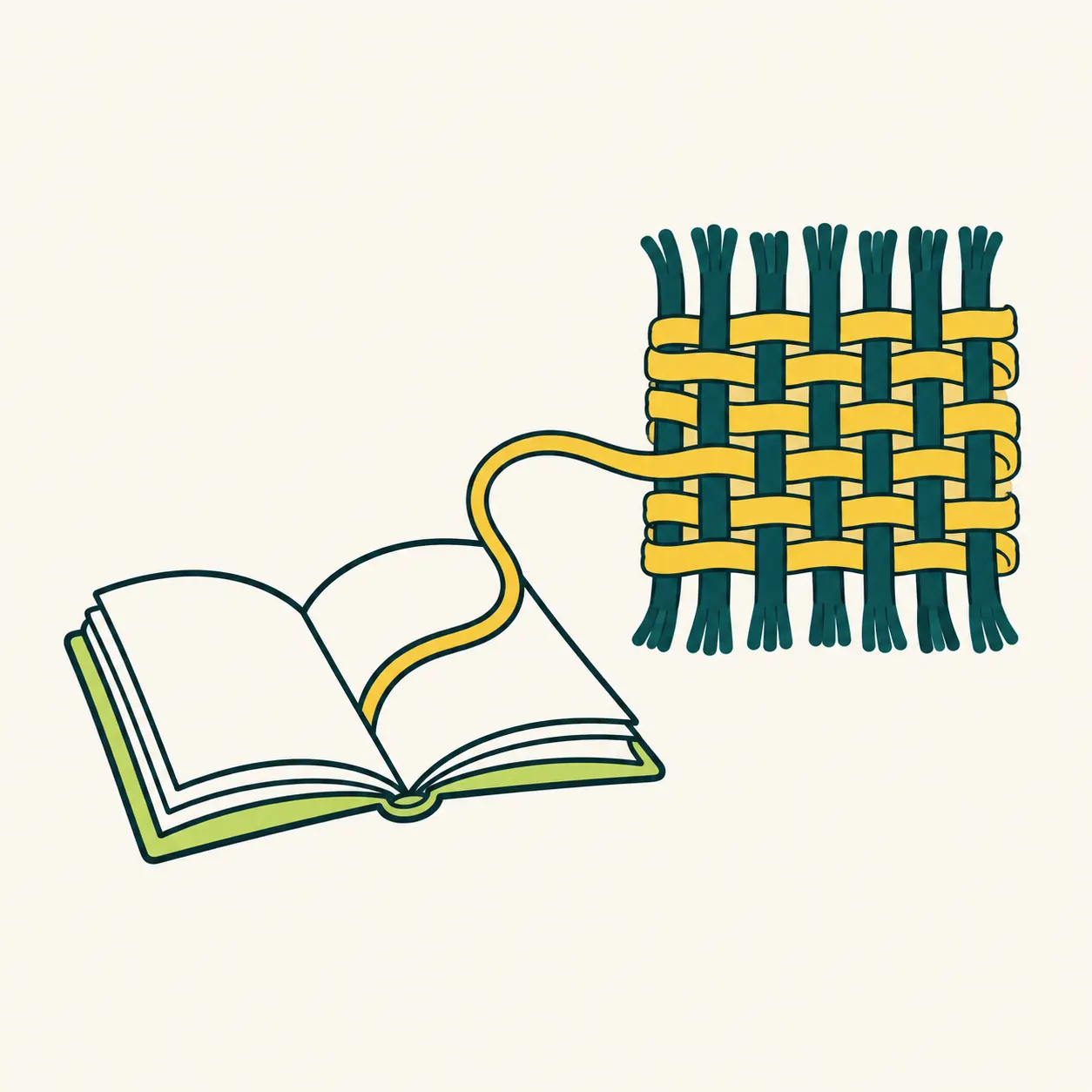
When someone asks for a film’s trama in Italian, we should not hand them a fabric sample. Yet a dictionary leads us towards cloth. In textile usage, trama means the weft, the threads crossing the warp. From this concrete interlacing, the Italian word extends to the structure of a story and other figurative meanings. We are not inventing a decorative coincidence today: dictionaries record both the textile and narrative senses. [1]
Il Nuovo De Mauro traces the Italian word to Latin trama(m) and records an attestation from 1279. Treccani says that the Latin term’s etymology is uncertain. We can therefore follow the Italian-to-Latin connection without constructing an imaginary road further back. The date records a documented occurrence, not the word’s birthday in every speaker’s mouth. A dictionary date is not a certificate ruling out every possible earlier use. [2][1]
Its figurative sense lets us discuss how events are interwoven in a narrative work. To make this visible, consider an example invented by our editors: someone loses a key, retraces their steps and meets another person. We can list the three actions, or decide how to connect them, what to reveal first and what follows from the meeting. This little exercise does not reconstruct the word’s history; it illustrates a recorded meaning. [1]
Dictionaries preserve a less innocent sense too: trama can mean an intrigue or a concealed scheme. Context changes the reading. Someone who says they have discovered a trama might be discussing a novel or a secret plan. A word does not always carry one meaning in its own separate box. Neighbouring words and the situation help us choose which sense matters, without erasing the other available meanings. [2]
The weaving image is attractive, but needs restraint. Not every story resembles a loom in every detail, and not every narrative thread corresponds to a technical part of weaving. Our picture symbolically connects fabric with a book. It is an editorial metaphor, not an archaeological object proving how storytelling began. A useful analogy can illuminate a relationship without pretending to explain its entire history or every possible use. [1]
In English and French, we are discussing the same Italian word, trama. We are not assigning its etymology to English plot or French intrigue. The pleasure lies in recognising a possibility within one language, rather than forcing all languages through the same loom. Next time you encounter trama, ask which kind of interlacing is being named. The dictionary offers several doors without making readers enter the same room every time. [2][1]
Take this with youChoose a sentence containing trama and examine its context: are threads, events or intentions being interwoven? Nearby words help clarify the meaning.
One idea, in simple words
In Italian, trama can mean the threads crossing the warp to form cloth. The warp is the other set of threads that they interlace with. The same Italian word also describes how events form a story. Dictionaries connect trama to Latin trama(m), but the Latin term’s more distant origin is uncertain. We should not invent an origin to make the story sound better. Imagine this example: someone loses a key, walks back and meets another person. Connecting those actions can create a small narrative trama. The word can also mean a concealed plan. Reading the whole sentence helps us choose the intended meaning. We are studying the Italian word here: English plot does not automatically receive the same origin. [1][2]
A little discovery to keep
What did you discover?
Read the sources (2)
Original writing and illustration made with AI assistance. Our editorial method
More in Words