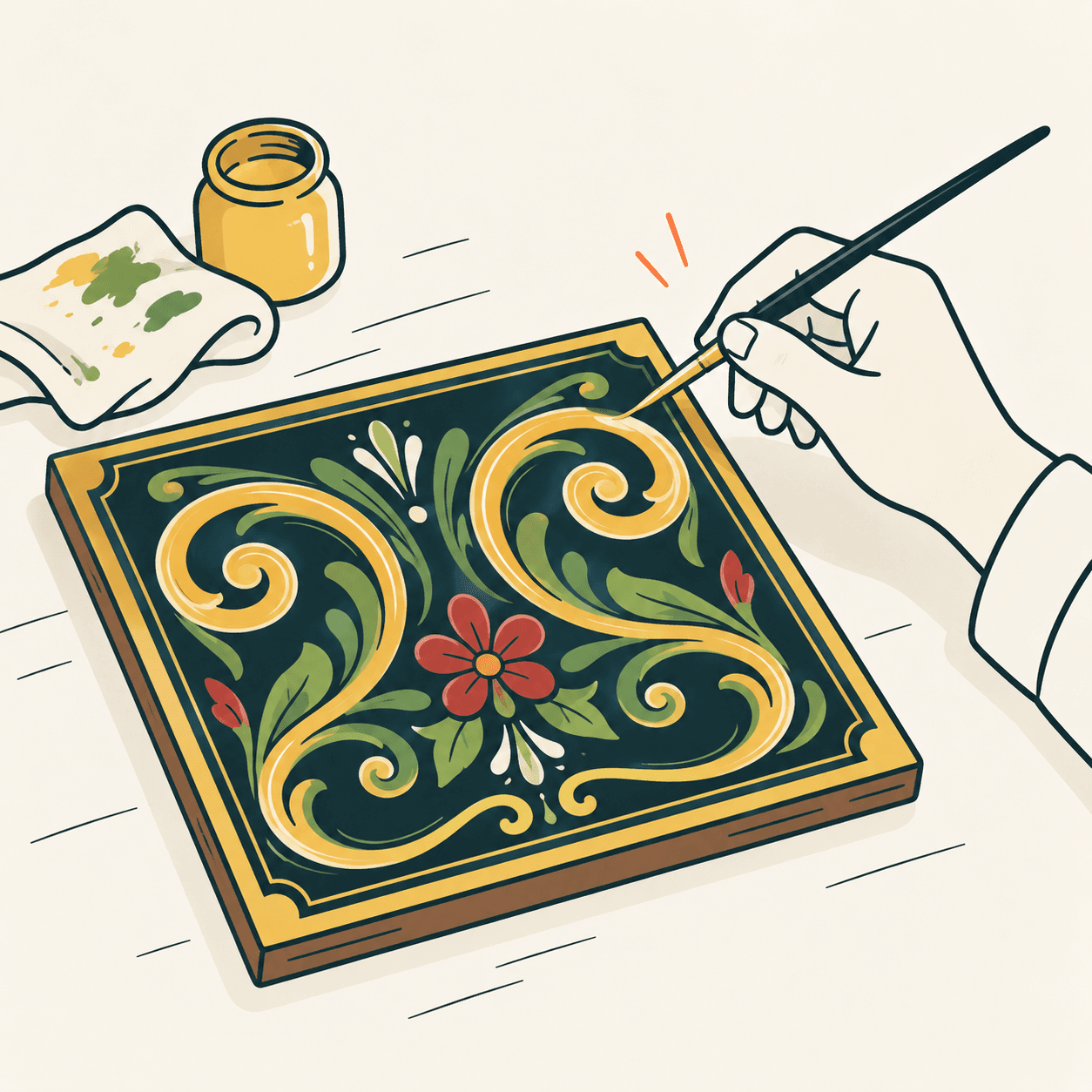
Fileteado porteño is a painting practice associated with Buenos Aires: vivid colours, ornamental lines and drawn lettering work together. UNESCO added it to its Representative List of the Intangible Cultural Heritage of Humanity in 2015. The recognition concerns a technique and the people passing it on, rather than simply a collection of images. Looking at a finished panel also means encountering learned gestures, individual choices and shared memories. [1]
The story has no precise birthday. The city’s website warns that its origins are incompletely documented and does not identify a single inventor. It places its development in cart workshops in the early twentieth century, with contributions from Italian immigrant craftspeople. Decorations later appeared on trucks and buses. This caution about origins matters: a tradition can develop through many workshops without a single, certain opening scene. [2]
The repertoire includes flowers, leaves, scrolls and ribbons, but it is not simply a matter of adding ornaments at random. The tourism authority’s account describes compositions and techniques developing alongside different surfaces. It also discusses artists who teach and experiment with new applications. Continuity therefore does not require every work to look the same; it can emerge through the effort involved in adapting a recognisable visual language. [3]
One documented example makes this distinction clear. On 11 June 2024, the city announced a competition to decorate tourist buses: designs had to be painted using the filete technique, while their transfer onto vehicles was planned through printed film. This is a historical initiative, not a call still open for entries. The document distinguishes an original painted gesture from a reproduction intended for another surface, without confusing those two stages. [4]
Here is an editorial exercise: imagine a neighbourhood bookshop’s sign and draw two versions of its border. In one, leave plenty of space at the centre; in the other, bring the curves closer to the name. Ask where your eye travels and which rhythm you prefer. This is an observation exercise, not an authentic traditional work or a shortcut to becoming a fileteador. The craft requires learning and practice, rather than simply a decorative motif to copy. [1][3]
UNESCO describes transmission open to people interested in learning and contributions from a new generation of women practitioners. This invites us to notice who keeps the technique alive, without assigning one taste to every resident of a city. For our exercise, the final question could be this: whose work have we studied, and what have we actually learned from the gesture? The reference matters as much as the result. [1]
Take this with youNext time a painted border catches your eye, look for the person who made it. Heritage includes the craft’s path from one practitioner to another.
One idea, in simple words
Buenos Aires, in Argentina, has a decorative art called fileteado porteño. It uses lines, flowers, curves and vivid colours. Decorations appeared on carts and later moved to trucks and buses. The city explains that we do not know an exact starting date or a single inventor. Many craftspeople contributed to its history. [2]
Today the technique also inspires new applications. Here is an imagined editorial example: picture a sign’s border and follow its curves with your finger, without touching it. You are observing how the drawing guides your eye. Learning the actual craft takes practice and teaching instead. A decoration is more than a collection of shapes: it also carries the work of the person who painted it. [3]
A little discovery to keep
What did you discover?
Read the sources (4)
- El filete porteño de Buenos Aires, una técnica pictórica tradicional UNESCO · accessed 4 Oct 2026
- Fileteado porteño Gobierno de la Ciudad Autónoma de Buenos Aires · accessed 4 Oct 2026
- El Fileteado, un genuino arte porteño Ente de Turismo de la Ciudad de Buenos Aires · accessed 4 Oct 2026
- En su aniversario, la Ciudad lanza un concurso de fileteado porteño Gobierno de la Ciudad Autónoma de Buenos Aires · accessed 4 Oct 2026
Original writing and illustration made with AI assistance. Our editorial method
More in Cultures & peoples