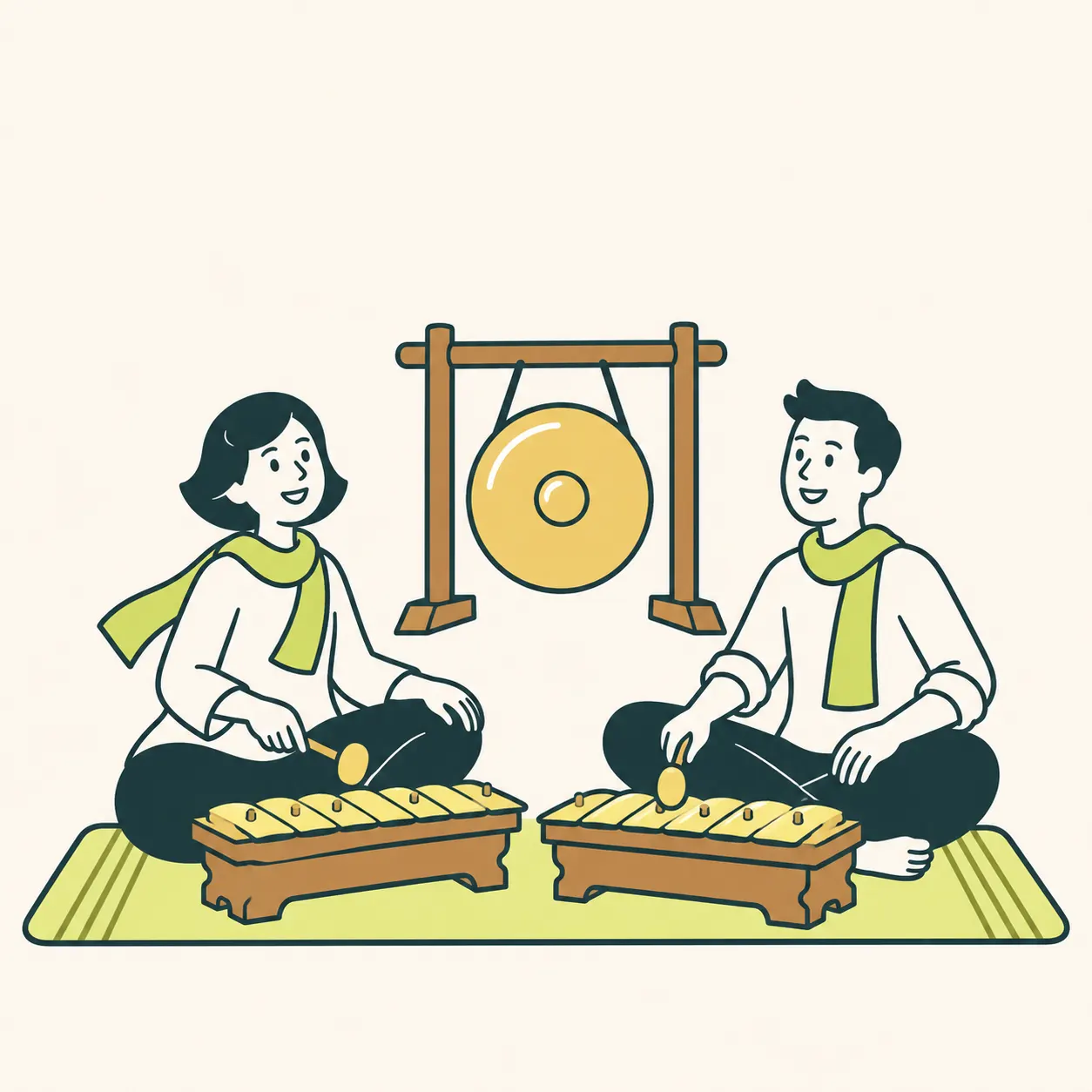
Two instruments can be tuned slightly differently without this being a mistake to correct. Smithsonian programme notes for Gamelan Mitra Kusuma explain that paired keyed instruments in the Balinese tradition presented contribute in this way to a shimmering sound. The discovery asks us to suspend an automatic judgement: hearing a difference does not mean we have identified a fault. We first need to understand what relationship between sounds the musicians are trying to create. [1]
Gamelan names a family of Indonesian instrumental ensembles, rather than one object or a single composition. The Ministry of Tourism describes groups with gongs, metallophones and drums, sometimes complemented by flutes and string instruments. Metallophone helps identify struck metal bars: the appearance may suggest a xylophone, but we should not pretend that all materials and sounds are identical. The ensemble becomes understandable through relationships between parts, not just through a list of separate objects. [2]
The Smithsonian source is specific: it describes a concert on 4 December 2008 and a Balinese ensemble called gamelan angklung. It distinguishes this group from other gamelan types in instruments, size and context, and presents a programme combining traditional repertoire with more recent compositions. One evening’s documentation cannot represent all of Indonesia. It does, however, let us approach a living tradition through musicians, choices and pieces, rather than treating it as an unchanging sound from the past. [1]
Imagine our own listening exercise: in an authorised recording, follow one low sound for a few seconds, then shift attention to shorter, brighter sounds. You need not identify every instrument immediately. Note what returns and where your attention changes. We are not recreating a Balinese technique with a game, or making the ensemble a universal metaphor for social harmony. This is simply a respectful way of making room for listening before applying familiar labels. [1][2]
UNESCO recognition of gamelan dates to 2021, as documented by the Indonesian delegation: it is not today’s news. The same source discusses transmission through education, training and performances. Preserving a practice therefore involves people learning and teaching, rather than only instruments on display. We can appreciate collective work without claiming that a musical genre automatically makes people better. The interesting precision lies in a relationship that must be built, and it does not always require everything to become identical. [3]
Take this with youDuring your next listening session, seek a relationship between sounds rather than a soloist to follow at all costs. Check the recording’s place, ensemble and context: names and differences make a tradition more understandable.
One idea, in simple words
Gamelan is a family of musical ensembles from Indonesia. It can include gongs, metal-bar instruments and drums. There are different forms: not every ensemble sounds the same. Smithsonian notes for a Balinese concert explain a surprising detail. Some instruments are played in pairs with slightly different tunings to contribute to the ensemble’s shimmering sound. This difference is intentional, rather than necessarily a mistake. The documented concert happened in 2008, so it is not news from today. Imagine first following the low sounds and then shorter sounds in a recording. This is our attention exercise, not a complete gamelan lesson. Understanding a tradition also requires attention to its place, musicians and context, instead of expecting one example to represent an entire country. [1]
A little discovery to keep
What did you discover?
Read the sources (3)
- Balinese Music and Dance: Gamelan Mitra Kusuma — programme notes Smithsonian National Museum of Asian Art · accessed 6 Nov 2026
- Gamelan Ministry of Tourism, Republic of Indonesia · accessed 6 Nov 2026
- Gamelan ditetapkan sebagai Warisan Budaya Tak Benda UNESCO Permanent Delegation of Indonesia to UNESCO · accessed 6 Nov 2026
Original writing and illustration made with AI assistance. Our editorial method
More in Cultures & peoples