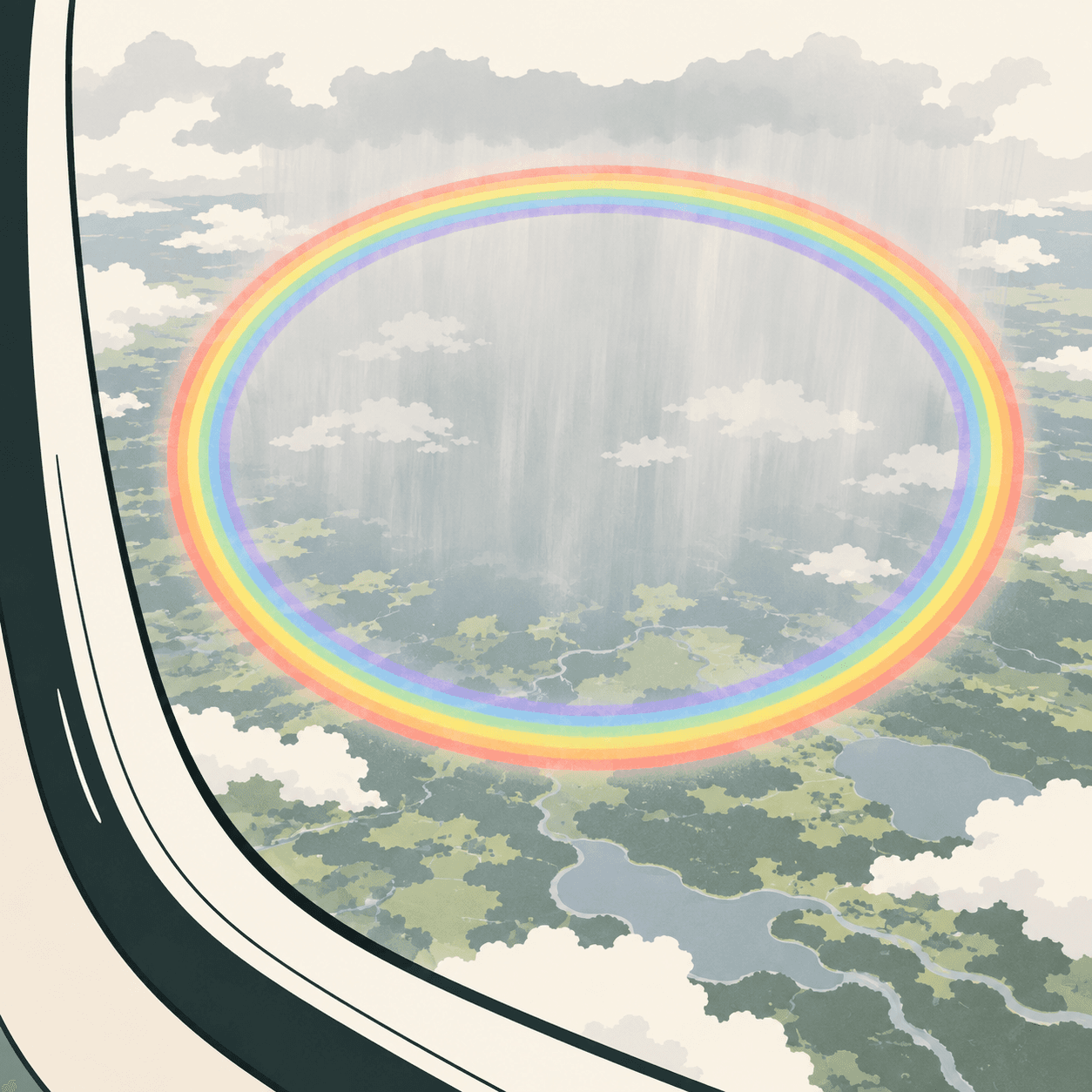
We draw a rainbow as a bridge, but its geometry is circular. The Met Office explains that an elevated viewpoint, with illuminated droplets below the observer too, can reveal a complete circle. From the ground we normally see only part of it. A piece of colour has not gone missing: our viewing conditions and the landscape limit what is visible from where we stand. [1]
The National Weather Service follows light travelling through a droplet. Entering water changes its direction, a process called refraction. Some light reflects inside the drop and bends again as it leaves. Different colours are deflected differently. To see the primary rainbow, we need the Sun behind us and water ahead; red forms the outer edge. The rainbow is not an object resting at a particular spot on the lawn. [2]
Aerial photographs contain a possible trap. NASA describes a glory, another phenomenon that can appear as coloured rings around the point opposite the Sun. Its optical mechanism differs from a rainbow’s. A coloured circle photographed from an aircraft therefore does not identify itself. Shape is one clue, while size, conditions and the photograph’s explanation help us understand what we are actually observing in the image. [3]
An activity from our editors: draw a circle on paper and cover its lower part with another sheet. An arc remains visible, but the drawing underneath has not changed. This is only a model for distinguishing a complete shape from the visible portion; it is not an experiment that produces a rainbow. Move the covering sheet. How many different portions can you show? Describe each result without renaming the original shape. [1]
Another example invented by our editors: two friends examine the same photograph. One claims to know where the rainbow lands; the other asks where the photographer was standing. Try answering only the second question. Mark what is genuinely visible and what the photograph does not reveal. There is no need to guess the precise position. The exercise helps us recognise that the observer belongs inside the explanation, rather than being merely an external spectator. [2]
For a small notebook activity from our editors, next time you encounter a rainbow from a safe place, record the Sun’s position without looking directly at it, the visible portion and the presence of rain. Do not chase a supposed endpoint. When comparing photographs online, read their original captions and retain uncertainty when information is missing. A carefully described question is more useful than a confident identification based only on resemblance to a drawing. [3]
Take this with youAn arc can be the visible part of a circle. Before asking where it ends, ask where you are looking from.
One idea, in simple words
A rainbow is not a bridge resting between two fields. It is sunlight travelling through water droplets. Light changes direction as it enters and leaves the drops. This is called refraction. Some light also reflects inside each droplet. The different colours take slightly different directions. [2]
The complete shape is a circle. From the ground, the landscape usually prevents us from seeing the lower part. From a high enough viewpoint, in the right conditions, the whole circle may become visible. Here is a model from our editors: draw a circle and cover half with another sheet. You see an arc, but the circle underneath is still complete. This model explains a hidden part; it does not create coloured light. When watching a rainbow, the Sun must be behind you, not in front of your eyes. [1][2]
A little discovery to keep
What did you discover?
Read the sources (3)
- Rainbows: optical wonders Met Office · accessed 25 Sept 2026
- How Do Rainbows Form? NOAA · National Weather Service · accessed 25 Sept 2026
- A Glorious View NASA Earth Observatory · accessed 25 Sept 2026
Original writing and illustration made with AI assistance. Our editorial method
More in Curiosities