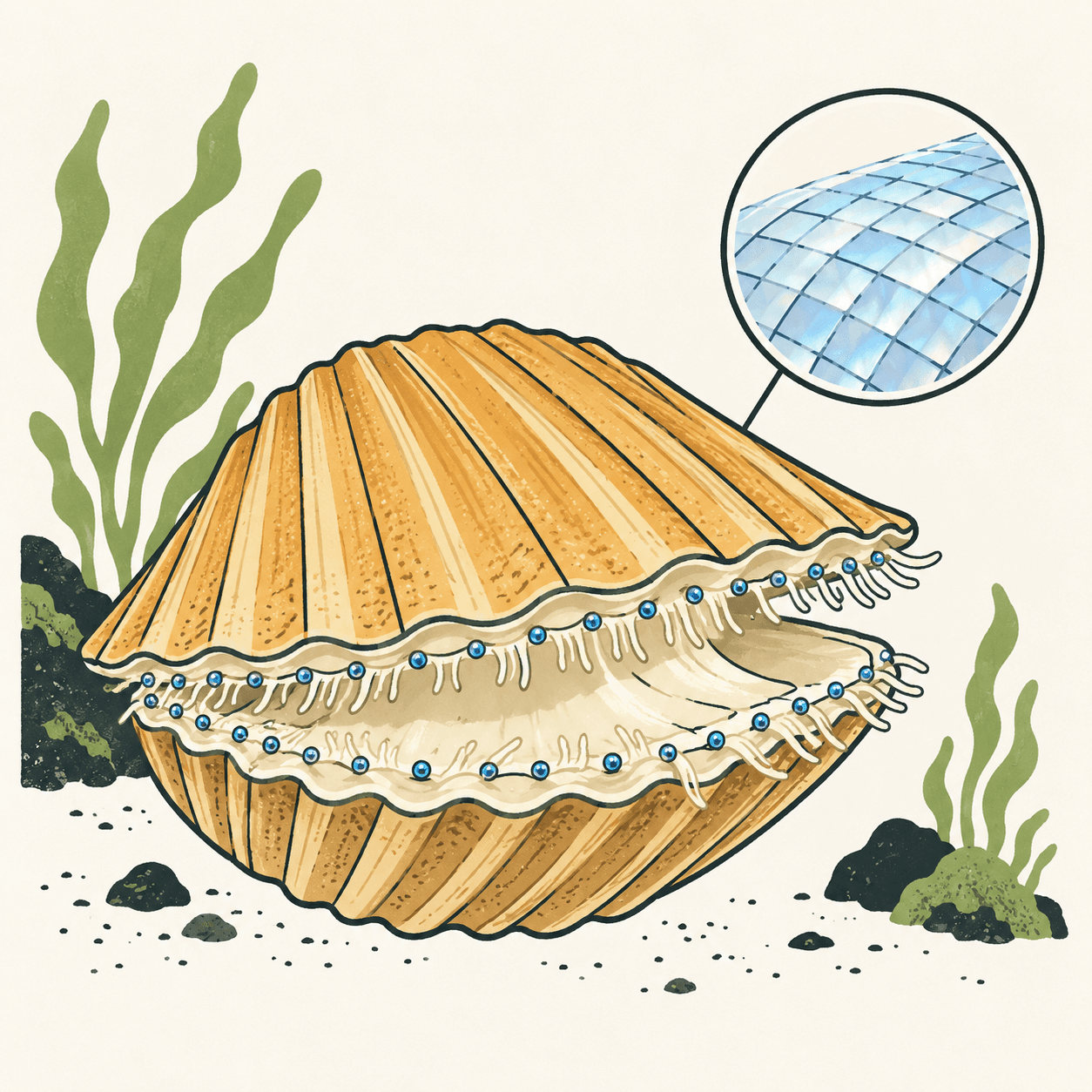
Along the edge of a living scallop, many small shining dots can be seen. They are eyes, arranged on the mantle, the tissue bordering the animal's two valves. Their presence already changes how we look at the animal: an apparently motionless shell contains complex sensory organs. In research on scallops, however, the most unusual discovery concerns the journey that light takes inside each individual eye. [1]
At the back of the eye is a concave mirror: a reflecting surface that curves inwards. A study published in Science in 2017 describes a mosaic of small guanine crystals arranged in layers. This structure reflects light and helps form images on two retinas. It is not a little mirror attached outside the animal: it belongs to the biological organisation of the eye, at very small scales. [2]
Saying that a scallop sees using a mirror does not mean its eye has no lens. The study of Argopecten irradians also describes a cornea and a lens, alongside the two retinas and reflector. The crucial question is which component provides the main mechanism for forming the image. The presence of a part and its function are different questions. Confusing them would make the curiosity more spectacular but less accurate. [1]
The Weizmann Institute team combined microscopic observations, three-dimensional reconstructions and simulations of light paths. Comparison with the segmented mirrors of telescopes helps visualise the organisation into small tiles. This is an analogy of structure, not a claim that a scallop watches the sky or performs like an astronomical instrument. The research connects the crystals' shape, the mirror's curvature and the behaviour of light. [3]
Try an editorial thought exercise. Draw a curved surface, a light-receiving area and a line arriving at the surface and changing direction. Then erase the drawing and ask which details were missing: dimensions, angles, materials and the positions of the retinas. A first sketch makes a question intuitive, but does not demonstrate that an eye works. Experiments and quantitative models therefore add something that an appealing metaphor alone cannot supply. [1]
Finally, reconstructing an optical system differs from knowing exactly how the animal integrates its information. The Weizmann account identifies that open question. We need not fill the gap with an imaginary view of the scallop's world. We can appreciate the verified result while keeping separate what still requires investigation. Wonder does not diminish when an explanation preserves a boundary between what is known and what we still want to discover. [3]
Take this with youWhen a curiosity compares an animal with a machine, ask which feature is being compared. A useful analogy illuminates a detail without making the two things equivalent.
One idea, in simple words
A living scallop has many small eyes along its mantle, the tissue near the shell's edge. Inside these eyes is a surprising structure: a concave mirror, meaning a mirror that curves inwards. Its surface contains tiny crystals arranged in layers. It reflects light towards the retinas, the parts that collect information from light. [2][1]
The eyes also contain a lens. The discovery is therefore not that a lens is missing, but that a mirror plays a key role in forming images. Researchers study these parts with instruments and models. Imagine a mirror drawn on paper: it may help you understand the idea, but cannot show every detail of a real eye. Knowing how light travels does not yet explain everything the animal sees. [1][3]
A little discovery to keep
What did you discover?
Read the sources (3)
- Examining the Effects of Chromatic Aberration, Object Distance, and Eye Shape on Image-Formation in the Mirror-Based Eyes of the Bay Scallop Argopecten irradians Integrative and Comparative Biology · PubMed Central · accessed 5 Oct 2026
- The image-forming mirror in the eye of the scallop Science · PubMed · accessed 5 Oct 2026
- Mirror Images Weizmann Institute of Science · accessed 5 Oct 2026
Original writing and illustration made with AI assistance. Our editorial method
More in Curiosities