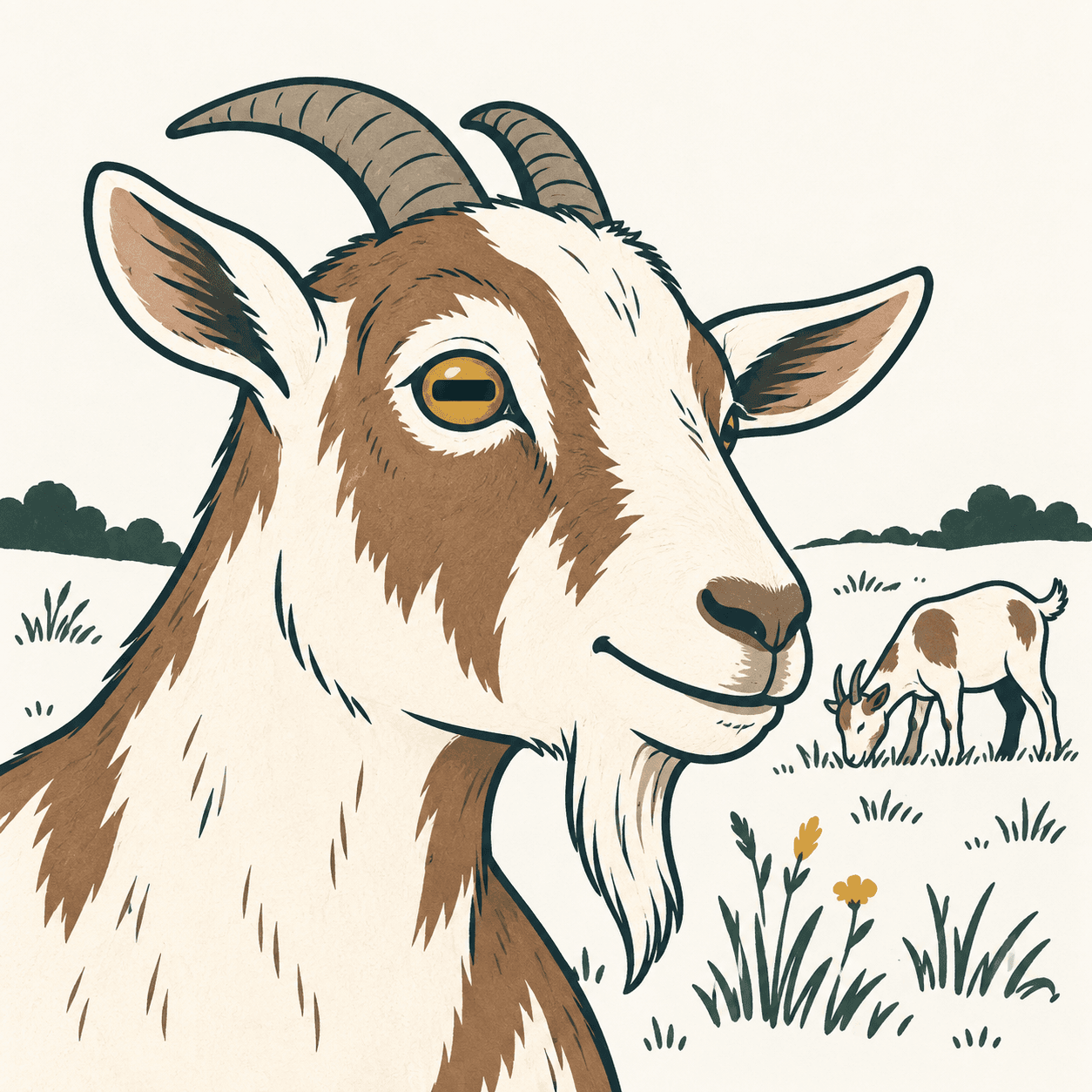
Look closely at a goat and an unusual shape appears: its pupil resembles a rectangle stretched horizontally, rather than the circle we see in our own eyes. The pupil is the opening through which light enters. Its shape is not decoration; it affects the information an eye gathers. A study published in Science Advances in 2015 examined the relationship between pupil shapes and the lives of terrestrial animals. [1]
The team, including researchers at Berkeley and Durham, compared 214 species. Horizontal pupils were strongly associated with plant-eating animals that can become prey and have eyes on the sides of their heads. This is a statistical relationship, not a password for correctly guessing every animal’s lifestyle. The study combines comparisons between species with optical models: calculations of how light passes through eyes and forms images. [2]
The optical analysis suggests that a horizontally wide pupil supports a panoramic view along the ground and useful images for detecting obstacles while moving. For an animal vulnerable to predators, monitoring approaches from several directions can matter greatly. This does not mean seeing through walls or resolving every detail everywhere. It means having a visual arrangement suited to particular demands of survival, rather than one universally superior kind of eye. [1]
One question remains. If a goat lowers its head to eat, should the rectangle not tilt with it? Observations reported by the researchers reveal compensation: the eyes rotate to keep the pupils approximately aligned with the ground. Berkeley describes observations of goats and other hoofed animals. This is not a goat consciously deciding to rotate a picture frame; it is a characteristic of the way its eyes move. [2]
Consider an example invented by our editors. Imagine filming a road while tilting your camera downwards. Now imagine part of the system maintaining the orientation of the view relative to the ground. The comparison helps us think about compensation, but it does not mean an eye works like phone software. With goats, we are discussing observed biological structures and a hypothesis about the optical advantages those structures may provide. [1]
The study’s limits belong in the explanation. Its analysis concerns terrestrial species and does not establish a universal rule for all living things. Pupil shape also changes as the opening widens or narrows. One photograph captures a moment rather than the full range of movement. To observe without disturbing an animal, compare reliable images of the same species with its head raised and lowered, avoiding human intentions as an explanation for anatomy. [1][2]
Take this with youA good curiosity does not stop at “that looks strange”. It asks what we observe, what function it might serve, and which evidence supports the explanation.
One idea, in simple words
Pupils are openings that let light enter the eyes. A goat’s pupils are stretched sideways. A study linked this shape with seeing well along the ground. For an animal that may be attacked, noticing danger approaching from the sides matters. Seeing obstacles while moving can also help. [1]
When a goat lowers its head to eat, its eyes rotate and keep the pupils roughly parallel to the ground. Here is a comparison from our editors: imagine a picture frame staying level while its support tilts. This helps explain the movement, but it is not a full description of an eye. The scientists studied land animals. Their explanation does not automatically apply to every animal on the planet. [2]
A little discovery to keep
What did you discover?
Read the sources (2)
- Why do animal eyes have pupils of different shapes? Banks et al. · Science Advances · UC eScholarship · accessed 23 Sept 2026
- Pupil shape linked to animals’ place in ecological web University of California, Berkeley · accessed 23 Sept 2026
Original writing and illustration made with AI assistance. Our editorial method
More in Curiosities