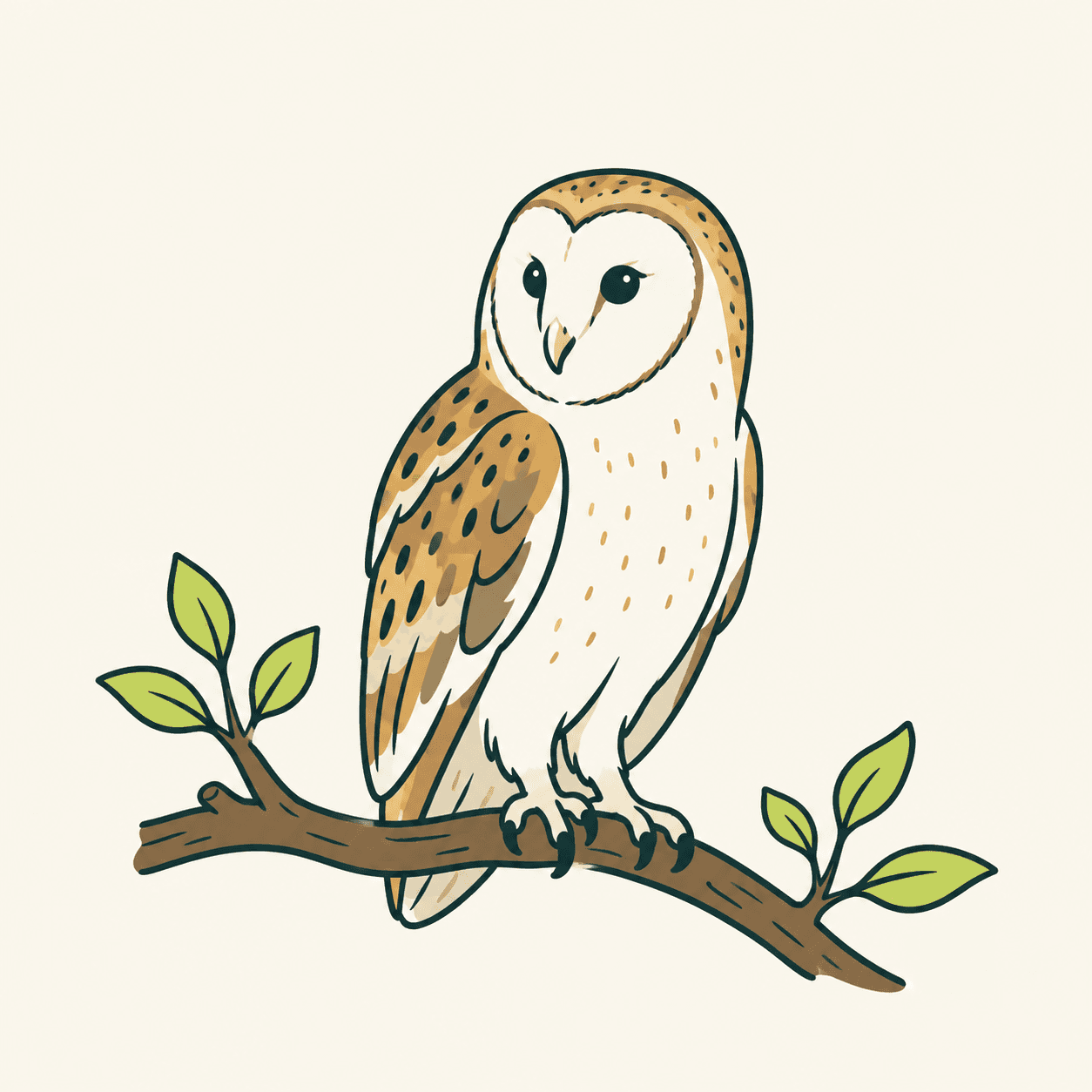
A barn owl turns its head and seems to perform an impossible trick. Cornell University’s Bird Academy explains that owls can look far beyond their shoulders, reaching close to three quarters of a turn. Their heads are not free to spin continuously. Feathers hide the neck, encouraging us to imagine one pivot where several different movements are actually taking place. [1]
A 2017 study of American barn owls investigated that combination. The researchers found neck regions with different roles: some contribute more to turning, while others contribute to sideways bending. The joints do not all do the same thing at the same time. To understand the large final change in position, imagining a single extraordinary neck bone is therefore not enough. We need to consider how several parts work together. [2]
Movement is not just a question of bones, either. In 2013, Johns Hopkins University described research into adaptations that help maintain blood flow during these wide head rotations. That is another part of the problem. For our reading, it is a reminder that a moving structure has to accommodate what passes through it. The movement we can see does not reveal every constraint that the animal’s body has to manage. [3]
Let us make an editorial model entirely on paper. Draw a head connected to a body by a chain of short sections. In the first version, change the direction of just one section. In the second, spread small changes along the chain. Compare where the head ends up. We have not reproduced an animal’s anatomy, but we have made two different visual proposals. The model helps us ask how many points might contribute to a movement. [2]
Now draw a broad outline of feathers around the sections, leaving only the head and body visible. Show the drawing to someone with the outline first, and then without it. This is an editorial exercise about what an image conceals: which parts did we imagine were still? What new questions become possible when we can see them? All this activity needs is pencil and paper. We should not try to copy the range of a barn owl’s movement with our own necks. [1]
Research has limits too. The anatomical study combined images of living birds, anatomical preparations and reconstructions, using a limited number of specimens. We should not turn its description into an identical measurement for every individual and species. The main discovery is more interesting than a record: an apparently simple movement can emerge from many coordinated parts. Our paper model remains a useful metaphor, rather than a machine that could predict every position of a real bird. [2]
Take this with youWhen an animal seems to make an impossible movement, first ask which part of its body you cannot see. Wonder can become a question.
One idea, in simple words
A barn owl can turn its head much farther than we can. Its neck does not work like one hinge. Different parts move together: some turn and others bend. A study of American barn owls examined this teamwork. Feathers hide much of the neck, making the movement look even more surprising. [2][1]
Here is a model invented by our editors. Draw a head connected to a body by a chain of short pieces. Change the direction of several pieces a little. The head can end up in quite a different position. This drawing explains an idea; it is not an exact copy of the animal. Do not try turning your own neck like an owl’s. Paper is enough for this experiment. [2]
A little discovery to keep
What did you discover?
Read the sources (3)
- Free Preview: The Wonderful World of Owls — How Owls Rule the Night Cornell Lab of Ornithology · Bird Academy · accessed 29 Sept 2026
- Barn owls maximize head rotations by a combination of yawing and rolling in functionally diverse regions of the neck Journal of Anatomy · PubMed Central · accessed 29 Sept 2026
- How owls rotate their heads without injury Johns Hopkins University · accessed 29 Sept 2026
Original writing and illustration made with AI assistance. Our editorial method
More in Curiosities