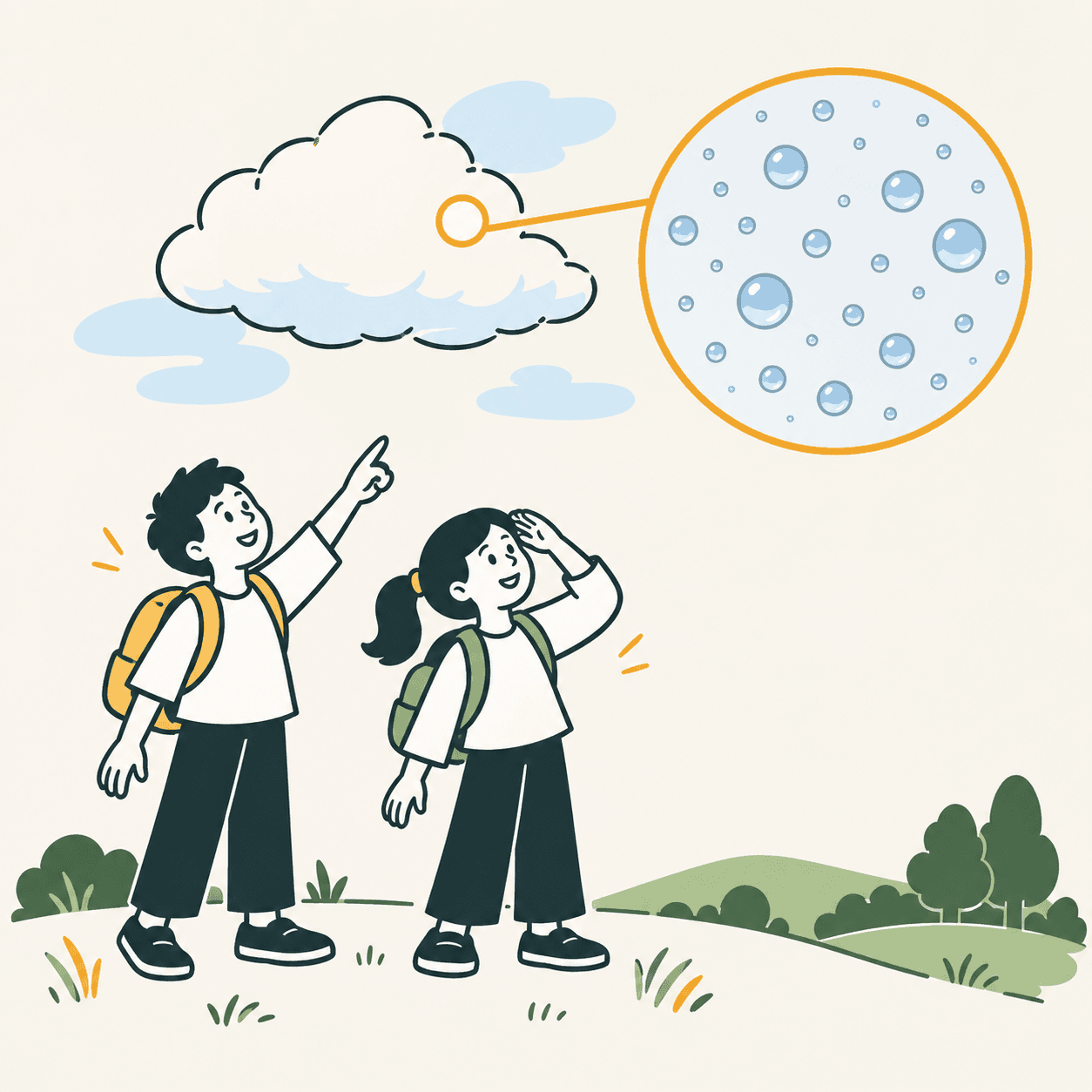
A cloud is not a solid bundle. Its visible part consists of tiny water droplets, ice crystals or both. Water vapour, by contrast, is water in its gaseous state and cannot be seen: that is the central distinction in NASA’s explanation. [1]
The Met Office describes condensation: the change from gas to liquid. When moist air cools sufficiently, some of its water vapour can become droplets. These form around very small particles already present in the air. [2]
NASA’s GPM explanation also reminds us that a cloud contains mostly air. Clouds can contain different proportions of liquid water and ice. An enlarged drawing of droplets is therefore a diagram, not a photograph of a compact object. [3]
Try an exercise invented by our editors. Write two sentences on a sheet: I see a white shape in the sky; I know what it contains thanks to a scientific explanation. Those sentences describe different kinds of work. The first records an observation from far away. The second uses knowledge that cannot come from the outline alone. Now draw the cloud’s edge without calling it a sheep or a castle. You can invent a story later; for now, make a description another person can compare with their own. [1]
To continue our editorial workshop, imagine three labels: liquid water, ice and vapour. Make a drawn scene in which the first two have different symbols. Do not use a little white cloud as the symbol for vapour: choose a written label instead. This is a convention invented for our activity, not a way of making the gas visible. Add a small key and ask a classmate to explain your drawing. If they mistake a symbol for a photograph, make the key clearer before asking again. [3]
Our final suggestion is to compare two descriptions: what seemed right before this reading and what you would write now. You do not have to erase the first one. Put them side by side and circle the word you changed. Your notebook then preserves the learning process as well as a tidy answer. We are not making a weather forecast here: one drawing of a cloud cannot tell us what tomorrow will bring. We are practising how to revise a mental picture using a precise distinction and a source we can check. [2]
Take this with youTry explaining the difference between seeing a cloud and seeing water vapour. If you use an enlarged drawing, label it as a diagram: images help when we understand their limits.
One idea, in simple words
Water vapour is water in the form of a gas: it is invisible. The visible part of a cloud contains tiny water droplets or ice crystals, or a mixture of both. [3]
Condensation means changing from gas to liquid. It can happen when moist air cools enough. A cloud also contains lots of air. Here is a game invented by our editors: draw a cloud and a circle beside it showing enlarged details. Use dots for droplets and another symbol for ice. Write that this is a diagram, not a photograph. Ask a friend to read it. Can they explain what your symbols mean? If necessary, improve the key: the short explanation that helps someone understand the drawing. [2][3]
A little discovery to keep
What did you discover?
Read the sources (3)
- What Are Clouds? (Grades 5–8) NASA · accessed 26 Sept 2026
- Clouds Met Office · accessed 26 Sept 2026
- What are clouds made of? NASA Global Precipitation Measurement · accessed 26 Sept 2026
Original writing and illustration made with AI assistance. Our editorial method
More in Curiosities