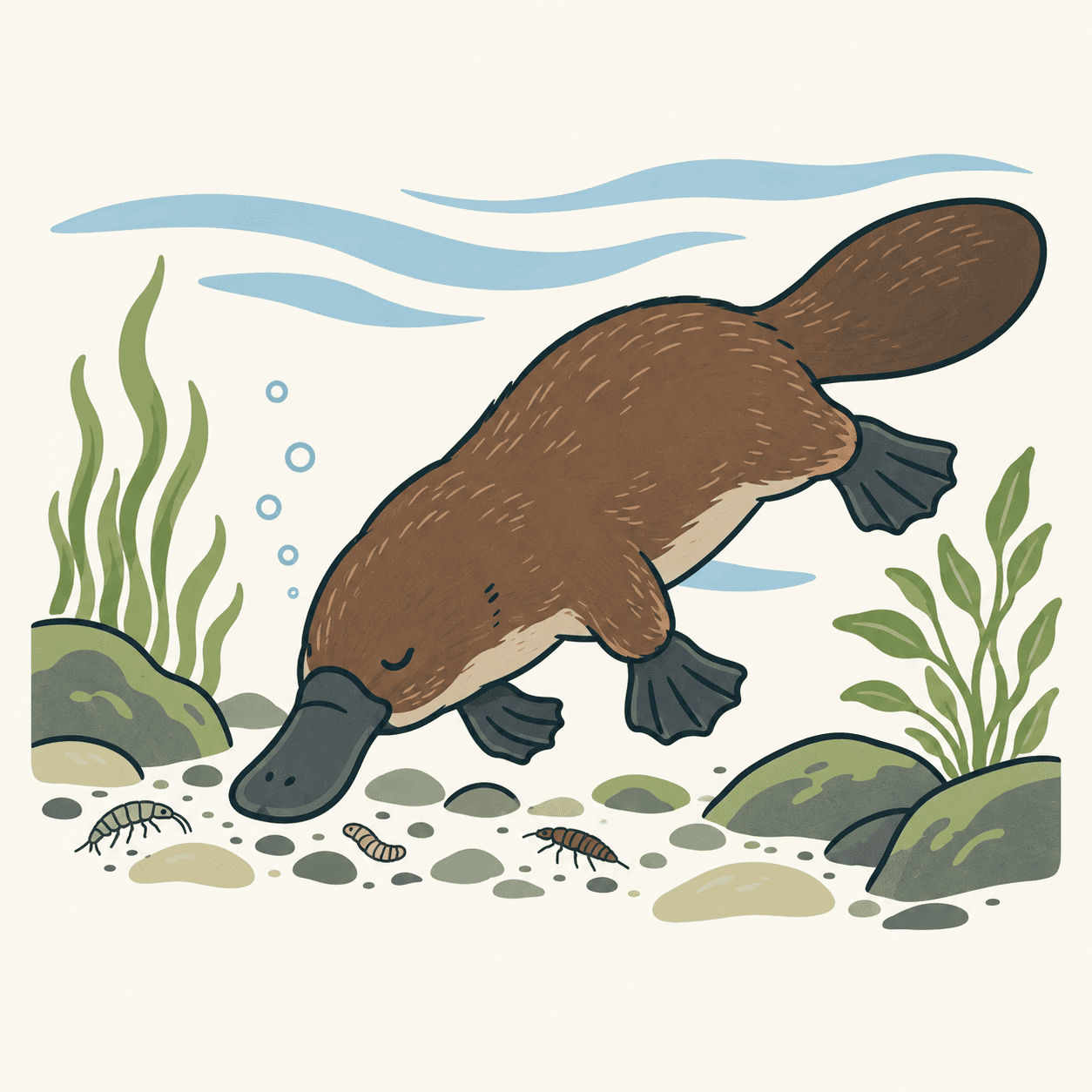
It looks like a bill mainly designed to pick things up, but it is also a sensory organ. A platypus searches for food underwater with its eyes, ears and nostrils closed. The Australian Museum describes pressure-sensitive receptors and electrical receptors in the bill. Rather than simply trying to see better through mud, the animal has access to information different from our visual pictures. [1]
The bill has soft skin and flexible edges. According to the Australian Platypus Conservancy, some receptors register water movement, while others detect the tiny electrical signals associated with activity in prey muscles. Electroreception means receiving those signals. It does not mean lighting up the riverbed, firing electric shocks or carrying a hidden battery inside the head. [2]
Healesville Sanctuary’s account explains that gathered food can be stored in cheek pouches and processed after the animal returns to the surface. Adults have no teeth. Detecting prey, collecting it and eating it are therefore different stages: looking only at the shape of the bill cannot tell us the whole sequence of events. [3]
An example imagined by our editors: make two cards, one showing an eye and the other a small wave. Looking at an illustrated animal diving, choose which information you are describing. You can cover the first card without removing the second. This changes the question from what the animal sees to which clues it can gather. The game does not reproduce an electrical sensation. [1][2]
A second editorial activity: draw three empty boxes for searching, collecting and eating. Put the bill in the first, the cheeks in the second and the water surface in the third. Then try explaining the sequence to someone without using the word magic. Return to the source if necessary: a metaphor can help us remember, but should not replace a description of the animal. [3]
An important limit remains: the museum’s account says that the precise way the bill is used to detect prey is not fully understood. Coloured lines in an explanatory drawing would be illustrative marks, not beams visible in the river. We can represent a function without pretending to photograph a signal or assigning the animal thoughts that we have not observed. [1][2]
Take this with youRemember: an animal can gather information without looking. Different senses work in the platypus bill; there is no secret eye inside.
One idea, in simple words
The platypus spends time in water. When searching for food underwater, it closes its eyes, ears and nostrils. How does it find small prey? Its bill has receptors: sensitive parts that gather information. Some detect water pressure. Others pick up very weak electrical signals. [1]
These signals can come from the muscles of small animals moving around. This ability is called electroreception. It does not mean making lightning. Here is an example invented by our editors: cover the eye of a drawn platypus with a card, then point to its bill. You have shown that seeing is not the only way to gather clues. The drawing does not reproduce what the animal actually senses, and some details of its search remain unclear. [2][1]
A little discovery to keep
What did you discover?
Read the sources (3)
- Platypus Australian Museum · accessed 2 Oct 2026
- The platypus bill, push rods and electroreception Australian Platypus Conservancy · accessed 2 Oct 2026
- Platypus Zoos Victoria — Healesville Sanctuary · accessed 2 Oct 2026
Original writing and illustration made with AI assistance. Our editorial method
More in Curiosities