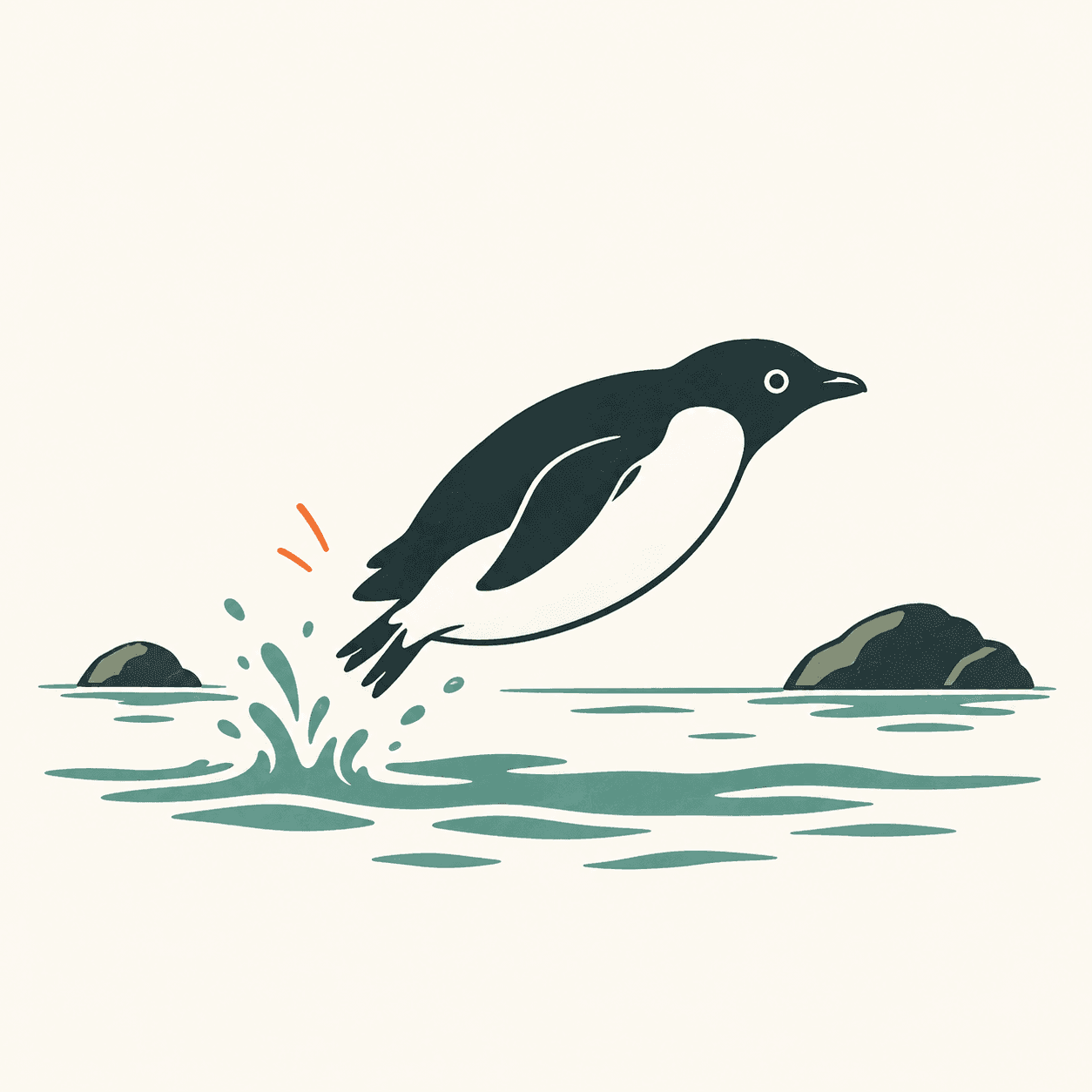
A penguin breaks the surface, follows a low arc and re-enters the water; soon it appears again. This series of leaps is called porpoising because it resembles the movement of porpoises. The Smithsonian describes it as a way to travel quickly while reaching air to breathe without interrupting progress. The short stretch above water therefore belongs to a swimming sequence: it is not a return to flight. [1]
SeaWorld’s zoological account adds two qualifications. Many species make these leaps, but the behaviour is not universal: emperor penguins are not known to porpoise, and king penguins do so infrequently. It also presents confusing predators as a possible function. That degree of caution matters: a visible leap does not automatically reveal what caused it in one particular individual. [2]
The submerged part matters at least as much as the spectacular one. The Australian Antarctic Program explains that flippers provide propulsion, while feet and tail help with steering. A covering of short, overlapping feathers keeps water out; fat contributes to insulation. Body shape and these adaptations belong to the animal’s marine life. Understanding its movement means considering what the surface hides, without reducing a penguin to its walk on land. [3]
Even its two-tone outline takes on a different meaning when the viewpoint shifts above or below the water. San Diego Zoo describes the dark back and pale belly as aids to camouflage: from above, the former blends with deeper water; from below, the latter with the bright surface. This is no invisibility cloak; it is another reason to observe the animal in its setting, instead of only as a figure against white. [4]
Here is a small exercise devised by our editorial team using a video, not a scientific experiment. Watch the whole sequence, then pause at three moments: emergence, movement through air, and re-entry. Mark the body’s position relative to the surface. One still image might appear to show a leap towards shore; the sequence lets you follow the route. If the video supplies too little context, leave the interpretation open. Do not add an unseen predator or infer an energy saving simply because the movement looks smooth. [1][2]
Take this with youNext time you watch wildlife, look for what comes before and after the most surprising frame. Describe the visible behaviour first, then distinguish possible explanations from what you actually observed.
Read the sources (4)
- Penguins Smithsonian Ocean · accessed 17 Sept 2026
- All About Penguins: Adaptations United Parks & Resorts · SeaWorld · accessed 17 Sept 2026
- Penguins Australian Antarctic Program · accessed 17 Sept 2026
- Penguin San Diego Zoo Wildlife Alliance · accessed 17 Sept 2026
Original writing and illustration made with AI assistance. Our editorial method
More in Curiosities