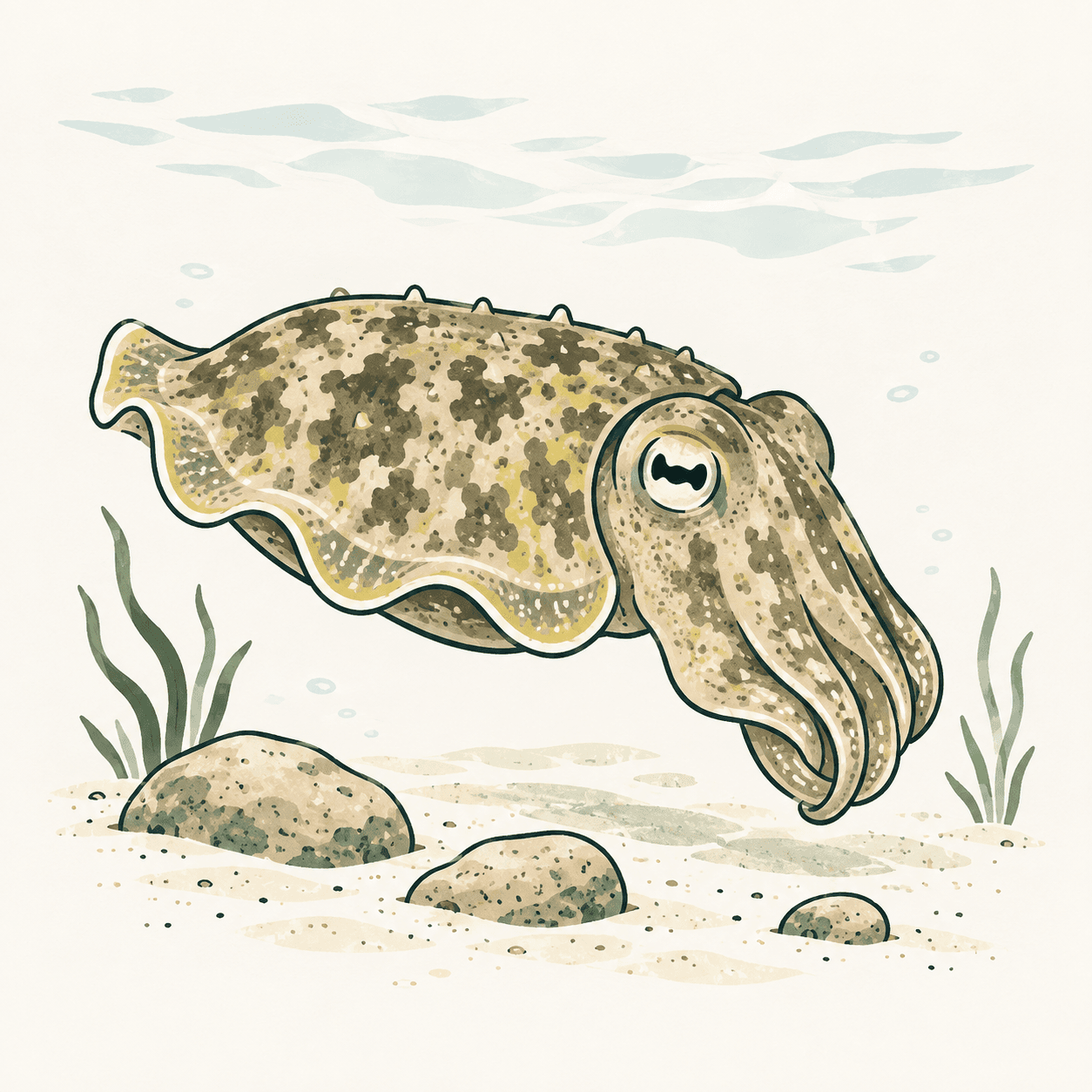
The common cuttlefish, Sepia officinalis, can rapidly change the colour and pattern of its skin. But describing it as an animated screen leaves out part of the story. Alongside its pigmented areas, it has muscular structures called papillae that can rise, turning a smoother surface into a textured one. Camouflage here has a third dimension too. [1]
Chromatophores are pigment-containing organs: muscles arranged around an elastic sac control its expansion. Papillae, by contrast, physically alter the skin’s outline. Gonzalez-Bellido and colleagues show that the two systems can be activated independently. Colour and texture contribute to the animal’s appearance, but they are not the same biological control. [1]
Research presented by Harvard and the Marine Biological Laboratory in 2014 also revealed how complex the work of chromatophores can be. Their granules interact with light through absorption, reflection and fluorescence. Rather than imagining a tin of paint changing shade, we should picture living tissues whose structures and optical properties are studied at very small scales. [2]
In the papillae study published in 2018, researchers traced nerve signals and examined skin muscles. Control passes through the stellate ganglion, a peripheral nerve centre. They observed both rapid movements and the ability to keep some papillae raised without continuous descending neural input. This is therefore more than a simple matter of switching a feature on and off. [1]
The authors propose a tension-maintaining mechanism resembling, in its behaviour, one studied in certain bivalve muscles. They call it catch-like and discuss the further tests needed to identify it precisely. The distinction matters: observing a sustained posture and knowing every molecular step responsible for it are different achievements. An explanation should not be inflated beyond the evidence. [1]
The eye also changes appearance with the light. Mäthger and colleagues’ 2013 study describes a characteristically W-shaped pupil in bright conditions that becomes circular in darkness. The authors relate this shape to the distribution of light across the visual field. We mention it chiefly to read images correctly: one photograph does not represent every condition the animal experiences. [3]
Here is an editorial exercise: examine our illustration and look separately for markings and raised areas. These are two different questions about the same surface. The drawing simplifies rather than demonstrating behaviour in the wild; the paper also notes that each species has a particular repertoire of papilla shapes. A cuttlefish cannot choose any disguise simply because that would make our story convenient. [1]
Take this with youLook beyond colour to texture: sometimes the surprise lies in the surface. A cuttlefish changes its outfit without opening a wardrobe, although its costume department still follows biological rules.
Read the sources (3)
- Neural Control of Dynamic 3-Dimensional Skin Papillae for Cuttlefish Camouflage Gonzalez-Bellido et al. · iScience / University of Cambridge · accessed 15 Sept 2026
- Harvard-MBL Bioengineering Collaboration Uncovers New Reflective Mechanism in Cuttlefish Skin Marine Biological Laboratory · accessed 15 Sept 2026
- The W-shaped pupil in cuttlefish (Sepia officinalis): functions for improving horizontal vision — abstract Mäthger et al. · Vision Research / PubMed · accessed 15 Sept 2026
Original writing and illustration made with AI assistance. Our editorial method
More in Curiosities