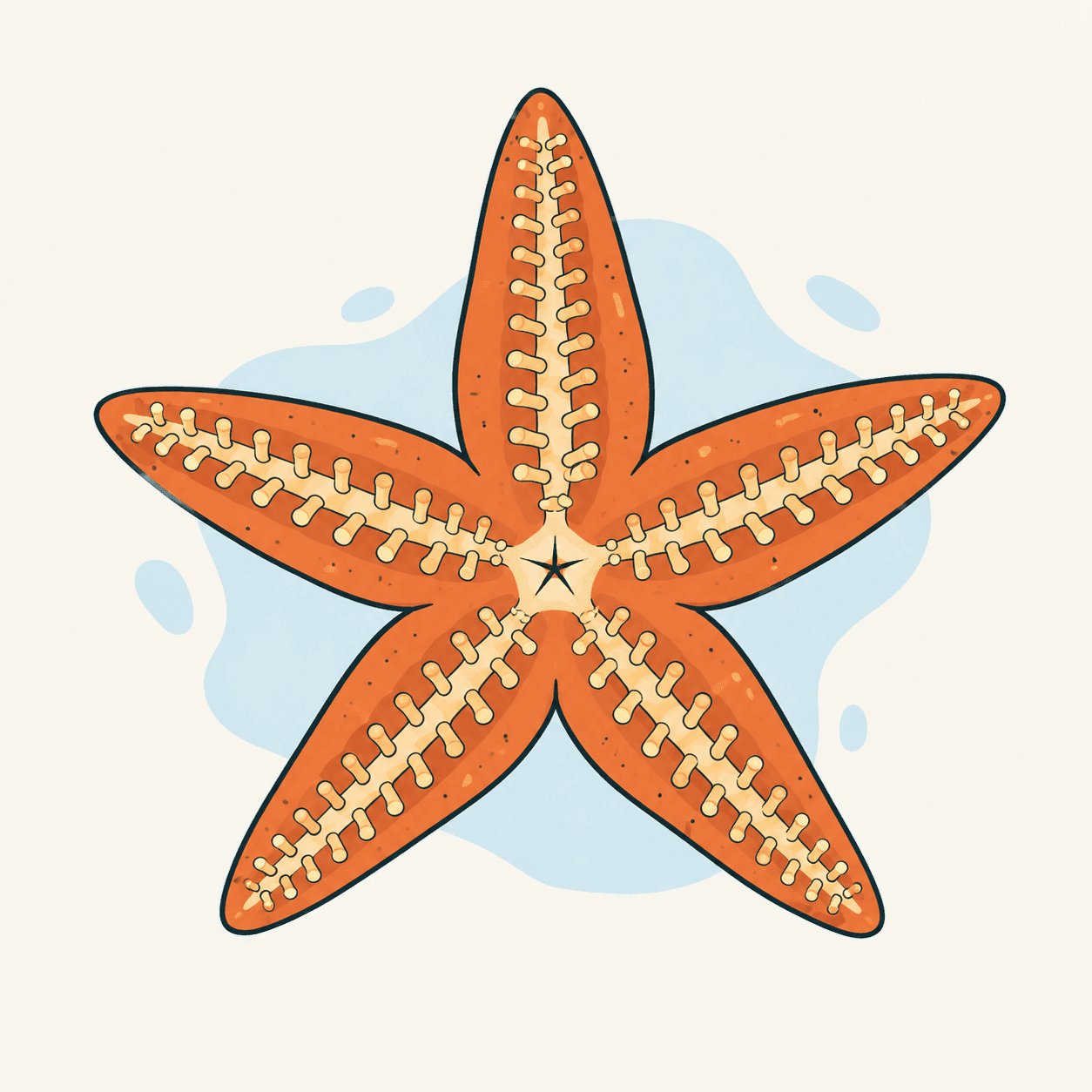
A sea star may look like a drawing resting on the seabed, but it is a moving animal. It is not a fish: it belongs to the echinoderms, a group that also includes sea urchins and sea cucumbers. To move, it uses tube feet, small tube-like extensions on the underside of its body. Looking from above, it is easy to miss them completely. [1]
Movement involves muscles and fluid. The Woods Hole Science Aquarium explains how small feet extend through water pressure in the internal system. They are not legs with bones and knees like ours. Many small actions distributed along the body contribute to the animal’s movement, while the important work stays almost hidden beneath the arms. What looks still from one angle may be busy from another. [2]
There is also the question of grip. A 2008 study of Asterias rubens examined adhesive material produced by its tube feet. Tiny footprints remained on surfaces after the feet detached, and the researchers examined them using different microscopes. For this species, describing the feet only as suction cups would therefore miss the adhesive secretions. The study concerns a particular animal, not every detail of every sea star. [3]
Tube feet vary in both shape and use. A comparative study of fourteen species described several kinds of tips, associated with functions including movement, attachment and burrowing. A small foot in one photograph is therefore not an identical model for them all. This variety is why a general explanation needs to leave room for differences between species and the places where they live. [4]
NOAA Ocean Exploration provides a concrete observation: during a 2018 expedition in the Gulf of Mexico, Dytaster insignis was filmed moving over the seabed using its tube feet. The film records that observation rather than a speed contest. Watching carefully helps distinguish the outline of the arms from the smaller movements that carry the body across the bottom. [5]
Our editors suggest an imaginary comparison: draw a large paper star and put many small arrows beneath each arm. We have not built an animal or explained all its coordination. We have made a question visible: which part touches the ground, and which part is being carried? We can use the same approach while watching the film, without picking up or turning over a living animal to investigate. Curiosity can remain careful at a distance. [1][5]
Take this with youFirst observe the outline, then the points touching the bottom. Describe what changes: searching for a small detail can transform your understanding of a familiar shape.
One idea, in simple words
A sea star is an animal, but it is not a fish. Under its body are many small tubes called tube feet. They help it move. From above, we may barely notice them. [1]
Muscles and water pressure help these little feet extend. In a species called Asterias rubens, researchers have also studied sticky material that helps the feet grip a surface. Different sea stars can have differently shaped feet. [2][3][4]
Imagine a paper star with little arrows drawn under its arms. This example from our editors shows where to look; it is not a real animal model. In NOAA’s film, you can watch a sea star crossing the seabed. Try looking below its outline for the small moving parts. We can learn by observing without turning a living animal over. [1][5]
A little discovery to keep
What did you discover?
Read the sources (5)
- Are starfish really fish? NOAA Ocean Service · accessed 21 Sept 2026
- Woods Hole Science Aquarium FAQs: How do sea stars move? NOAA Fisheries · accessed 21 Sept 2026
- Micro- and nanostructure of the adhesive material secreted by the tube feet of the sea star Asterias rubens Journal of Structural Biology; Université de Mons repository · accessed 21 Sept 2026
- Comparative histological and immunohistochemical study of sea star tube feet Journal of Morphology; Université de Mons repository · accessed 21 Sept 2026
- Speed Star — Gulf of Mexico 2018 NOAA Ocean Exploration · accessed 21 Sept 2026
Original writing and illustration made with AI assistance. Our editorial method
More in Curiosities