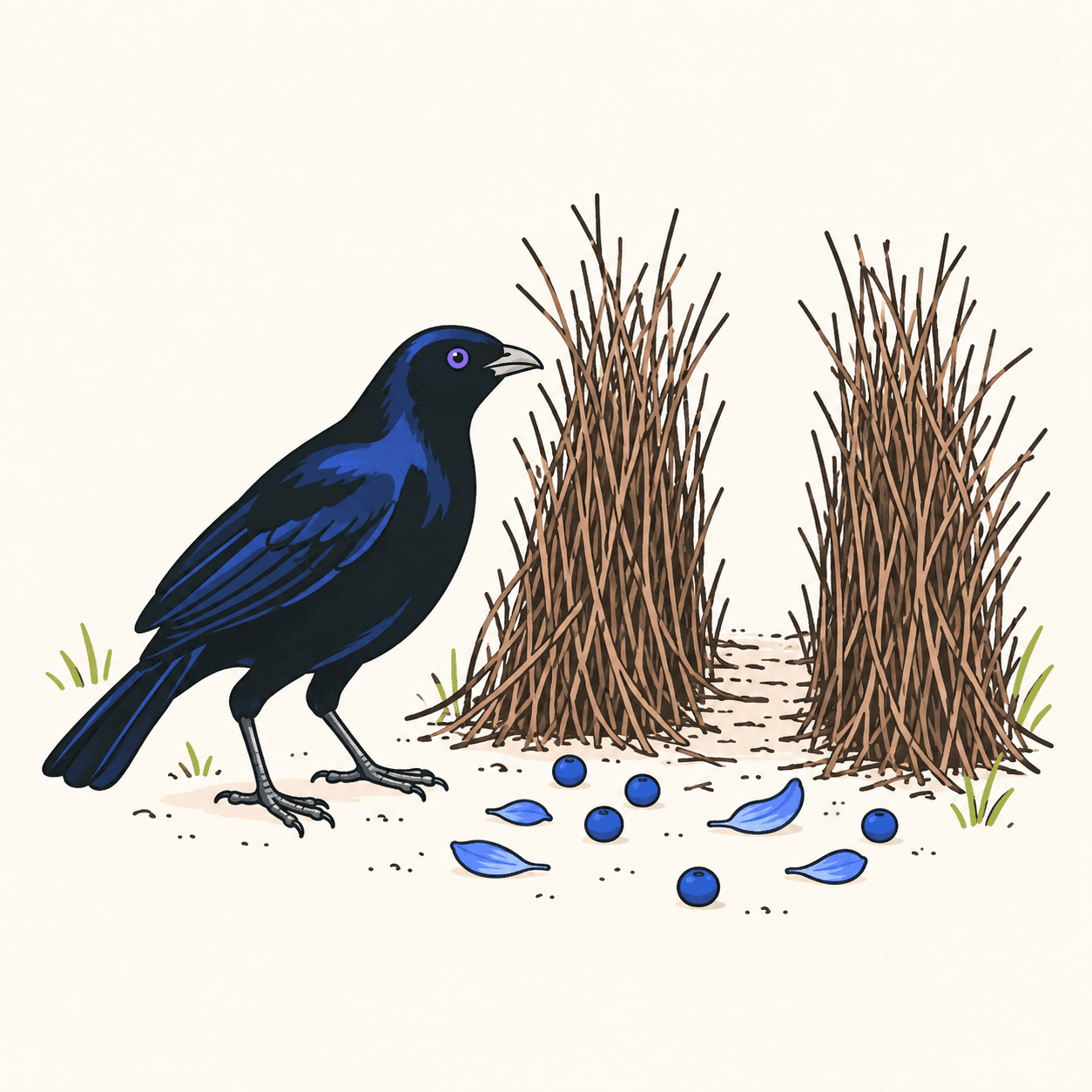
The male Ptilonorhynchus violaceus, Australia’s satin bowerbird, builds two parallel walls of sticks on the ground. According to the Australian Museum, this structure is a courtship arena. The adult male has glossy blue-black plumage, a pale bill and a violet-blue iris; females and young birds have different colouring. The first correction to our intuition is therefore straightforward: the bower should not be interpreted as a little bedroom prepared for eggs. [1]
The American Museum of Natural History describes collections selective in their effect but varied in their materials: feathers and flowers can appear alongside bottle caps and other objects, with males of this species favouring blue. Competition can include stealing decorations from other bowers. The presentation continues with a dance in which the male may hold an object in his bill. The setting is therefore only one part of the encounter. [2]
The New South Wales parks service places the species in eastern Australia, in forests and woodlands. It also explains the distinction between the two places: after mating, the female builds a nest, incubates and raises the chicks alone. The male’s bower and the female’s nest have different functions. Observing where behaviour takes place matters as much as recognising the materials: similar-looking twigs do not necessarily serve the same purpose. [3]
Consider a comparison devised by our editorial team: picture a room prepared for a party, with a small stage and decorations, then a room used for sleeping. If a photograph shows only walls and chairs, we might confuse their purposes; seeing what happens there changes our interpretation. This comparison helps us remember the distinction between arena and nest without assigning human social arrangements to birds. Likewise, calling the male an interior decorator is an editorial joke, not a scientific explanation of his intentions. The collection of artificial objects is not an invitation to leave plastic behind to make the scene more interesting. Museum photographs are enough for our exercise: mark the structure, objects and bird’s position, separating observation from imagination. No interior-design quotation is required. [1][3]
Take this with youTry this: when an animal structure reminds you of a human object, first ask what it is used for. Resemblance can start a question; observed function should guide the answer.
Read the sources (3)
- Satin Bowerbird Australian Museum · accessed 18 Sept 2026
- Fast Facts: Bowerbirds American Museum of Natural History · accessed 18 Sept 2026
- Satin bowerbird NSW National Parks and Wildlife Service · accessed 18 Sept 2026
Original writing and illustration made with AI assistance. Our editorial method
More in Curiosities