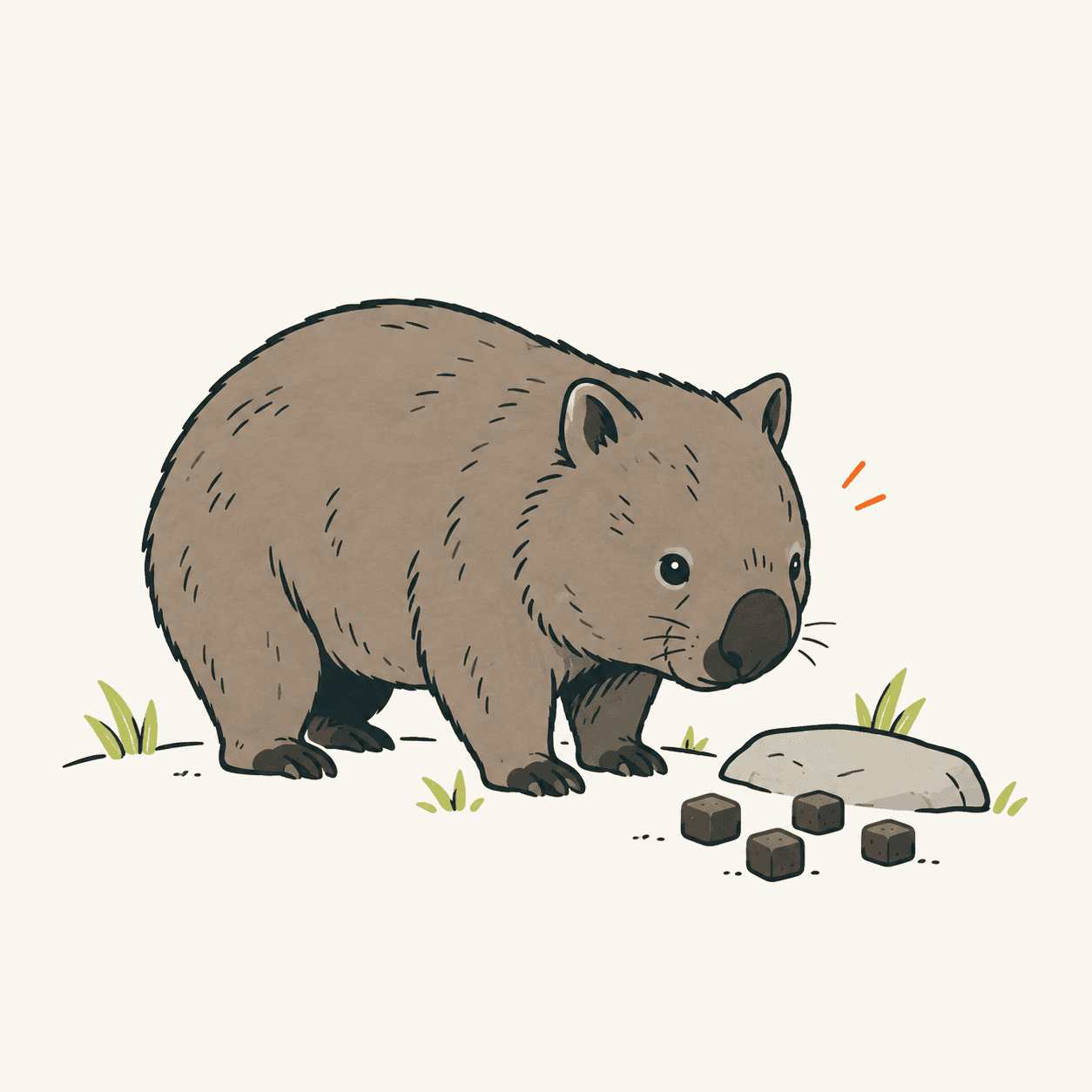
The bare-nosed wombat produces cube-shaped droppings. The corners form inside its intestine: a study linked contractions to regions of tissue with different stiffness. Measurements and a mathematical model explain how a soft tube can produce a squared cross-section. [1]
A later study investigated whether drying creates regularly spaced cracks along the material. Experiments with starch and mathematical models offer clues, but the authors acknowledge that further checks are needed: a complete explanation remains unfinished. [2]
Take this with youSerious curiosity can begin with questions that rarely make polite conversation. Here, the geometry department is working very much behind the scenes.
Read the sources (2)
- Intestines of non-uniform stiffness mold the corners of wombat feces Soft Matter · Royal Society of Chemistry · accessed 9 Sept 2026
- Drying dynamics of pellet feces Soft Matter · Royal Society of Chemistry · accessed 9 Sept 2026
Original writing and illustration made with AI assistance. Our editorial method
More in Curiosities